Best Seed Funds and Seed Investors in India (2026 List)
By Rohini Rajpoot · 29 July 2026
Turn your startup idea into reality with a smarter execution strategy. Learn how validation, MVPs, and mentorship help founders build successful startups.
Raising your first round of outside capital can feel confusing, mostly because "seed funding" gets used as a catch-all term for very different kinds of money. An angel writing a personal check behaves nothing like a government scheme, and a seed-stage VC fund operates on a completely different timeline than an accelerator. This guide breaks down who the real players are in India's seed ecosystem right now, what each one actually offers, and how to figure out which one fits where your startup stands today.
A quick note before we go further: this is not a ranked "Top 10" list. There is no single, verifiable methodology that could honestly rank seed investors against each other, since they operate in different sectors, stages, and check sizes. Instead, this is a curated overview of active, well-known funds and networks, based on their current investment activity and reputation in the ecosystem.
What Is seed funding?
Seed funding is the first meaningful round of outside capital a startup raises, usually coming in after founders have exhausted their own savings and maybe a bit of money from friends and family. It typically funds:
Building or refining an MVP
Product validation with real users
Early hiring for core roles
Market testing in a limited geography or segment
Getting the first paying or non-paying customers on board
The amount and structure of seed funding vary a lot depending on the source. A grant from a government scheme works completely differently from equity funding through a VC fund, and founders often end up combining a few of these sources rather than relying on just one.
Who are seed investors?
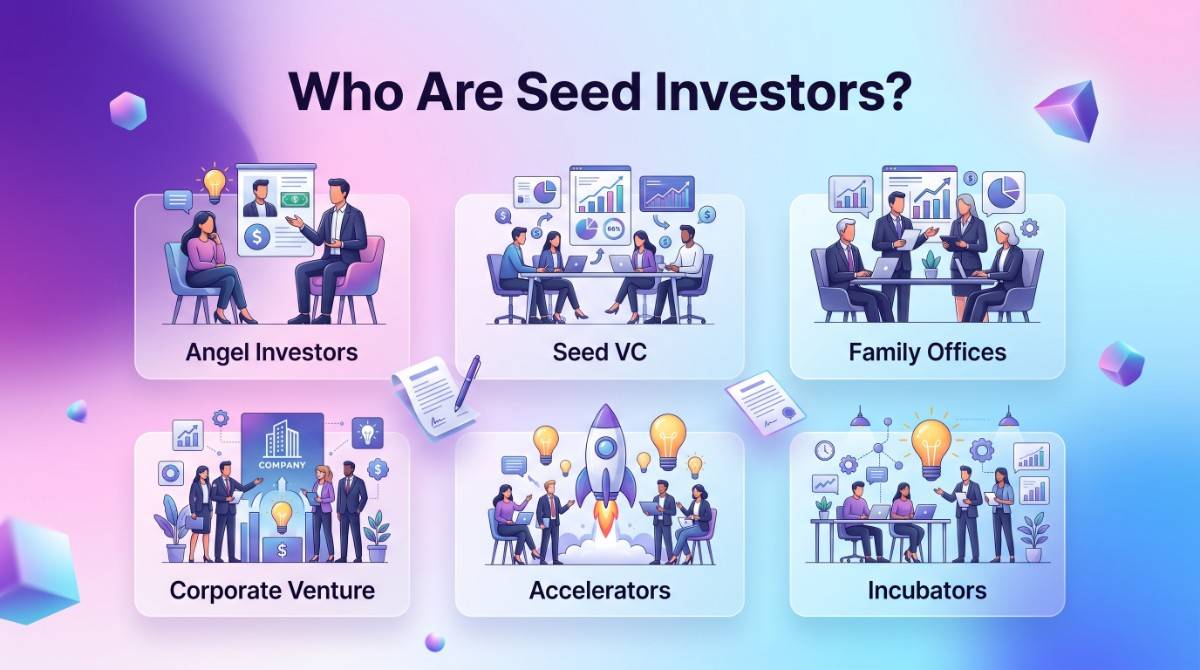 The term "seed investor" covers several distinct categories, and knowing which one you're talking to changes how you should approach them.
Angel investors are individuals investing their own money, often former founders or operators who bring both capital and personal experience. They tend to move faster than institutional funds and are usually the right first stop when you have little more than an idea and an early prototype.
Seed VC funds are institutional funds that raise money from limited partners and deploy it specifically into early-stage startups. They bring a more structured process, follow-on capital in future rounds, and a formal investment thesis. Approach these once you have at least early signs of product-market fit.
Family offices manage wealth for high-net-worth individuals or families and have increasingly started allocating a portion of their capital to startups, often alongside VC funds rather than leading rounds independently.
Corporate venture capital arms belong to larger companies looking for strategic bets in areas adjacent to their core business. These can be valuable if your startup has an obvious synergy with the parent company's business.
Accelerators combine a fixed amount of capital with a structured, time-bound program, usually ending in a demo day. They're best suited to founders who want intensive mentorship alongside their first check.
Incubators tend to work earlier in the journey, supporting founders through the prototype stage, often with lab access, workspace, or technical resources rather than large checks.
Types of seed investors in India: Quick comparison
Investor Type | Typical Focus | Best Suited For |
Angel Investors | Early MVP, first outside check | Idea to early prototype stage |
Seed VC Funds | Post product-market fit signals | Startups ready to scale |
Accelerators | Mentorship bundled with capital | Structured validation |
Incubators | Innovation and prototype support | Very early, pre-product stage |
Government Schemes | Grants and low-cost seed support | Early-stage, DPIIT-recognized startups |
Active seed funds in India (2026)
The funds below are included because they are currently active, have a visible track record in the Indian seed ecosystem, and are commonly approached by early-stage founders. This is a factual overview, not an endorsement or a claim that any one of these is objectively "better" than another; fit depends entirely on your sector and stage.
Peak XV's Surge program Surge, run by Peak XV Partners (the firm formerly known as Sequoia Capital India and Southeast Asia before its 2023 split), remains one of the most recognized seed-stage programs in the region. It's built as a fast-track cohort for seed-stage founders across India and Southeast Asia, pairing capital with a structured multi-month program covering everything from hiring to go-to-market support. Check sizes have grown over time, with more recent rounds reportedly landing anywhere between half a million and several million dollars depending on the startup and co-investors involved. Best fit: founders with a working product and early traction who want intensive, high-visibility backing.
Blume Ventures One of India's longest-running early-stage VC firms, remains among the most active seed-stage investors in the country, with a consistent focus on technology-driven startups across sectors. Best fit: technology-first founders at seed to pre-Series A stage.
India Quotient An early-stage fund with a long history of backing consumer and internet-first startups in India, typically investing at the seed and early Series A stage. Best fit: consumer, D2C, and internet-first founders.
Prime Venture Partners A Bengaluru-based seed fund known for backing SaaS, fintech, and product-driven startups, with a hands-on approach to working closely with founding teams post-investment. Best fit: product and technology-led B2B startups.
Kalaari Capital An established early-stage VC firm with a long track record in the Indian startup ecosystem, investing across consumer tech, SaaS, and deep tech. Best fit: startups looking for a fund with strong follow-on capacity into later rounds.
Elevation Capital Formerly SAIF Partners, Elevation invests across seed to growth stages and has one of the more sector-agnostic mandates among Indian VC firms. Best fit: founders open to a fund that can support them across multiple funding stages.
Accel India Accel's India arm invests across seed and early growth stages and is one of the larger, more established venture platforms operating in the country, with a broad sector mandate spanning SaaS, fintech, and consumer.
Titan Capital Founded by the co-founders of Snapdeal, Titan Capital operates as an active seed-stage investor known for writing early checks across a wide range of sectors and being founder-accessible relative to larger institutional funds.
Venture Catalysts One of India's larger integrated investment platforms, combining an accelerator-style program with an angel network, aimed at startups looking for both capital and mentorship at the seed stage.
Leading Angel Investor Networks in India
If you're earlier in your journey than most of the funds above are looking for, angel networks are usually a more realistic starting point.
Indian Angel Network (IAN) Established in 2006 and based in Delhi, IAN is one of India's older and larger angel investment groups, with a portfolio spanning enterprise and consumer sectors. It works through a due diligence committee and syndicated member investments rather than a single large check.
Mumbai Angels Mumbai Angels is a long-running angel network focused on early-stage venture investing, and has built a strong reputation in financial services and consumer categories, alongside broader sector coverage.
LetsVenture LetsVenture operates as an online fundraising platform connecting startups with angels, syndicates, family offices, and early-stage funds. Founders build a profile and upload their fundraising materials, which investors on the platform can then review and respond to directly. It has become one of the more widely used ways for Indian founders to get in front of a broad set of individual and syndicate investors in one place.
AngelList India AngelList India remains, alongside LetsVenture, one of the two largest angel investing platforms operating in the country, and continues to be a major channel for syndicate-based angel investing, particularly for startups with a technology or global-facing angle.
Chandigarh Angels Network A regional angel network with a growing presence, useful for founders based outside the traditional Bengaluru, Mumbai, and Delhi hubs who want access to investors with a stronger regional footprint.
Startup Accelerators and Incubators That Offer Seed Funding
These institutions tend to work earlier in the journey than most VC funds and often combine capital with structured mentorship or academic resources.
T-Hub, based in Hyderabad, runs cohort-based programs connecting startups with mentors, corporates, and investors
CIIE.CO, the incubation arm of IIM Ahmedabad, supports early-stage startups with funding, mentorship, and access to its alumni and investor network
NSRCEL, run by IIM Bangalore, offers structured incubation programs along with seed support for early founders
Atal Incubation Centres, set up under the Atal Innovation Mission, provide infrastructure and seed support across a network of centers nationwide
IIT Madras Incubation Cell supports deep-tech and technology-driven startups with funding and lab access
SINE, the incubation cell at IIT Bombay, provides similar support with a focus on technology commercialization
The common thread across all of these is that you get more than capital. Demo days, mentor access, and warm introductions to investor networks are often just as valuable as the check itself at this stage.
How to Choose the Right Seed Investor
Money is money, but not all seed money comes with the same value attached. Before you say yes to a term sheet, weigh:
Industry expertise: does this investor actually understand your sector, or are you going to spend the next two years explaining your business to them
Investment thesis fit: does your startup genuinely match what they say they invest in, or are you a stretch that happened to get lucky
Founder support: will they be reachable when things go wrong, not just when the numbers look good
Follow-on capacity: can they participate in your next round, or will you be starting from scratch again in twelve months
Network access: what doors can they realistically open for you, whether that's customers, talent, or future investors
Strategic value beyond capital: what do they bring that a generic check wouldn't
How to Approach Seed Investors in India
Build an MVP first. Even a rough one signals seriousness far better than a polished deck with no product behind it.
Validate market demand. Talk to real potential customers before you talk to investors. Their questions will be sharper if you've already done this work.
Prepare a clear pitch deck. Cover the problem, your solution, market size, business model, traction, and team in a way that's easy to follow without a live explanation.
Build a realistic financial model. Investors can tell the difference between grounded projections and hopeful guesses within minutes.
Research investor fit. Look at each fund or angel's actual portfolio before reaching out. Generic outreach gets ignored.
Seek warm introductions. A referral from someone in an investor's existing network will get you a response far more reliably than a cold email.
Send a short, specific outreach message. State what you do, your traction, and what you're raising in the first two lines.
Follow up professionally. One polite follow-up after a week or two is normal. Repeated pestering is not.
What Seed Investors Actually Look for Before Investing
Before writing a check, most seed investors are weighing:
The size and clarity of the market opportunity
How well the problem and solution actually fit together
What makes your product genuinely different from existing alternatives
Early traction, even if it's small
Whether the revenue model makes sense long term
The founding team's ability to execute, not just their idea
How scalable the business is beyond its first market
Basic unit economics, meaning whether the business can eventually make money on each transaction or customer
Some sense of what a future exit could look like, even if it's early to say
This due diligence process gets more rigorous as the check size grows, but even angel investors will usually ask pointed questions on most of these fronts before committing.
Common Mistakes Founders Make While Raising Seed Funding
Pitching before there's anything real to show, whether that's a product, users, or data
Reaching out to investors whose thesis has nothing to do with your sector or stage
Asking for a valuation that has no basis in comparable rounds or metrics
Presenting financial projections that read like wishful thinking rather than analysis
Skipping customer validation and hoping the idea speaks for itself
Telling a confusing or overly technical story instead of a clear one
Being vague about exactly how the funds will be used
Government Seed Funding Options for Indian Startups
Equity funding isn't the only route, and for very early-stage founders, government schemes can be a useful complement or even a starting point before approaching investors.
Startup India Seed Fund Scheme (SISFS), run by DPIIT, offers up to ₹20 lakh as a grant for proof of concept and prototype work, and up to ₹50 lakh through debt or convertible instruments for market entry and commercialization
NIDHI-PRAYAS, run under the Department of Science and Technology, provides early-stage support through compulsorily convertible debentures or equity-linked instruments, aimed at helping startups move from prototype to a market-ready product, with funding available up to ₹1 crore
CGTMSE offers credit guarantee support that can help startups access collateral-free loans from banks and financial institutions
SIDBI initiatives, including its Fund of Funds for Startups, indirectly support the ecosystem by backing many of the VC funds that later invest in individual startups
State startup missions, run by individual state governments, often provide grants, subsidized office space, or matching funds, with details varying widely by state
The key difference to understand here is grant versus equity funding. A grant doesn't require giving up ownership or repaying the money, which makes it attractive for the earliest, riskiest stage. Equity funding, by contrast, gives investors a stake in your company and usually comes with an expectation of eventual returns through growth or an exit. Most founders end up using a mix of both over time rather than relying on just one source.
Conclusion
Choosing the right seed investor is about more than the size of the check. It's about finding a partner whose expertise, network, and expectations actually align with where your startup is headed. Spend real time researching investor fit before you reach out, put in the work to build genuine traction before you pitch, and treat the fundraising process as an ongoing relationship rather than a one-time transaction. Founders who approach it this way tend to raise faster, and with partners who stick around when things get harder.
Frequently Asked Questions
1. Who are the best seed investors in India?
There's no single, objective ranking, since fit depends on your sector, stage, and geography. Active players worth researching include VC funds like Peak XV's Surge, Blume Ventures, and 100X VC, angel networks like Indian Angel Network and Mumbai Angels, and platforms like LetsVenture, alongside government schemes such as SISFS.
2. What is the difference between a seed fund and an angel investor?
An angel investor is typically an individual investing personal money, often quickly and with fewer formal processes. A seed fund is an institutional pool of capital raised from limited partners, with a more structured evaluation process and the ability to lead larger rounds with follow-on capacity.
3. How much seed funding can startups raise in India?
This varies widely. Angel checks can start from a few lakh rupees, while VC-led seed rounds through funds like Peak XV's Surge program have gone up to several million dollars, depending on the startup's traction and sector.
4. How do I approach seed investors in India?
Build a working product first, validate demand with real users, prepare a clear pitch deck and financial model, research which investors actually match your sector and stage, and try to get a warm introduction rather than relying purely on cold outreach.
5. Do seed investors take equity?
Most VC funds, angel investors, and angel networks invest in exchange for equity or convertible instruments like SAFE notes or convertible debentures. Government schemes are a partial exception, since a portion of that funding, such as the SISFS grant component, doesn't require giving up ownership.
6. What documents do investors require?
Typically a pitch deck, financial projections, information on the founding team, incorporation documents, and sometimes a detailed business plan or product roadmap, depending on the investor and stage.
7. What is the typical seed investment ticket size?
It ranges enormously depending on the investor type, from a few lakh rupees for an individual angel check to multi-million dollar rounds through larger seed-stage VC programs. There's no single "typical" number across the board.
8. Can pre-revenue startups raise seed funding?
Yes, particularly through angel investors, accelerators, and programs like Kalaari Capital that are specifically built to write a startup's first institutional check. Revenue helps, but it isn't a strict requirement at this stage as long as there's a credible product and some form of validation.