What Are CFO Services? Types, Cost, and When Startups Need One
By Rohini Rajpoot · 30 September 2026

Learn what CFO services are, their types, costs, benefits, and when startups need financial leadership to support growth and fundraising.
Most startups begin the same way: the founder handles the money. They track invoices in a spreadsheet, pay themselves last, and figure out cash flow as they go. It works for a while.
Then the business starts to grow. Payroll gets bigger. Investors start asking for real numbers. Suddenly, "I'll figure it out" isn't good enough anymore. This is usually the point where founders hear the term "CFO services" for the first time and wonder if they actually need one.
Bookkeeping keeps your records clean. Accounting keeps you compliant. But neither one tells you whether you have six months of runway left or whether you can afford to hire five more people this quarter. That's where CFO services come in. They give startups access to senior financial expertise without the commitment (or cost) of a full-time hire through models like part-time, fractional, temporary, or advisory support.
This guide breaks down what CFO services actually cover, what they cost, and how to know when your startup is ready for one.
What Are CFO Services?
What Does a CFO Do?
A chief financial officer isn't just someone who watches the bank account. Their job is to guide the financial health and direction of the business as a whole. In practice, that usually means
Financial planning and forecasting
Cash-flow management
Budgeting
Financial reporting
Business performance analysis
Fundraising support
Investor reporting
Financial risk management
A good CFO connects the dots between what's happening in the business today and what needs to happen for it to survive and eventually thrive tomorrow.
CFO vs Accountant vs Bookkeeper
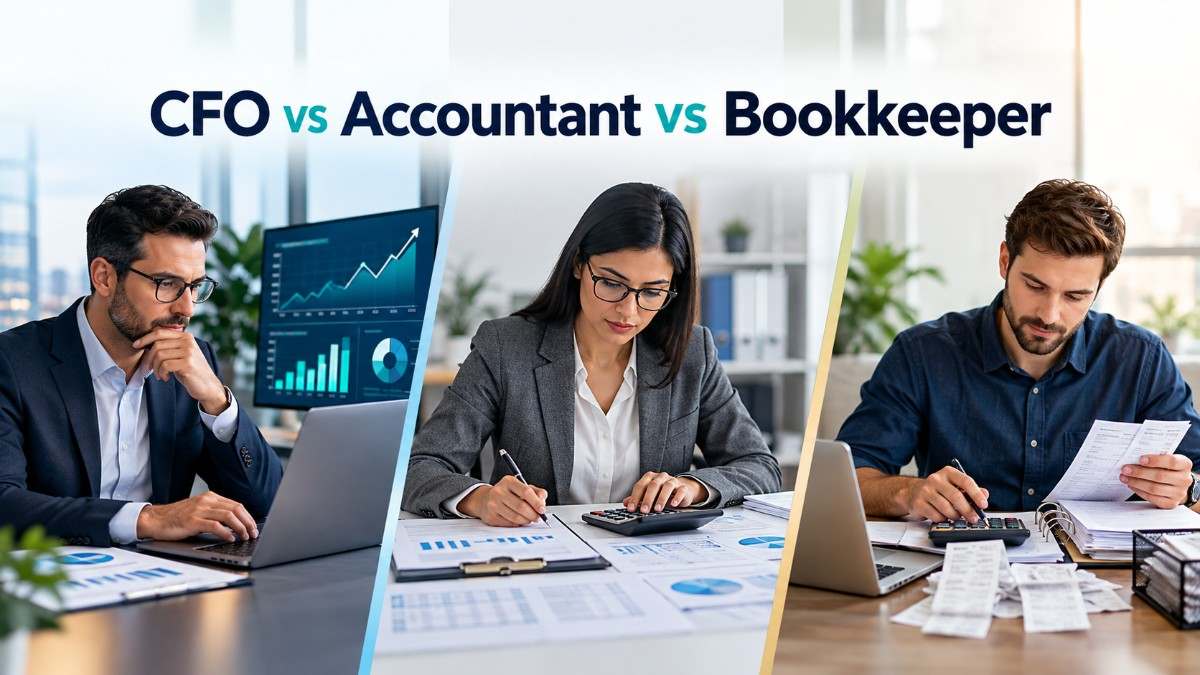 These three roles get mixed up constantly, but they're not interchangeable.
Role | Primary Focus |
Bookkeeper | Records financial transactions |
Accountant | Accounting, reporting, and compliance |
CFO | Financial strategy and business decisions |
Think of it this way: the bookkeeper tells you what happened, the accountant makes sure it's recorded correctly and legally, and the CFO uses all of that information to help you decide what happens next. CFO services don't replace your accounting function. They build on top of it.
Types of CFO Services
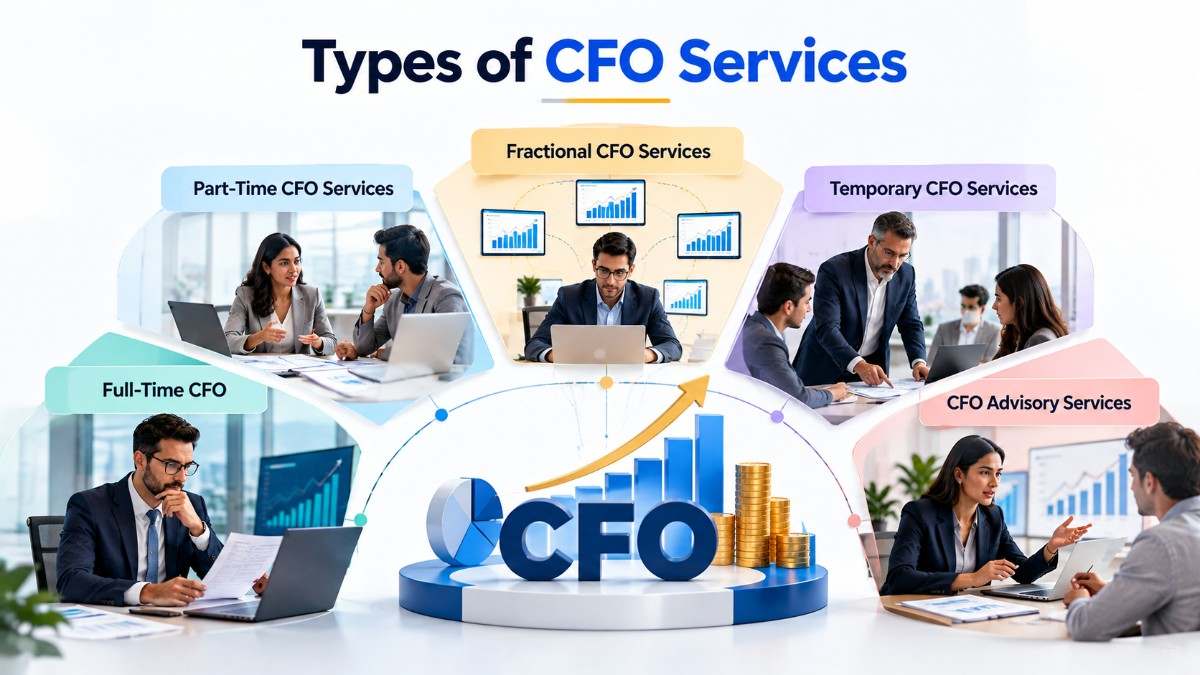
There's no one-size-fits-all version of a CFO anymore. Startups can choose from several engagement models depending on their stage and budget.
Full-Time CFO
This is the traditional setup: one person, fully dedicated to your business, deeply involved in day-to-day operations. It makes sense for larger companies or ones with genuinely complex finances, but it's often overkill (and expensive) for an early-stage startup.
Part-Time CFO Services
Here, you get CFO-level expertise for a set number of hours or days each week or month. It's a practical middle ground for startups that need senior guidance but don't have the workload or the budget to justify a full-time salary.
Fractional CFO Services
Fractional CFO services work on a shared basis, meaning the CFO splits their time across multiple clients. The advantage is flexibility. You can scale the engagement up or down as your needs change, without renegotiating an employment contract.
Temporary CFO Services
Sometimes you just need financial leadership for a specific window of time. Temporary CFO services are common during:
Fundraising rounds
Leadership transitions
Restructuring
Financial transformation projects
CFO Advisory Services
This is the lightest-touch option. CFO advisory services offer strategic input on specific decisions, like financial planning, growth strategy, capital allocation, or getting ready to raise, without taking over the entire finance function.
None of these CFO engagement models is objectively "better." The right one depends entirely on your stage, the complexity of your finances, and how much hands-on support you actually need.
What Is Included in a CFO's Scope of Work?
The exact CFO scope of work will shift depending on the engagement, but most fall into four practical buckets.
Financial Strategy This covers the financial roadmap, growth planning, capital allocation decisions, and scenario planning, essentially the finance strategy advisory work that shapes where the business is headed.
Cash Flow and Business Performance Cash-flow forecasting, burn-rate monitoring, runway planning, profitability analysis, unit economics, and tracking the financial KPIs that actually matter for your business.
Fundraising and Investor Support Building financial projections, putting together investor-ready financial models, preparing for due diligence, and managing ongoing investor reporting.
Risk and Financial Controls Spotting financial risk early, setting up proper controls and processes, and coordinating closely with your accounting and legal teams so nothing falls through the cracks.
How Much Do CFO Services Cost?
There's no single number here, and anyone who gives you one without asking about your business first is probably guessing. CFO service costs depend on a mix of factors.
Factors That Affect CFO Costs
Startup stage
Business size and complexity
Scope of work
Frequency of engagement
Fundraising requirements
Number of entities or markets
The CFO's experience and expertise
Common CFO Engagement Models
CFO support is usually structured in one of these ways:
Hourly or project-based engagement
Monthly retainer
Part-time engagement
Fractional CFO arrangement
Full-time employment
The real takeaway is that cost has less to do with the job title and more to do with what you're actually asking the CFO to handle. A narrow advisory engagement will cost far less than someone managing your entire finance function week to week.
When Does a Startup Need CFO Services?
The need for CFO support tends to track pretty closely with your growth stage.
Early Stage: You're mostly looking for cash-flow visibility, basic budgeting, financial controls, and simple forecasting to keep things on track.
Growth Stage: Revenue and expenses start climbing, forecasting gets harder, working capital becomes trickier to manage, and founders often realize they've lost visibility into their own numbers.
Fundraising Stage: This is where CFO support tends to pay for itself, through solid financial models, clean investor reporting, due diligence prep, and capital planning.
Scaling Stage: Multiple revenue streams, bigger teams, new markets, and more complicated operations all raise the financial stakes, and the need for deeper financial leadership.
5 Signs Your Startup May Need CFO Support
Not sure if you're at that point yet? Here's a quick gut check. Your startup may need CFO support if:
You don't know your exact cash runway.
Financial decisions are based on assumptions instead of data.
You're preparing to raise external funding.
Revenue is growing, but profitability isn't clear.
Most financial decisions still depend entirely on the founder.
CFO support isn't reserved for startups pulling in huge revenue numbers. Often, it's most valuable earlier than founders expect, while you're still building the financial systems your next stage will require.
CFO Services vs Hiring a Full-Time CFO
CFO Services | Full-Time CFO |
Flexible engagement | Dedicated role |
Scalable support | Full-time involvement |
Lower long-term commitment | Higher fixed cost |
Can address specific needs | Broader ongoing responsibility |
Useful for startups at different stages | Often suited to larger or complex operations |
This isn't really about which option is universally better. It's about which one fits your startup's current financial needs, stage, and budget right now, not where you hope to be in three years.
How to Choose the Right CFO Service for Your Startup

Before picking an engagement model, sit down and answer a few honest questions:
What financial problem are we actually trying to solve?
Do we need strategic advice, or daily financial management?
Are we preparing for fundraising?
How complex is our finance function right now?
How often do we realistically need CFO support?
Are we looking for a temporary fix or ongoing financial leadership?
What level of CFO experience does our business actually require?
Working through these questions helps you land on the right CFO engagement model, instead of just defaulting to whichever option looks cheapest on paper.
Read More: How a Virtual CFO can transform your business finances
How Startup Coach Can Help With Financial Leadership
Startup Coach helps founders access financial expertise based on their stage and business needs. That support can include CFO services, financial strategy, fundraising preparation, and business planning. The goal is simple: connect startups with the right level of financial expertise as their needs evolve, rather than a one-size-fits-all package.
Whether a founder needs ongoing financial leadership or guidance through a specific milestone, like a funding round or a restructuring push, the right CFO engagement can bring clarity without requiring an immediate full-time hire.
Conclusion:
CFO support isn't something you unlock only after hitting a specific revenue milestone. The real trigger is financial complexity: how fast you're growing, whether you're fundraising, and how confident you feel making financial decisions on your own.
Part-time, fractional, temporary, advisory, and full-time models each offer a different way to bring in financial expertise, at a level that matches where you actually are. The right engagement can sharpen your financial visibility, support your next raise, strengthen your planning, and take some of the guesswork out of running the business.
If your startup is entering a stage where financial decisions are becoming more complex, the right CFO support can help you build the financial foundation for your next phase of growth.
FAQs About CFO Services
1. What are CFO services?
CFO services give businesses access to financial strategy, planning, cash-flow management, and high-level decision-making support, without necessarily hiring a full-time CFO.
2. What does a CFO do for a startup?
A CFO typically handles financial planning, forecasting, fundraising support, cash-flow management, reporting, and overall financial strategy.
3. What is the difference between a fractional CFO and a part-time CFO?
A fractional CFO splits their time across several clients at once, while a part-time CFO usually commits set hours to one business. In practice, the terms are sometimes used interchangeably.
4. How much do CFO services cost?
Costs vary based on scope of work, the CFO's experience, how often they're engaged, and which engagement model you choose.
5. When should a startup hire a CFO?
Generally, once financial complexity increases, whether from fundraising, rapid growth, or scaling operations, it's worth bringing in CFO-level support.