Compliance Risk Assessment: How to Identify & Evaluate Business Risks Effectively
By Rohini Rajpoot · 5 May 2026
Learn compliance risk assessment for startups with steps, examples, and a checklist. Identify risks and stay legally safe. Read the guide now.
It's exciting to start and grow a business in India, but there are many rules, filings, and legal obligations that can quickly turn into a founder's worst nightmare. You could be facing fines, lawsuits, or even a notice to shut down if you miss a GST deadline, forget about a labor law, or don't review a contract clause. This is precisely why compliance risk assessment isn't just for big businesses. Every startup must know how to do compliance risk assessment.
We explain what compliance risk assessment is, how to do it step by step, give examples of compliance risks that Indian startups might face in the real world, and give you a compliance risk checklist that you can start using right away.
What is a compliance risk assessment?
Compliance risk assessment is the process of identifying, analyzing, and evaluating the legal and regulatory risks your business faces and then deciding how to manage them before they become problems. Think of it as a health check-up for your business's legal standing. Just as a doctor screens for risks before they turn into diseases, this assessment helps you spot regulatory gaps before they turn into fines or lawsuits.
For startups, this matters more. You're building fast, hiring fast, and signing contracts fast, often without a dedicated legal or compliance team. The compliance risk assessment process gives you a structured way to stay protected while you move quickly.
Why Can't Startups Ignore Compliance Risk?
Founders often assume compliance is something to worry about later — after product-market fit, after funding, after scaling. That's a costly mistake. Here's why:
Investors perform due diligence before writing any check. Compliance gaps discovered during fundraising can instantly terminate a deal.
Regulatory penalties in India can be severe, from GST non-compliance fines to MCA penalties for missed ROC filings.
Reputational damage from a compliance failure can take years to recover, especially in a market where trust travels fast.
Legal disputes arising from unclear contracts or IP ownership can consume enormous time and capital at the worst possible moment.
The earlier you build a risk assessment in compliance into your operations, the cheaper and easier it is to resolve problems.
The Compliance Risk Assessment Process: Step by Step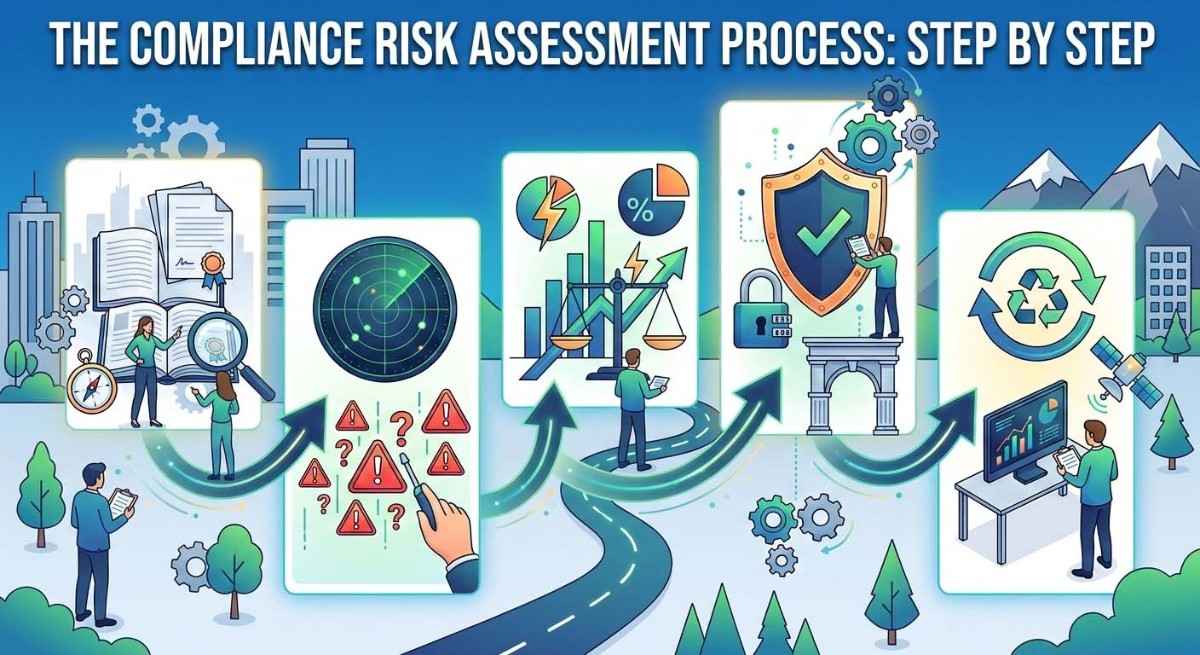 A structured compliance risk assessment process typically follows five core steps. Here's how to apply each one to your startup:
Step 1: Identify the Regulatory Universe That Applies to You
Start by mapping every law, regulation, and guideline relevant to your business. For Indian startups, this typically includes:
Company law: Companies Act 2013, ROC filings, annual returns
Tax compliance includes GST registration and returns, TDS, advance tax, and income tax obligations.
Labor laws: PF, ESI, gratuity, POSH Act, employment contracts
Data protection: IT Act, DPDP Act obligations if you handle user data
Sector-specific regulations include SEBI (Securities and Exchange Board of India) for fintech, FSSAI (Food Safety and Standards Authority of India) for food, IRDAI (Insurance Regulatory and Development Authority of India) for insurtech, and RBI (Reserve Bank of India) for lending or payments.
Your regulatory universe depends on your industry, business model, and the states you operate in. A SaaS startup has a very different compliance map than a D2C brand or an NBFC, as each type of business faces unique regulatory requirements and challenges based on their operational models and the specific regulations that govern their industries.
Step 2: Identify Potential Compliance Risks
Once you know which laws apply, go deeper and ask, "Where are we most likely to fall short?" This is the core of how to assess compliance risk moving from theory to reality. Look at:
Areas where processes are manual or informal
Deadlines that are tracked on spreadsheets (or not tracked at all)
Contracts that were signed in a hurry without legal review
Team members handling sensitive data without clear protocols
Any business activity that has outpaced the compliance infrastructure surrounding it.
Talk to your finance, HR, and tech leads. Compliance gaps are often hiding in plain sight in the way onboarding is done, how payments are processed, or how customer data is stored, which can lead to significant legal and financial repercussions for the business if not addressed.
Step 3: Evaluate the Likelihood and Impact of Each Risk
Not all risks are equal. Some non-compliance issues carry small fines. Others can cause criminal liability or business suspension. Build a simple risk matrix. For each risk identified, rate it on two dimensions:
Likelihood: How probable is it that this risk will materialize? (Low / Medium / High)
Impact: If it does materialize, how damaging will it be? (Minor / Moderate / Severe)
A risk that is both high-likelihood and high-impact is a Priority 1 issue. Repair it immediately. A low-likelihood, low-impact risk might just need monitoring. This prioritization is what makes the compliance risk assessment process practical rather than overwhelming.
Step 4: Design Controls and Mitigation Actions
For every significant risk, define a clear action:
Who is responsible for this compliance area?
What process or system should be in place?
What is the timeline for addressing the gap?
How will compliance be monitored going forward?
For startups without in-house legal teams, this often means engaging a compliance partner, setting up automated reminders for regulatory deadlines, or using tools like Razorpay's compliance suite or cleartax for tax filings.
Step 5: Monitor, Review, and Update Regularly
Compliance is not a one-time exercise. Laws change, your business model evolves, and new risks emerge.
Set a calendar to review your compliance risk assessment at least twice a year and immediately whenever you enter a new geography, launch a new product, raise a round of funding, or cross a revenue threshold that triggers new obligations, such as mandatory Goods and Services Tax (GST) registration for businesses with a turnover above ₹20 lakhs.
Real-World Compliance Risk Examples for Indian Startups
To make this concrete, here are common compliance risk examples that startup founders encounter:
GST non-compliance refers to issues such as missing return deadlines, making incorrect claims for Input Tax Credit (ITC), or failing to register for Goods and Services Tax (GST) when turnover crosses the threshold.
Employment contract gaps refer to issues such as not having signed offer letters, non-disclosure agreements (NDAs), or intellectual property (IP) assignment clauses with early employees or co-founders.
Data privacy breaches: Storing user data without consent mechanisms or without a privacy policy that reflects actual practices
ESOP non-compliance refers to issuing Employee Stock Ownership Plans (ESOPs) without following the procedures outlined in the Companies Act, which can lead to invalid grants.
Foreign investment violations: Accepting foreign funding without proper FEMA filings and RBI reporting
POSH non-compliance: Failing to constitute an Internal Complaints Committee (ICC) once headcount exceeds ten employees
Each of these issues poses a significant risk that has derailed actual startups. A proper compliance risk assessment identifies these issues before they become a problem for you.
Compliance Risk Checklist for Startups
Use this compliance risk checklist as your starting point. Tick what's in place, flag what isn't:
1. Legal & Corporate
Company incorporated with the correct structure (Pvt. Ltd., LLP, etc.)
MOA/AOA reviewed and updated as per business model
ROC annual filings up to date
All co-founder agreements and shareholder agreements in place
2. Tax
GST registered (if applicable) and returns filed monthly/quarterly
TDS deducted and deposited on time
Advance tax paid as per schedule
Books of accounts maintained and audited annually
3. HR & Labor
Offer letters and employment contracts signed by all employees
PF and ESI registered and contributions deposited
POSH policy in place and ICC constituted (if 10+ employees)
Leave policy and attendance records maintained
3. Data & Technology
Privacy policy published and accurate
User consent mechanism in place for data collection
Data storage and access controls documented
4. Fundraising & Finance
FEMA filings completed for any foreign investment
ESOP pool created and grants documented correctly
The cap table is accurate and updated after every round
Startup Coach’s Perspective
From a startup coach’s lens, compliance risk assessment is a growth enabler, not just a safeguard. Startups that stay compliant move faster in fundraising, build stronger trust, and avoid costly disruptions. The goal is not to eliminate risk, but to manage it early and scale with confidence.
Conclusion
The best time to do a compliance risk assessment was when you started. The second best time is today. As a founder, you don't need to become a lawyer, but you do need a system that catches compliance risks before they become crises. Whether you're pre-revenue or post-Series A, building a robust compliance risk assessment process is one of the highest-ROI things you can do for your startup's long-term health.
At Startup Coach, we help founders navigate exactly these issues, from legal structuring and regulatory compliance to fundraising readiness. If you'd like a compliance audit for your startup, get in touch with our team and let's make sure your foundation is as strong as your vision.
FAQs
Q: How often should a startup conduct a compliance risk assessment?
Startups should review their compliance risks at least twice a year or whenever there is a major business change like funding, expansion, or new product launches.
Q: Do early-stage startups really need compliance risk assessment?
Yes, even early-stage startups face legal and regulatory obligations. Addressing compliance early helps avoid costly issues later.
Q: What are the most common compliance risks for Indian startups?
Common risks include GST non-compliance, missing ROC filings, weak employment contracts, data privacy gaps, and FEMA violations.
Q: Can compliance risk assessment be done without a legal expert?
Basic assessments can be done internally, but consulting a legal or compliance expert is recommended for accuracy and complete coverage.
Q: What happens if a startup ignores compliance requirements?
Ignoring compliance can lead to penalties, legal notices, loss of investor trust, and in serious cases, business shutdown.