FLA Filing in India: Annual Compliance Guide for Companies with Foreign Investment
By Toishaa Soni · 12 February 2026

FLA filing guide for Indian companies with foreign investment, including due dates, process, and penalties.
Foreign investment plays an important role in India’s economic growth by bringing capital, technology, and global expertise into local businesses. However, companies in India that receive foreign investment or hold foreign assets must comply with annual reporting requirements under the Foreign Exchange Management Act (FEMA), 1999. One of the most important of these is the Foreign Liabilities and Assets (FLA) Return — an annual declaration of foreign investment and overseas assets of Indian entities.
This blog offers a complete, beginner-friendly guide to FLA filing in India, explaining who must file, when and how to file, what information is required, consequences of non-compliance, and best practices to stay compliant year after year.
What Is FLA Filing?
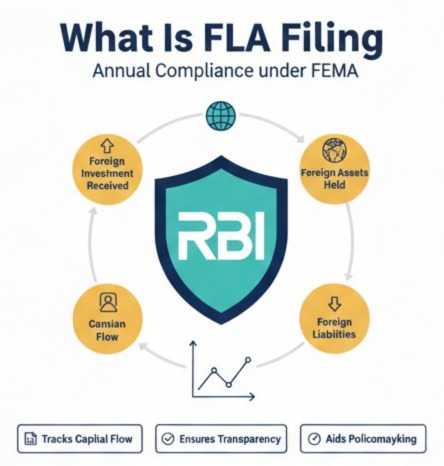 The FLA Return is an annual compliance requirement under FEMA. It requires Indian companies with foreign investment or foreign liabilities/assets to report details of such holdings to the Reserve Bank of India (RBI). The goal is to help the RBI track foreign capital flow in and out of India, ensure transparency, and maintain accurate data for policymaking and economic monitoring. In simple terms, the FLA return tells the government:
How much foreign investment a company has received,
What foreign assets it holds,
What foreign liabilities are attributable to that company
— all as of March 31st each year.
Who Must File an FLA Return?
FLA filing applies to several types of entities operating in India that have foreign investment exposure. These include:
Indian Companies with Foreign Equity: If an Indian company has received Foreign Direct Investment (FDI)—whether through shares, convertible instruments, or RBI-approved automatic routes—it needs to file an FLA Return.
Companies with Foreign Loans or Trade Credit: This includes any overdrafts, loans, or trade credit from non-resident entities or foreign investors.
Entities with Overseas Direct Investment (ODI): Indian companies that invest abroad — for example, a subsidiary in another country — must also report those foreign assets.
LLPs & SEBI-registered Funds: Limited Liability Partnerships (LLPs) and SEBI-registered Alternate Investment Funds (AIFs) with foreign liabilities or assets may also be required to file.
Important Note: Even if a company did not receive new foreign investment during the year but still has outstanding foreign equity or asset positions as of March 31st, it must file the return. If a company has absolutely no foreign investment or foreign liabilities/assets as of March 31, FLA filing is not required. But this must be verified carefully before deciding not to file, as companies that once had foreign investment may still have undisclosed offshore positions.
FLA Filing Deadlines in India
Standard Deadline: Traditionally, the FLA Return must be filed by July 15 following the financial year ending March 31. For example, for FY 2024–25, the return should be filed by July 15, 2025.
Revised Deadlines for FY 2024–25: For the 2024–25 year, the RBI extended the deadline to July 31, 2025, as a one-time relief measure. Entities not having audited figures can still file using provisional data by July 31, 2025, and then submit a revised return once audited accounts are finalized.
Revised Return Deadline: If final audited financials are not ready at the initial filing date, companies can submit provisional figures first. The revised return must then be filed by September 30 of the same year.
Missing the deadline can trigger penalties or interest for late filing, so it’s crucial to mark important dates in your compliance calendar.
Information Required for FLA Filing
The FLA Return requires companies to report all foreign liabilities and assets as of March 31 of the financial year. Below are the key categories of information that are typically required:
1. Foreign Equity: Details about foreign equity held in the company, including type of shares, number of shares, and valuation.
2. Foreign Direct Investment: Breakdown of FDI received, including equity and instruments that are treated as equity (like compulsorily convertible preference shares).
3. Foreign Liabilities: Details of loans, overdrafts, and credit received from non-resident entities.
4. Overseas Assets: If the company has invested abroad, such as in subsidiaries, LLPs, or joint ventures, information needs to be captured, including what was invested and how it’s classified.
5. Financial Statements Reconciliation: The foreign positions reported should be consistent with your balance sheet figures as on March 31.
How to File FLA Returns in India
1. Registration on RBI’s FLAIR Portal: Since 2019, all FLA filings must be done through the online FLAIR (Foreign Liabilities and Assets Information Reporting) portal. To get started:
Visit the FLAIR portal: https://flair.rbi.org.in
Register your entity by submitting details like CIN, PAN, registered office address, and an authorized signatory.
Once approved, you receive a login ID to access the portal and begin filing.
2. Fill in the Required Details
After login:
Choose the appropriate financial year.
Enter foreign investment details and overseas assets.
Use audited figures if available; otherwise, enter provisional figures initially.
Each section of the form must be carefully validated to ensure accuracy and consistency with audited financials or ROC filing data.
3. Submit the Return
Once all details are entered:
Click Submit on the portal.
The system will generate an Acknowledgement Receipt—save this for your records.
If provisional numbers were used, don’t forget to file the revised return once audited accounts are available.
Consequences of Not Filing FLA Returns
FLA filing is a mandatory compliance under FEMA. Failure to file, filing late, or submitting incorrect information can result in penalties. The RBI is authorized to impose fines, which may include:
Monetary penalties based on the amount involved,
A fixed penalty when an amount cannot be quantified (up to ₹2 lakh),
Ongoing penalties for continued non-compliance.
In addition to financial penalties, non-compliance may attract scrutiny from tax or foreign exchange authorities, increased due diligence, and restrictions on further foreign investments or transfers.
Common Mistakes to Avoid in FLA Filing
Since FLA filing requires several data points and reconciliation with financial statements, avoid these common errors:
Inaccurate Classification: Some entities incorrectly classify instruments (like CCDs) or mix equity with debt figures.
Missing Deadlines: Don’t assume that no change in foreign investment means no filing. Even unchanged foreign positions must be reported.
Mismatch with Audited Figures: Always reconcile the figures with audited financial statements to avoid discrepancies.
Ignoring Revisions: If audited figures become available after the initial filing, the revised return must be filed. Ignoring it can be a compliance violation.
Best Practices for Smooth Annual FLA Filing
Here are some tips to make FLA filing compliant and stress-free:
Start Early: Begin data gathering several weeks before the due date—foreign investment tracking often requires consolidation of multiple accounts.
Maintain Accurate Records: Keep updated details of foreign equity, loans, overseas investments, and relevant agreements.
Reconcile with Audited Financials: Ensure your foreign asset and liability figures match your audited balance sheet as of March 31.
Use Expert Help if Needed: If FLA filing feels complex, consider consulting a FEMA compliance expert or professional.
Monitor RBI Circulars: FLA filing rules and deadlines change occasionally. Track announcements from the RBI so you never miss updated compliance requirements.
Conclusion
For Indian companies with foreign investment or overseas assets, FLA filing is a key annual compliance requirement. It ensures transparency in foreign capital flows, allows the RBI to monitor cross-border investment data, and keeps businesses aligned with FEMA regulations. By knowing who must file, how to file, what data is required, and how to avoid common mistakes, businesses can meet their compliance obligations efficiently. Staying organized and proactive with FLA reporting not only avoids penalties but also contributes to better financial governance and confidence among global investors. Whether you’re a startup with foreign equity or a multinational holding overseas assets, FLA filing should be part of your yearly compliance planning.
FAQs:
1. What is FLA filing in India?
FLA filing is an annual return submitted to the RBI by companies with foreign investment or overseas assets under FEMA regulations.
2. Who is required to file the FLA Return?
Any Indian company, LLP, or entity with foreign direct investment (FDI) or overseas investment as of March 31 must file it.
3. What is the due date for FLA filing?
The FLA Return must generally be filed by July 15 (or as extended by RBI) each year.
4. Can provisional figures be used for FLA filing?
Yes, companies can file using provisional data if audited statements are not ready and later submit a revised return.
5. What happens if an FLA return is not filed?
Non-filing or incorrect filing can lead to penalties under FEMA, including monetary fines.