Government Agri Startup Schemes in India – Agri Preneurs Explained
By Toishaa Soni · 21 January 2026
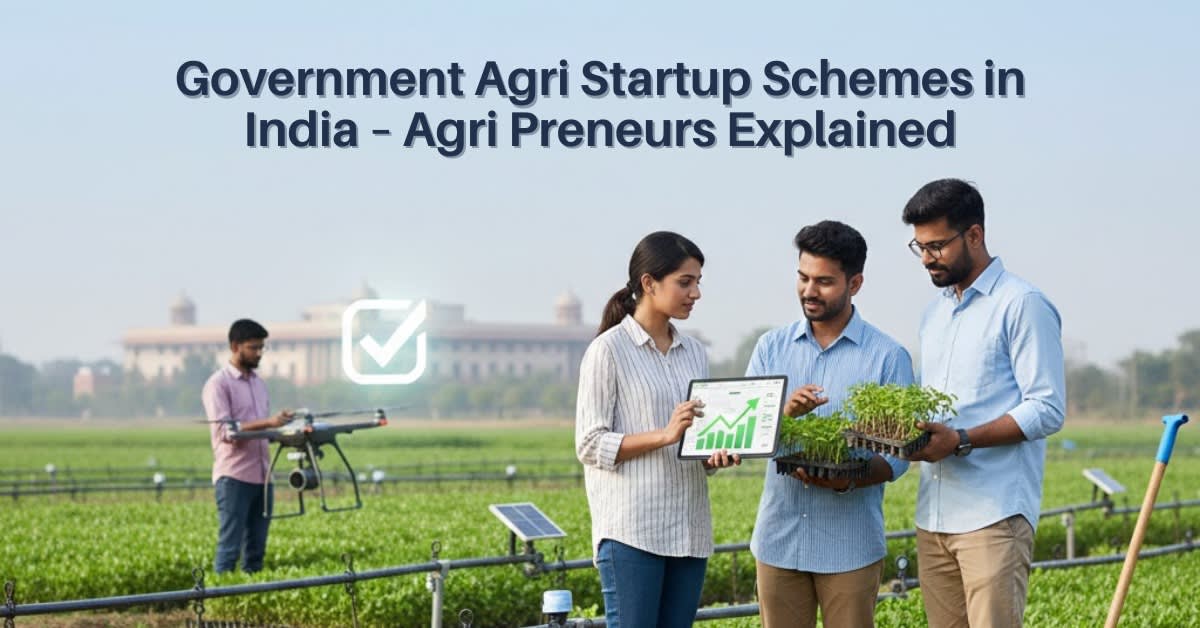
Explore key government agri startup schemes in India, funding options, eligibility, and how agri-preneurs can scale agritech and rural ventures.
Agriculture in India is no longer limited to traditional farming practices. Today, agri startups are building solutions across precision farming, food processing, supply chains, sustainability, and rural infrastructure. However, agri ventures face longer validation cycles, higher capital requirements, and slower adoption compared to conventional tech startups.
To address these challenges, the Government of India has introduced multiple schemes focused specifically on supporting agri-preneurs through funding, incubation, and structured execution support.
Who Is an Agri-Preneur?

An agri-preneur is an entrepreneur building a business around agriculture or allied sectors. This includes agritech startups, food processing units, supply chain platforms, farm mechanization solutions, animal husbandry ventures, and rural infrastructure businesses.
Government agri-startup schemes are designed to help such founders move from idea to execution while reducing early-stage financial and operational risk.
Why Government Support Is Critical for Agri Startups?
Agri startups often operate in high-risk environments where field pilots, farmer adoption, and infrastructure development take time. Private investors typically hesitate at very early stages due to uncertainty and long gestation periods.
Government schemes fill this gap by offering grants, low-cost financing, incubation support, and mentoring, allowing founders to validate ideas and build viable business models before scaling.
Key Government Agri Startup Schemes in India
1. Innovation and Agri-Entrepreneurship Development under RKVY-RAFTAAR
This scheme operates under the Rashtriya Krishi Vikas Yojana and focuses on nurturing innovation in agriculture and allied sectors.
Agri startups at the idea or pre-seed stage can receive grants of up to ₹5 lakh, while seed-stage startups can receive grants of up to ₹25 lakh. Along with funding, startups receive incubation, training, and mentoring through RKVY-supported Agri-Business Incubators.
The scheme supports startups working in precision agriculture, food processing, supply chains, waste-to-wealth, animal husbandry, and farm mechanization.
2. AgriSURE Fund (Agri Fund for Startups and Rural Enterprises)
The AgriSURE Fund targets high-impact, technology-driven agri ventures operating across the farm-produce value chain.
With a corpus of ₹750 crore, the fund provides blended capital through direct equity investments and fund-of-funds structures. It is managed by NABARD through its venture arm.
AgriSURE is best suited for startups that have validated their solution and are ready for growth-stage capital.
3. Agriculture Infrastructure Fund (AIF)
The Agriculture Infrastructure Fund focuses on strengthening post-harvest and supply-chain infrastructure.
Under AIF, startups and agri enterprises can access low-cost loans with interest subvention for projects such as cold storage, warehouses, sorting and grading units, and processing facilities. This scheme is particularly relevant for logistics-focused and infrastructure-led agri startups.
4. Startup India Initiative for Agritech Startups
Agritech startups recognized under the Startup India initiative can access tax exemptions, simplified compliance, faster IP processing, and government funding schemes.
Startup India recognition often acts as the foundation layer, enabling agri startups to qualify for sector-specific programs and investor attention.
What Agri-Preneurs Get from These Schemes?
Government agri-startup schemes offer more than funding. Founders receive financial support through grants, loans, or equity, depending on the scheme and stage.
They also gain access to incubation support, mentorship, testing facilities, and business advisory services through agricultural universities and national institutes. These programs help startups refine their models, validate in real-world conditions, and move toward commercial scale.
Key Focus Areas for Government-Backed Agri Startups
Most schemes prioritize innovation in areas such as Artificial Intelligence, IoT, drones, and>Startups solving problems related to productivity, wastage reduction, and farmer income enhancement receive strong policy backing.
How Agri Startups Can Apply?
Agri-preneurs can apply through official government portals or directly via affiliated Agri-Business Incubators and knowledge partners.
Some opportunities also arise through innovation challenges and sector-specific hackathons, while AIF applications are routed through lending institutions. Each scheme follows a structured evaluation process focused on innovation, feasibility, and impact.
Startup Coach Perspective
Many agri founders miss out on government schemes because they approach them without execution clarity. Funding works best when aligned with clear milestones, realistic unit economics, and a scalable go-to-market plan.
At Startup Coach, we help agri-preneurs structure their ideas, prepare for incubation-led funding, and align government support with long-term growth strategy.
Conclusion
Government agri-startup schemes in India are creating a strong foundation for innovation-led growth in agriculture. By combining capital, incubation, and institutional support, these programs help agri-preneurs convert ideas into sustainable businesses.
For founders building in agritech, food processing, or rural value chains, leveraging these schemes strategically can significantly improve survival, scale, and long-term impact.
FAQs
Q- Who can apply for government agri-startup schemes?
Individuals and startups working in agriculture and allied sectors such as agritech, food processing, supply chains, and animal husbandry can apply, subject to scheme-specific eligibility.
Q- Is revenue required to apply?
No, many schemes support idea-stage and early-stage startups. Innovation and feasibility matter more than revenue.
Q- Are non-tech agri startups eligible?
Yes, food processing, logistics, farm mechanization, and sustainable farming startups are equally eligible if they demonstrate innovation and impact.
Q- Can startups apply to multiple agri schemes?
Yes, as long as eligibility criteria are met and the same activity is not funded twice.
Q- Why is incubation important for agri startups?
Incubation provides mentorship, field validation, and execution support, which significantly reduces risk in agriculture-focused ventures.