Outsourced Accounting Services vs Virtual CFO: What Startups Actually Need
By Rohini Rajpoot · 1 October 2026
Compare outsourced accounting services and virtual CFOs to find the right financial support for your startup, from daily operations to strategy.
In the early days, most founders ran finance themselves. They send the invoices, chase payments, reconcile the bank account at midnight, and somehow also try to build the actual product. It works until it doesn't.
At some point, the finance side of the business outgrows what one person can handle in their spare time. That's usually when two options show up in the conversation: outsourced accounting services or a virtual CFO. They sound similar, but they solve completely different problems.
Before picking either one, it helps to ask a simpler question first: does your startup need better financial operations, or does it need better financial decision-making? Accounting keeps the day-to-day finance function running smoothly. A virtual CFO helps you figure out what those numbers actually mean and what to do next. This guide breaks down both, so you know which one your startup actually needs right now.
What Are Outsourced Accounting Services?
 What Do Outsourced Accounting Services Include?
Outsourced accounting covers the practical, ongoing finance work that keeps a business running on paper. That typically includes:
Bookkeeping
Accounts payable
Accounts receivable
Bank reconciliation
Financial statements
Expense tracking
Payroll coordination
Tax and compliance support
Regular financial reporting
None of this is glamorous, but it's the foundation everything else gets built on. Without clean books, forecasting and strategy don't mean much.
Why Do Startups Outsource Accounting?
Most founders outsource accounting for a few practical reasons. It cuts down on operational workload, gives them access to real accounting expertise without hiring a full team, and creates financial processes that are actually consistent instead of held together with spreadsheets and guesswork.
For early-stage startups especially, bookkeeping outsourcing is often the first real finance decision a founder makes, well before they're thinking about CFOs at all.
What Is a Virtual CFO?

What Does a Virtual CFO Do?
A virtual CFO gives you senior-level financial leadership without the cost or commitment of hiring someone full-time in-house. Their work usually covers:
Financial forecasting
Cash-flow planning
Budgeting
Financial modelling
Business performance analysis
Fundraising preparation
Investor reporting
Risk management
Virtual CFO vs Accountant
Here's the simplest way to think about the difference:
An accountant answers the question, "What happened financially?"
A CFO answers the question, "What does it mean, and what should we do next?"
One looks backward to keep the record accurate. The other looks forward to help you make better calls.
Outsourced Accounting vs Virtual CFO: What's the Difference?
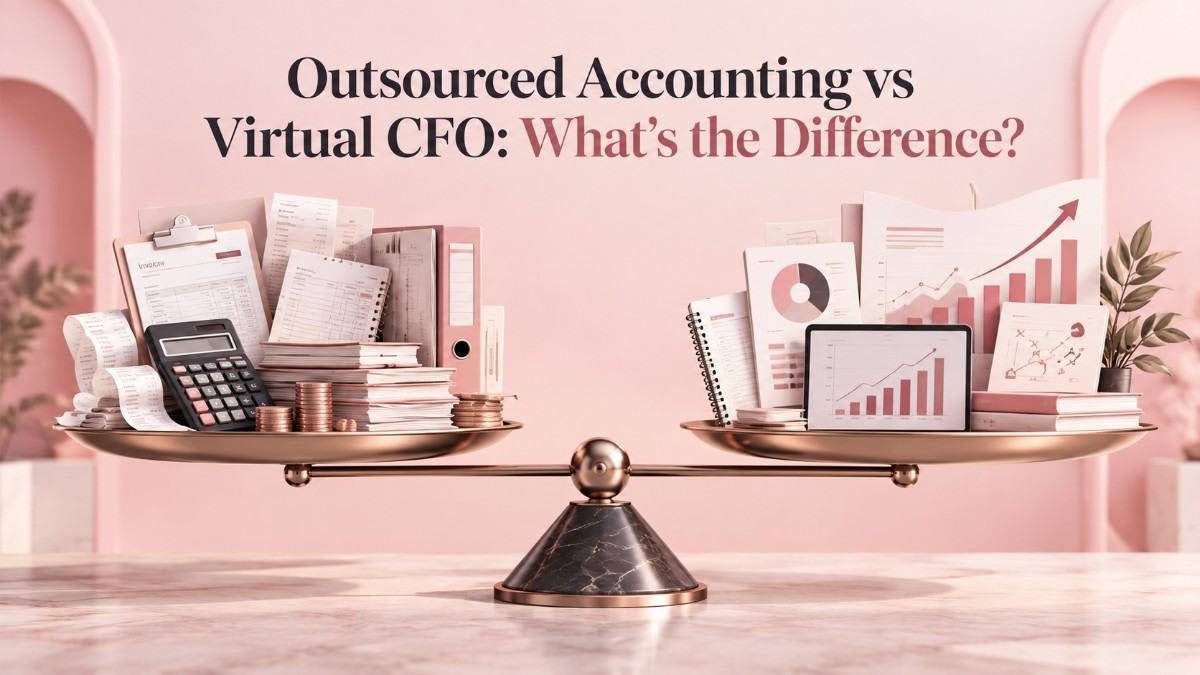 This is really the heart of the decision, so it helps to see it laid out side by side.
The simplest way to understand it: outsourced accounting keeps your financial records and processes organised. A virtual CFO helps you understand those numbers and use them to actually make business decisions.
Why Startups Often Need Both
This doesn't have to be an either/or choice, and honestly, for a lot of growing startups, it isn't.
An accounting team handles the daily finance operations, the invoices, reconciliations, and reporting that keep everything accurate. A virtual CFO then reviews those numbers and uses them to guide bigger strategic decisions. Together, they form a much stronger startup finance function than either one could build alone.
This combination tends to support:
Accurate financial records
Cash-flow visibility
Forecasting
Financial planning
Fundraising
Investor communication
Think of it less as choosing between two services and more as building an outsourced finance team, where each part covers a different piece of the puzzle.
When Should a Startup Choose Outsourced Accounting?
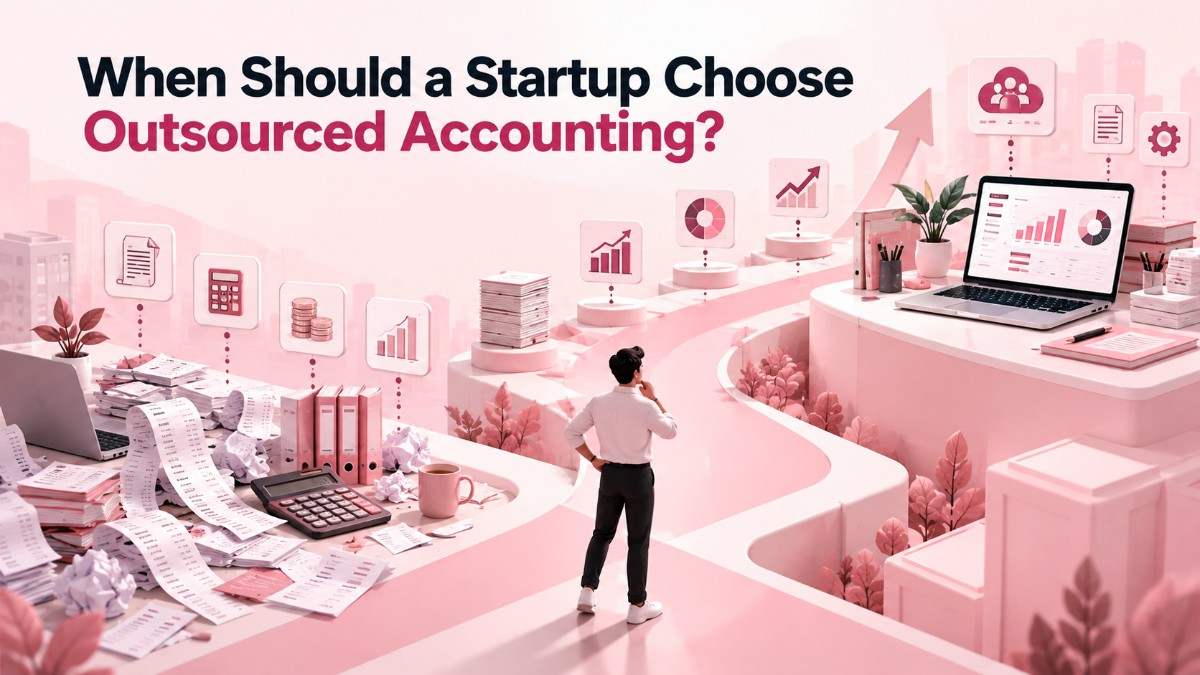
Outsourced accounting tends to be the more urgent priority when the basics are already slipping. You may need it if:
Bookkeeping is eating up too much of the founder's time.
Financial records are inconsistent or constantly delayed.
Invoices and payments are hard to track properly.
You need regular, reliable financial statements.
There's no internal accounting team to lean on.
Compliance and accounting tasks are becoming genuinely difficult to manage.
For most early-stage startups, this is where finance operations actually start, long before strategy enters the picture.
When Should a Startup Consider a Virtual CFO?
A virtual CFO becomes more relevant once the questions shift from "Is this recorded correctly?" to "What should we do about it?" Consider one when:
You're preparing to raise funding.
Cash flow and runway need closer, more careful monitoring.
You're planning rapid expansion.
You need real financial forecasts, not rough estimates.
Profitability and unit economics aren't clear.
You're making major hiring or investment decisions.
Investors are asking for stronger financial reporting.
The founder needs senior financial guidance they don't currently have in-house.
Outsourced Accounting Services in India: What Startups Should Consider
If you're evaluating outsourced accounting services in India, a few practical factors matter more than flashy marketing. Look at:
Experience working specifically with startups
Familiarity with GST and local tax requirements
Comfort with the accounting systems and software your startup already uses
Reporting frequency and how quickly they turn things around
Data security practices
Communication style and responsiveness
Whether they can actually scale with you as the business grows
Skip providers who lean on generic claims about India's outsourcing market. What matters is whether they understand startup accounting specifically, not just accounting in general.
Read More: How a Virtual CFO can transform your business finances
Hiring a CFO vs. Outsourcing Accounting
This is often where founders get stuck, so it's worth addressing directly.
Hiring a full-time CFO may make sense when finance is genuinely complex, the business needs daily financial leadership, there are multiple entities or markets involved, or the finance function has grown to a point where it needs dedicated, ongoing attention.
Outsourcing accounting tends to make more sense when the immediate need is operational, the company is still early-stage, the accounting workload is growing but not yet overwhelming, and full-time strategic financial leadership just isn't necessary yet.
A virtual CFO fits somewhere in between, ideal when you need real strategy without committing to a full-time hire, when fundraising or scaling is underway, or when founders need someone to help them make sense of the numbers.
The right question isn't "should we outsource?" It's "which part of our finance function actually needs support right now?"
How Much Do Outsourced Accounting and CFO Services Cost?
There's no single number that applies across the board here, since pricing depends on several moving parts:
Transaction volume
Business size
Number of entities
Scope of services
Reporting requirements
Frequency of CFO involvement
Fundraising requirements
Complexity of operations
Broadly speaking, accounting outsourcing costs are usually tied to operational workload and scope, essentially how much needs to be done and how often. Virtual CFO costs tend to reflect strategic involvement, the CFO's experience level, and the specific engagement model you choose.
How to Choose the Right Finance Support for Your Startup

Before committing to either option, it helps to sit with a few honest questions:
Do we mainly need bookkeeping and accounting handled?
Do we need better, more consistent financial reporting?
Do we need cash-flow forecasting we can actually trust?
Are we preparing for fundraising?
Do we need strategic financial guidance, not just record-keeping?
Do we need daily finance operations or periodic financial leadership?
Would an outsourced finance team, combining both, make more sense than choosing one?
The answer you land on today won't necessarily be the answer six months from now. That's normal. Finance needs evolve as the business does.
How Startup Coach Can Help
Startup Coach helps founders build the right financial support system for their stage of growth. That can include finance operations, CFO support, fundraising preparation, and broader financial strategy, structured around what the business actually needs right now rather than a one-size-fits-all package.
The goal is to help startups improve financial visibility and make more informed decisions, without needing to build a large in-house finance team before they're ready for one.
Conclusion
Outsourced accounting and virtual CFO services aren't competing for the same job. Accounting outsourcing focuses on financial operations, accuracy, and reporting. Virtual CFO services focus on strategy, forecasting, fundraising, and financial decision-making.
Early-stage startups often start with accounting support and bring in CFO guidance as things get more complex. Growing startups frequently benefit from combining both.
Don't build a finance function based on what other startups are doing. Build it around what your business needs today and what it's preparing for next. If you're not sure where your startup currently stands, that's a good place to start the conversation.
FAQs
1. What are outsourced accounting services?
They cover finance operations like bookkeeping, financial statements, payroll coordination, and compliance support, handled by an external team instead of in-house staff.
2. What is a virtual CFO?
A virtual CFO provides senior financial leadership and strategy, including forecasting, fundraising support, and investor reporting, without being a full-time employee.
3. What is the difference between outsourced accounting and a virtual CFO?
Accounting focuses on recording and reporting financial activity. A virtual CFO focuses on interpreting that activity and guiding business decisions.
4. Should a startup outsource accounting?
Many early-stage startups do, especially once bookkeeping starts taking up too much founder time or records become inconsistent and hard to manage.
5. Do startups need both an accountant and a CFO?
Often yes, especially as they grow. Accounting keeps records accurate while a CFO uses those records to guide strategic decisions.
6. How much do outsourced accounting services cost?
Costs vary based on transaction volume, business size, and scope of work, so pricing is typically tailored rather than fixed.
7. When should a startup hire a virtual CFO?
Usually when preparing to raise funding, planning expansion, or needing clearer forecasts and stronger financial decision-making support.
8. Are outsourced accounting services available for startups in India?
Yes, with many providers offering startup-specific support around GST compliance, local reporting requirements, and scalable service models.