Product Development Checklist: From Idea to Launch
By Toishaa Soni · 6 September 2026
Follow a product development checklist from idea validation and MVP planning to testing, launch, and post-launch improvements.
Turning a product idea into something customers are willing to use and pay for involves much more than building features and putting them online. A strong product development process helps you move systematically from identifying a problem to validating the idea, building the right solution, testing it with users, and preparing for a successful launch.
For startups, this process is especially important. Limited budgets, small teams, changing customer requirements, and pressure to launch quickly can make it tempting to start development immediately. But building before understanding the problem or validating demand can result in wasted time, money, and resources.
A product development checklist gives founders and product teams a structured way to manage each stage of the journey. It ensures that important activities such as customer research, MVP planning, product testing, go-to-market preparation, and launch readiness are not overlooked.
This guide covers the complete product development checklist from idea to launch, along with common mistakes to avoid and the steps that should continue after the product reaches the market.
Why product development matters
Product development matters because a good idea alone does not guarantee a successful product.
A product needs to solve a genuine customer problem, provide a clear reason for customers to choose it, and be technically and commercially viable. A structured development process helps a startup test these assumptions before making major investments.
Effective product development helps you:
Understand the problem you are trying to solve
Identify and understand your target customers
Validate whether there is sufficient market demand
Prioritize the features customers actually need
Build an MVP instead of an unnecessarily large first version
Allocate development resources more effectively
Identify usability and technical issues before launch
Prepare marketing, sales, support, and operations for launch
Collect feedback and continuously improve the product
The goal is not simply to build a product. It is to build the right product, for the right customers, at the right time.
Product development checklist
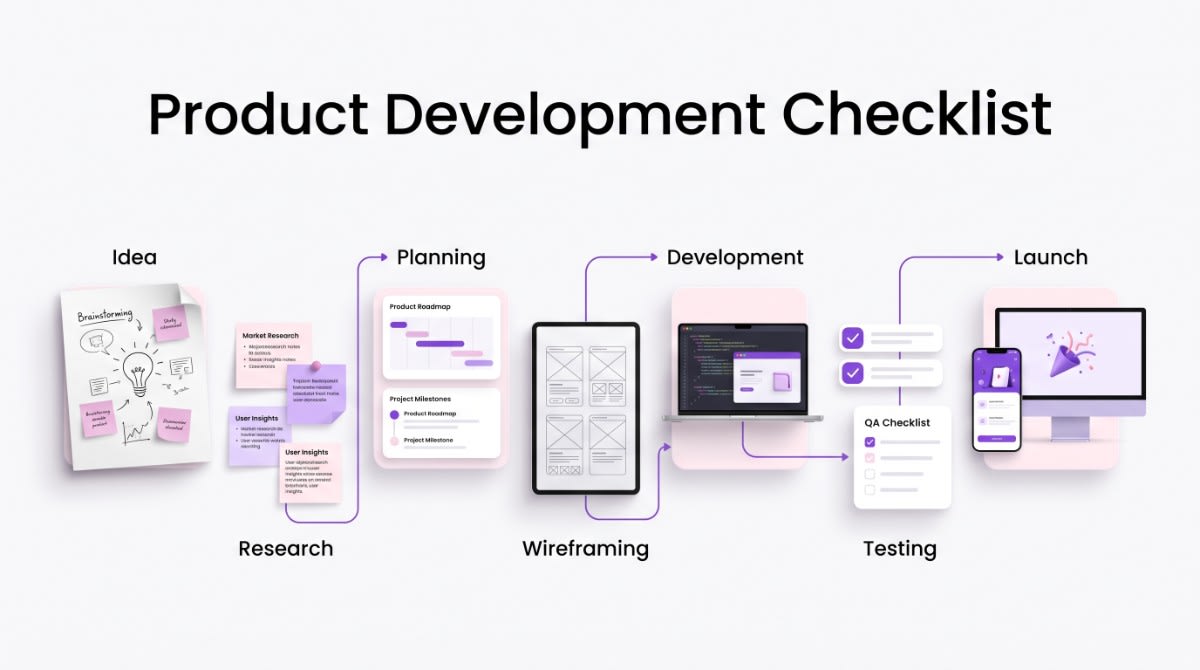 Step 1: Define the problem
Every successful product development process should begin with a clearly defined problem.
Before discussing features, technology, or design, identify what problem your product is expected to solve. The problem should be specific enough to research and validate rather than being based only on assumptions.
Start by asking:
What problem are customers currently facing?
Who experiences this problem?
How are they solving it today?
What makes the existing solutions inadequate?
How frequently does the problem occur?
Is the problem important enough for customers to seek a better solution?
Conduct initial market research and study existing alternatives. Competitor analysis can help you understand how other products address the same problem and where opportunities for differentiation may exist.
A clearly defined problem becomes the foundation for your product vision and subsequent development decisions.
Step 2: Identify your target Customer
Once the problem is clear, determine exactly who you are building the product for.
A broad audience such as "small businesses" or "online shoppers" may not be specific enough during the early stages of product development. Instead, define your ideal customer profile (ICP) and identify the users most likely to experience the problem.
Consider factors such as:
Customer demographics or business characteristics
Industry or use case
Current challenges and pain points
Buying behaviour
Existing solutions they use
Their willingness to pay
The circumstances in which they would use your product
You can also create customer personas to give your product team a clearer understanding of the users they are designing for.
The objective is to establish a clear connection between the problem, the customer, and the proposed solution.
Step 3: Validate the idea
Before investing heavily in development, validate whether your idea has genuine market potential.
Idea validation can involve market research, competitor analysis, customer interviews, surveys, prototypes, landing pages, or early MVP experiments.
At this stage, look for evidence that:
The problem actually exists
Your target customers care about solving it
Existing solutions leave meaningful gaps
Customers understand the value of your proposed solution
There is potential demand for the product
Customers may be willing to pay for the solution
Validation is not about proving that every assumption is correct. It is about identifying the biggest risks early and learning enough to make better product decisions.
This can prevent a startup from spending months developing a product that ultimately has little demand.
Step 4: Define the MVP
Once the idea has been validated, determine what the first version of the product actually needs to include.
This is where a minimum viable product (MVP) becomes important.
An MVP contains the minimum set of features required to solve the core customer problem and allow you to learn from real users. It should not be treated as a low-quality version of the final product. Instead, it should be a focused version that tests the most important product assumptions.
To define your MVP:
Identify the core customer problem
List potential product features
Separate essential features from optional features
Prioritize features based on customer value
Remove features that are not necessary for the initial use case
Define what success will look like after release
Keeping the MVP focused helps reduce development time and allows the team to collect meaningful feedback sooner.
Step 5: Create the product roadmap
With the MVP defined, create a product roadmap that establishes what needs to happen next.
The roadmap should provide a realistic view of the product's development stages rather than simply listing every feature you may eventually want to build.
A product roadmap can include:
MVP development
Major product milestones
Feature priorities
Design and testing stages
Beta release
Launch
Post-launch improvements
It should also account for dependencies, available resources, technical requirements, and expected timelines.
The roadmap may change as you learn more from customers and testing. A good roadmap provides direction without treating the original plan as unchangeable.
Step 6: Plan product development
Before development begins, establish how the product will actually be built.
This stage involves converting the product vision into a practical development plan. Define the technical requirements, development methodology, resources, budget, responsibilities, and expected milestones.
Depending on the product, planning may include:
Technical architecture
Technology and framework selection
Database and API requirements
Cloud infrastructure and hosting
Development team responsibilities
Development methodology
Security requirements
Product documentation
Development budget
Project timeline
For software products, teams may use an Agile development approach with iterative sprints, allowing them to build, test, and refine the product progressively.
Proper planning helps prevent avoidable delays and gives everyone involved a common understanding of what needs to be built.
Step 7: Build the product
Once the plan is established, development can begin.
The development team converts approved designs and technical requirements into a working product. Instead of waiting until the entire product is complete before testing it, development should generally happen in manageable iterations.
During this stage:
Build the prioritized MVP features
Follow the agreed technical architecture
Maintain version control
Document important technical decisions
Conduct code reviews where appropriate
Integrate required APIs and systems
Address security and performance requirements
Test features throughout development
Regular communication between product, design, and development teams is important. If customer requirements or product assumptions change, the team should be able to assess and adjust the roadmap accordingly.
Step 8: Conduct quality assurance
A product should not move directly from development to customers without proper quality assurance (QA).
QA helps identify technical problems, usability issues, performance concerns, and unexpected behaviour before the product reaches a wider audience.
Testing can cover areas such as:
Functional testing
Usability testing
Performance testing
Security testing
Compatibility testing
Integration testing
Regression testing
Bugs should be documented, prioritized, fixed, and tested again before release.
The objective is not simply to confirm that individual features work. QA should help determine whether the product works reliably as a complete experience.
Step 9: Conduct user acceptance testing
After internal testing, involve representative users in User Acceptance Testing (UAT).
UAT helps determine whether the product actually works for its intended users and meets the practical requirements of the use case.
Give selected users specific tasks to complete and observe:
Whether they understand the product
Where they experience confusion
Whether important workflows function as expected
Whether the product solves the original problem
Which features they find useful or unnecessary
What issues need to be addressed before launch
User acceptance testing is particularly valuable because an internally tested product can still feel confusing or ineffective to actual customers.
The findings from UAT should feed into the final product improvements before the beta or public launch.
Step 10: Run a beta launch
A beta launch allows you to introduce the product to a limited group of early users before making it widely available.
This creates an opportunity to test the product in real-world conditions while limiting the potential impact of unresolved issues.
During a beta launch, monitor:
User adoption
Product usage
Activation and engagement
Errors and technical issues
Customer support requests
User feedback
Feature usage
Early retention behaviour
Encourage beta users to provide specific feedback rather than simply asking whether they "like" the product.
The objective is to identify the problems that may not have appeared during internal testing and make the product stronger before the full launch.
Step 11: Prepare for go-to-market
Product development does not happen independently of marketing and sales.
Before launch, align the teams responsible for taking the product to market. Product, marketing, sales, customer support, and operations should understand what is being launched, who it is for, and how it should be positioned.
Your go-to-market preparation may include:
Defining product positioning
Finalizing the value proposition
Establishing pricing and packaging
Creating the website or landing page
Preparing marketing campaigns
Setting up analytics and tracking
Preparing sales materials
Creating customer support resources
Preparing product demos or documentation
Establishing launch communication
Defining acquisition and conversion metrics
A strong product can struggle after launch if customers do not understand what it does, who it is for, or why they should use it.
Step 12: Complete the launch readiness checklist
Before the public launch, conduct a final review to determine whether the product and business are genuinely ready.
The launch readiness checklist should bring together product, business, legal, operational, marketing, and customer support requirements.
Confirm that:
Critical product issues have been resolved
Key user journeys work correctly
Analytics and tracking are operational
Pricing and billing systems are ready
Website and landing pages are live or prepared
Marketing assets are complete
Customer support processes are established
Required documentation is available
Internal teams understand the launch plan
Launch responsibilities are assigned
Post-launch metrics have been defined
This final checkpoint helps prevent a technically complete product from being launched before the rest of the business is ready to support it.
Common product development mistakes
1. Building before validating
One of the biggest product development mistakes is starting development before confirming that the problem and demand are real.
A startup may spend significant time and money building a technically impressive product only to discover that customers do not consider the problem important enough to pay for a solution.
Validation should happen before major development investment.
2. Adding too many features
Another common mistake is trying to include every possible feature in the first version.
Feature overload can increase development costs, delay the launch, make the product harder to use, and make it more difficult to understand which features actually create value.
A focused MVP allows the team to concentrate on the core problem first.
3. Ignoring customer feedback
Customer feedback should not be collected simply because it is part of the checklist. It should influence product decisions.
If multiple users struggle with the same workflow or repeatedly request improvements to a critical part of the product, the team should investigate why.
At the same time, not every feature request needs to be implemented. Feedback should be evaluated against the product strategy, customer needs, and business goals.
4. Treating launch as the finish line
Launching the product is not the end of product development.
Once customers begin using the product, you gain access to real-world data and feedback that can reveal new opportunities and problems.
Successful products continue to evolve after launch through measurement, experimentation, customer feedback, and iterative improvements.
Product launch checklist
1. Product readiness
Before launch, confirm that the product itself is ready.
Core features are complete
Critical bugs have been resolved
Main user journeys have been tested
Performance is acceptable
Security requirements have been reviewed
Analytics and tracking are working
Product documentation is available
Customer support resources are prepared
2. Business readiness
The business should also be prepared to sell and support the product.
Pricing has been finalized
Billing and payment systems are operational
Sales teams understand the product
Marketing campaigns are prepared
Landing pages and website content are ready
Product positioning is clear
Sales and marketing assets are available
Launch metrics and KPIs have been defined
3. Legal and operational readiness
Depending on the nature of the product and business, review the legal and operational requirements before launch.
These may include:
Terms and conditions
Privacy policy
Customer agreements
Data protection requirements
Intellectual property considerations
Vendor and technology agreements
Customer support processes
Internal escalation procedures
Operational workflows
The exact requirements will depend on the product, industry, target market, and business structure.
What happens after launch?
The product development process continues after the product reaches the market.
Start monitoring how customers actually use the product and compare real-world behaviour with the assumptions made during development.
Important areas to monitor include:
User acquisition
Activation
Engagement
Retention
Conversion
Revenue
Customer feedback
Support requests
Product errors
Feature adoption
Use this information to identify what is working and where customers are experiencing friction.
A post-launch retrospective can also help the team evaluate the development and launch process itself. What went well? What caused delays? Which assumptions were incorrect? What should be changed in the next development cycle?
The answers can inform future product iterations and help the startup build a more effective product development process over time.
Startup coach perspective
For a startup, product development should be treated as a process of building, testing, learning, and improving rather than simply completing a development project.
The biggest mistake founders can make is becoming attached to the original product idea before testing it with the market. Your initial idea may be strong, but customer conversations, validation, MVP testing, and early usage can reveal that the product needs to change.
A practical approach is to keep the early product focused, validate assumptions before making large investments, and use customer feedback to guide subsequent development.
The product development checklist should therefore work as a decision-making framework, not just a document to tick boxes on. Each step should answer an important question:
Is this problem worth solving, are we building the right solution, and is the business ready to take it to market?
When these questions are answered systematically, startups can reduce unnecessary development, make better use of limited resources, and improve their chances of achieving product-market fit.
Conclusion
A product development checklist from idea to launch gives startups a structured path for turning an initial concept into a market-ready product.
The process begins with defining a real problem and identifying the right customer. From there, the startup validates the idea, defines its MVP, creates a roadmap, plans development, builds the product, and conducts QA and user acceptance testing. A beta launch then provides an opportunity to learn from real users before completing go-to-market and launch preparations.
But the process does not end when the product goes live. Post-launch data, customer feedback, and ongoing product improvements are essential for building a product that continues to meet changing customer needs.
The goal is not to launch as quickly as possible at any cost. It is to validate intelligently, build strategically, launch confidently, and keep improving after launch.
FAQs
Q: What is a product development checklist?
A product development checklist is a structured list of activities and checkpoints that helps a team move from a product idea through validation, planning, development, testing, launch preparation, and market launch. It helps ensure that important product, technical, business, and operational activities are not overlooked.
Q: What should a startup do before developing a product?
Before development begins, a startup should define the problem, identify its target customer, conduct market and competitor research, validate the idea, and determine the core value proposition. The startup should also define its MVP and create a realistic product roadmap before committing significant development resources.
Q: What is an MVP in product development?
An MVP, or Minimum Viable Product, is an initial version of a product containing the essential features required to solve the core customer problem and generate useful feedback from early users. The purpose is to learn and validate key assumptions without building the complete product upfront.
Q: Why is user acceptance testing important?
User Acceptance Testing helps determine whether a product works effectively for its intended users and whether important workflows meet practical customer requirements. It can uncover usability problems, confusing workflows, and other issues that may not be identified through internal QA alone.
Q: Is product development finished after launch?
No, launch is an important milestone, but product development continues after launch. Teams should monitor customer behaviour, adoption, engagement, retention, feedback, support requests, and other relevant metrics. These insights can then guide product improvements and future development cycles.