Product Development and Technology: Every Term Every Founder Must Know
By Rohini Rajpoot · 17 June 2026
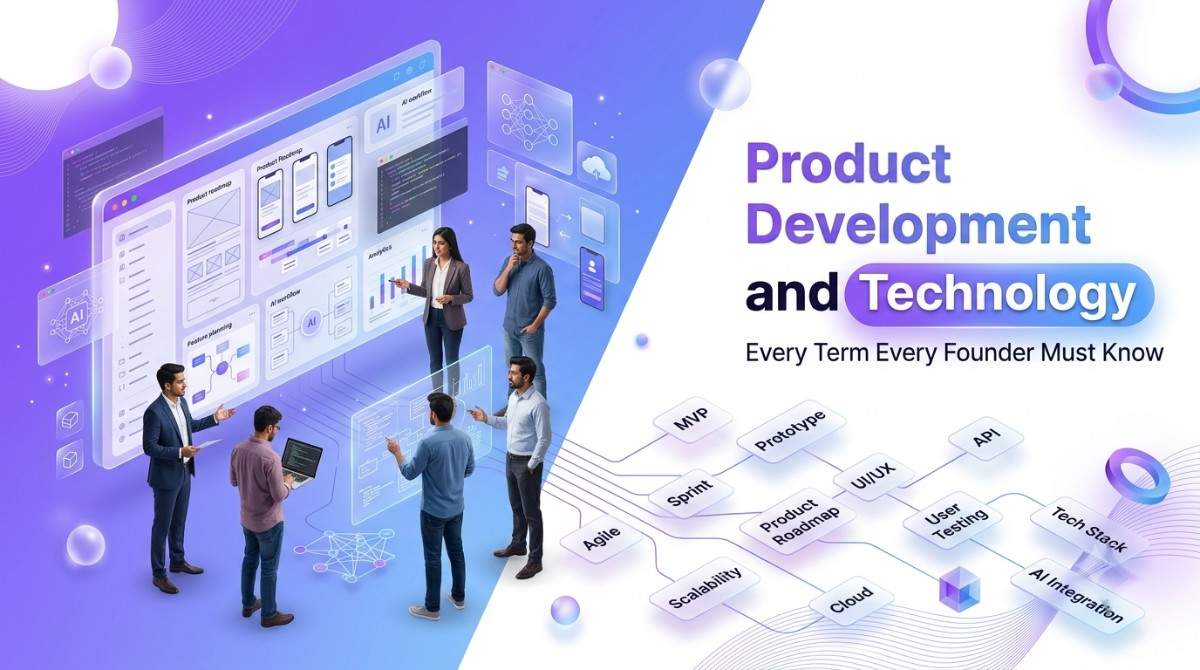
Learn essential product development terms, from MVP and Agile to SaaS and product-market fit, every founder should understand.
If you have ever sat in a product meeting and listening to your team of engineers use words such as scrum, stack, and dogfooding you know how fast the tech side of building a company can feel overwhelming. None of these terms are complicated once someone walks you through them.
Below, you'll find a list of all the terminology associated with building out a company and creating a great product, from both a product development point of view and technology consulting services, and even when addressing potential investors.
Where Products Begin: Research, Strategy, and Early Concepts
 Every product starts with an idea, but ideas only become products through deliberate effort. R&D, or Research and Development, is the organised process of investigating new technologies, testing hypotheses, and translating findings into something buildable. It is where product strategy and innovation live before any code gets written.
Before a full product exists, teams build a proof-of-concept, a bare-bones technical demonstration that answers one question: can this actually be built? It does not need to look polished. It just needs to confirm the core idea is feasible.
A prototype comes next. It is a more developed, testable version of the product, real enough to put in front of users and learn from their reactions. Many companies do this in stealth mode, avoiding press and public announcements while building, so they do not tip off competitors or raise expectations prematurely.
Building the First Real Version: MVP, LEAN, and Customer Development
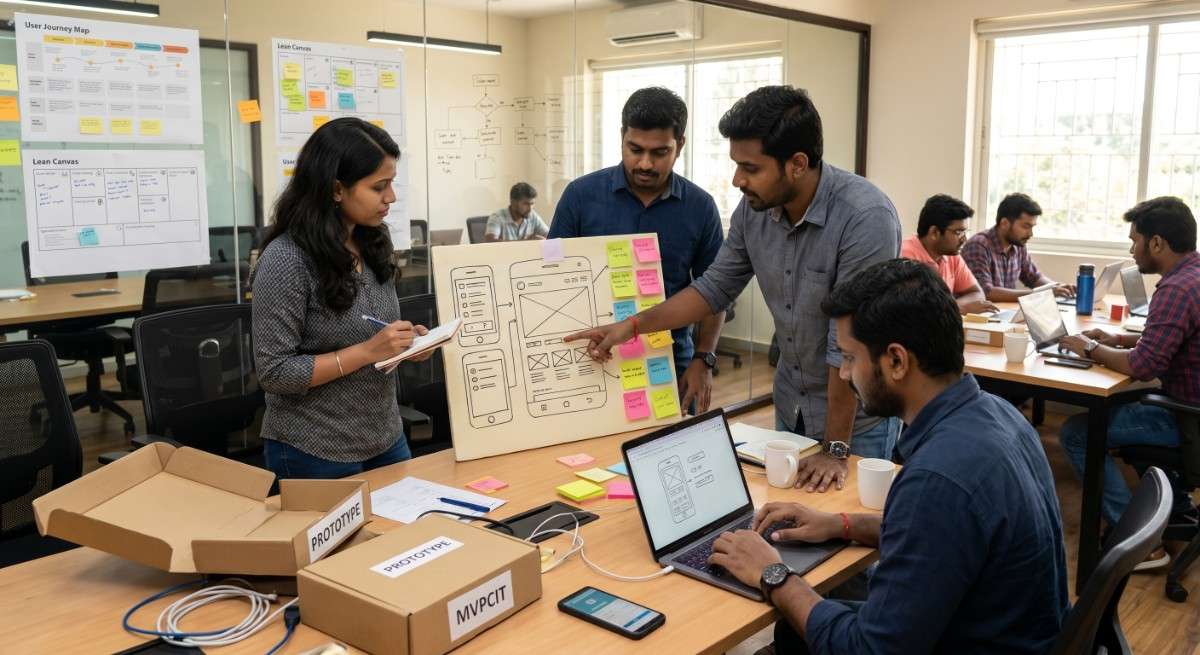 The MVP, or Minimum Viable Product, has fundamentally changed how the industry approaches software product development. An MVP is the simplest version of a product that delivers enough value for real users to engage and give meaningful feedback. It is not the finished product. It is the fastest path to learning whether your core assumption is right.
The MVP sits at the heart of the LEAN methodology, a philosophy that means building only what is necessary, measuring the response, and learning quickly. The cycle of build, measure, and learn replaces long planning phases with continuous, evidence-based progress.
The customer development model, developed by Steve Blank, takes this further. Rather than building first and hoping customers show up, it pushes founders to talk to potential customers before and during the build. The goal is to validate who actually has the problem and whether they would pay to solve it. This discipline is foundational to serious digital product development.
How Teams Work: Agile, Scrum, and Iteration
Most modern teams do not follow a rigid step-by-step plan. Instead, they use Agile, a set of principles for building software in short, adaptive cycles. Agile teams prioritise working software over heavy documentation and respond to change rather than sticking to a fixed plan regardless of what users are saying.
Scrum is the most widely used framework within Agile. Work is broken into fixed cycles called sprints, typically two to four weeks. Each sprint ends with a reviewable product increment. Daily standups and retrospectives keep the team aligned and honest.
What both enable is iteration, the habit of improving the product through repeated small cycles rather than trying to get everything right before releasing. Each round builds on what was learned in the last one. That compounding of small improvements is how genuinely great products get built.
Testing Before You Ship: Alpha, Beta, and Dogfooding
The product is subjected to structured tests before it reaches the public. This process begins at the alpha stage, which is carried out internally and not entirely, identifying the most significant bugs that are yet to be identified.
This is followed by the beta stage, where the software is opened up for a limited external group who tries out the early form of the product and identifies everything that causes them trouble.
The dogfooding process involves using your own product before it is released. If you depend on your product every day, then you are going to identify the pain points sooner than a test plan could make you do it.
Launching, Pivoting, and Finding Product-Market Fit
The launch is when the product goes live to its intended audience. It marks the shift from building mode to learning mode, the point where real feedback replaces assumptions.
That feedback often leads to a pivot, a deliberate shift in strategy. A pivot might mean changing the target customer, the core feature, or the pricing model. Instagram started as a location-sharing app. Slack was built as an internal tool for a gaming company. A pivot is not failure. It is a decision grounded in evidence.
What every founder is ultimately chasing is product-market fit, the point where a product meets a genuine, strong demand in a specific market. When it exists, customers stay, word spreads organically, and growth feels natural. Before it, no amount of acquisition spending covers the cracks for long.
The Tech Behind the Product: Stack, SaaS, PaaS, and AWS
When a team starts building, one of the first decisions is the stack, the combination of languages, frameworks, databases, and tools used to run the product. A "full stack" covers both the front end, what users see, and the back end, which handles data and logic behind the scenes.
Most modern products are delivered as SaaS, or Software as a Service, meaning cloud-hosted software accessed through a subscription. Salesforce, Notion, and Slack are all SaaS products. The model appeals to investors because of its predictable recurring revenue and low distribution cost.
Underneath many SaaS products sits PaaS, or Platform as a Service, which gives developers a cloud environment to build and run applications without managing physical servers. Amazon Web Services, or AWS, is the dominant infrastructure platform powering a large portion of the internet. It provides computing, storage, databases, and much more. For most early-stage teams, AWS gives everything needed to scale a product from MVP to millions of users without owning a single server.
UI, UX, and the Experience Layer
UI or User Interface refers to the interface of the product: buttons, layout, typography, colour scheme, and icons among others. It is the part that a user comes into contact with. Great user interfaces should not need any further explanation.
On the other hand, UX or User Experience takes the discussion further. It refers to the overall experience of using the product, from how easy you find it to achieve your goal to areas of confusion and whether you got what you expected in the end.
Growth, Business Models, and the Bigger Picture
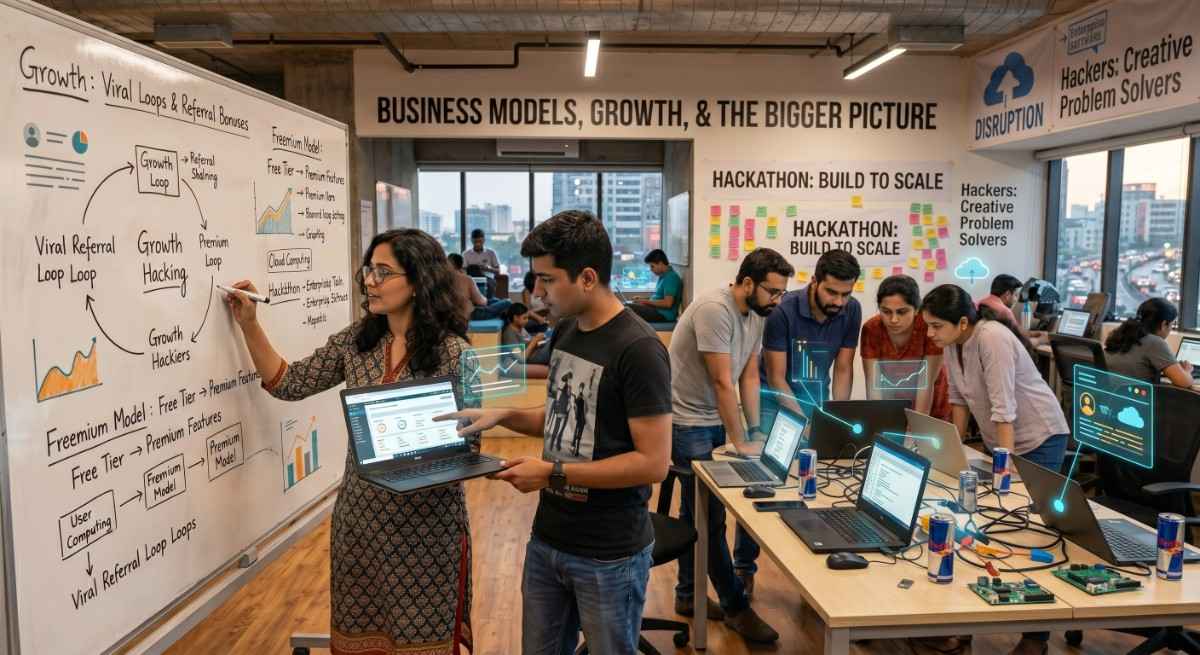 Growth hacking uses creative, low-cost experiments to grow a user base quickly, focusing on referral loops, product mechanics, and virality rather than traditional advertising.
Freemium offers a genuinely useful free version while charging for advanced features. Spotify, Dropbox, and LinkedIn all use this model. It lowers the barrier to adoption and converts a share of free users into paying customers over time.
To gamify a product means adding mechanics like streaks, badges, and leaderboards to drive engagement. Duolingo uses streaks. LinkedIn uses profile completion scores. When done well, it makes the right user behaviour feel naturally rewarding.
Disruption happens when a new model displaces an established one by serving underserved customers more affordably or conveniently. A disruptive technology is the specific innovation behind that shift. Cloud computing disrupted enterprise software. Streaming disrupted physical media.
Commercialisation is the step that turns a working product into an actual business, covering pricing, distribution, and go-to-market strategy.
Hackathons are time-limited events where developers and founders work intensively to build prototypes, usually within 24 to 48 hours. Many real products and features trace their origins to one.
In the startup world, hackers are skilled builders who solve problems creatively and efficiently. The term has nothing to do with malicious intent. A hacker finds clever solutions quickly and treats engineering as a craft.
Conclusion
These terms form the working vocabulary of every serious product team. In the stages from initial R&D to Proof of Concept, development of MVPs, Agile iterations, testing, and the final launch of the product, certain terms must be mastered. Learning these terms will enable you to have an advantage while working with your team, using the consulting services of technology firms, and making your decisions based on knowledge.
The most successful entrepreneurs are not necessarily tech-savvy. Yet, they have learned to communicate effectively with others by knowing the above languages. If you are planning on building your next product, understanding these concepts is the first step towards making better technology and business decisions.
For founders looking to turn ideas into scalable businesses, having the right guidance can make the journey much smoother. Platforms like Startup Coaching help startups navigate product development, business strategy, fundraising, and growth challenges, making it easier to transform innovative concepts into successful ventures.
Frequently Asked Questions
1. What is the difference between a Proof-of-Concept (PoC), prototype, and Minimum Viable Product (MVP)?
Proof-of-Concept shows that it technically works. Prototype proves that it works from a UX perspective. An MVP is a release of your product to real users to receive valuable feedback.
2. What is the difference between Agile and Scrum?
Agile refers to any approach for developing software in an adaptive manner with iterations. Scrum is an implementation of the Agile approach which includes working with sprints and having clear roles and reviews.
3. How can you tell when your product finds its Product-Market Fit?
High retention rate, customers talk about you without your active involvement, and they are sorry when your product disappears. Before Product-Market Fit, even though you spend money, it is hard to get your customers back.
4. What is the difference between SaaS and PaaS?
In SaaS, you provide some kind of software to end-users through the internet. In PaaS, you provide infrastructure to developers who develop their own software. Most startups prefer SaaS to use and PaaS to develop a product on.
5. Why do companies use the freemium model?
It removes the barrier to trying the product, builds a large user base quickly, and converts a percentage of active free users into paying customers over time rather than charging everyone upfront.