How to Start an AI Automation Agency: A Practical Guide
By Rohini Rajpoot · 30 October 2026
Learn how to start an AI automation agency, choose services and tools, find clients, set pricing, and build a scalable business.
Think about how much of a normal workday goes on small, repeated jobs. Answering the same customer questions. Copying details from an email into a CRM. Chasing leads who never replied. Building the Monday report by hand. None of this is hard, but it eats hours, and most small businesses don’t have the time or the technical skills to fix it.
That gap is the reason an AI automation agency can work as a business. These agencies help companies use AI tools to take repetitive work off their teams, so staff can spend time on things that actually need a person. If you’re thinking about how to start an AI agency, this blogs walks you through it in plain steps. We cover choosing a niche, deciding what services to sell, learning the tools, setting prices, keeping costs low and finding your first clients. We also point out the mistakes that trip up new agencies, so you can skip a few of them.
What Is an AI Automation Agency?
An AI automation agency is a service business that designs, builds and maintains automated workflows for other companies. It mixes AI tools with workflow automation and business process automation to cut manual work.
Some real examples: a system that scores incoming leads and sends the good ones straight to a salesperson, a support assistant that answers common questions and passes tricky ones to a human, a tool that books appointments and sends reminders, or a workflow that pulls numbers from several apps and writes a weekly report.
There’s an important difference between selling AI tools and selling automation. Plenty of people can sign up for a chatbot product. Fewer can look at how a clinic or a shop actually runs, work out where time is being lost, and set up something that fits. Clients pay for the second skill. They want a problem solved, not a software subscription.
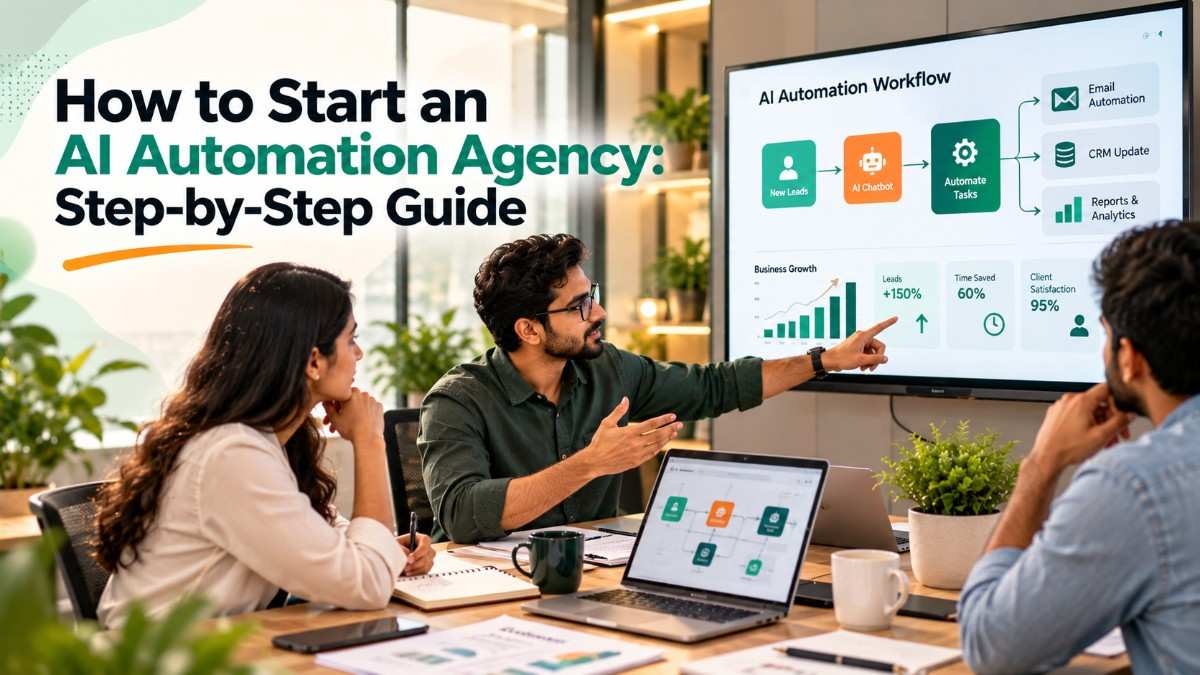
How to Start an AI Automation Agency: Step-by-Step Guide
Step 1: Choose a Niche
Start by looking for industries where people do the same tasks again and again. Healthcare clinics, real estate teams, e-commerce stores, schools and coaching businesses, and professional services like accounting or legal firms all fit that description.
Then check the practical side. Do these businesses have a budget? Do they feel the pain strongly enough to pay? Are there rules about data, such as patient or financial records, that you need to respect? Picking one niche also makes everything else easier. Your website, your outreach and your demos can all speak to one type of customer, and word spreads faster inside a small industry.
Step 2: Identify Problems You Can Solve
Don’t guess what people need. Talk to them. Ask owners and managers to walk you through a normal week and show you where things get stuck. Write down the manual tasks, the delays and the handoffs that go wrong.
Then pick the problems where automation will make a measurable difference, like hours saved or faster replies to leads. Be careful about the opposite approach, where you find a clever tool and go looking for a place to use it. That usually ends with a polished solution nobody asked for.
Step 3: Select Your AI Automation Services
Once you know the problems, shape them into a short list of services. Good starting points include:
Lead capture and qualification
Customer support chatbots and AI-assisted replies
CRM updates and sales workflow automation
Appointment scheduling and follow-up messages
Document processing, data entry and report generation
Internal knowledge assistants and workflow integrations
You don’t need all of them. Two or three that you can deliver well beat ten that you’re still figuring out.
Step 4: Learn the Required Tools
You need a working knowledge of a few things: AI assistants and large language model tools, no-code automation platforms and workflow builders, and the basics of how APIs, webhooks and CRM integrations connect different systems together.
The best way to learn is to build small projects for yourself or for a friendly business before touching paid client work. Pay attention to data privacy from day one. Know what information a tool stores, who can access it, and where a human should check the output before it goes to a customer, especially in sensitive areas.
Step 5: Build and Test Your First Solutions
Create two or three demonstrations around real business problems. A lead qualifier for a real estate team or an appointment bot for a dental clinic are good examples.
Test them properly. What happens when a customer writes something unexpected? What if a connected app is down? A workflow that works once in a demo isn’t the same as one that works every day. Write down how each one works and what result it should produce. When you show these in your portfolio, label them clearly as sample projects, so nobody thinks they were paid client work.
Step 6: Set Up Your Business
Choose a name, decide how you want to be positioned, and set up a simple website with your portfolio and contact details. Get your paperwork ready as well: a proposal template, a contract, an onboarding form and a service agreement. Also decide in advance how you’ll handle client data, ongoing maintenance and support requests, because these questions come up on the very first project.
What Services Can an AI Automation Agency Offer?
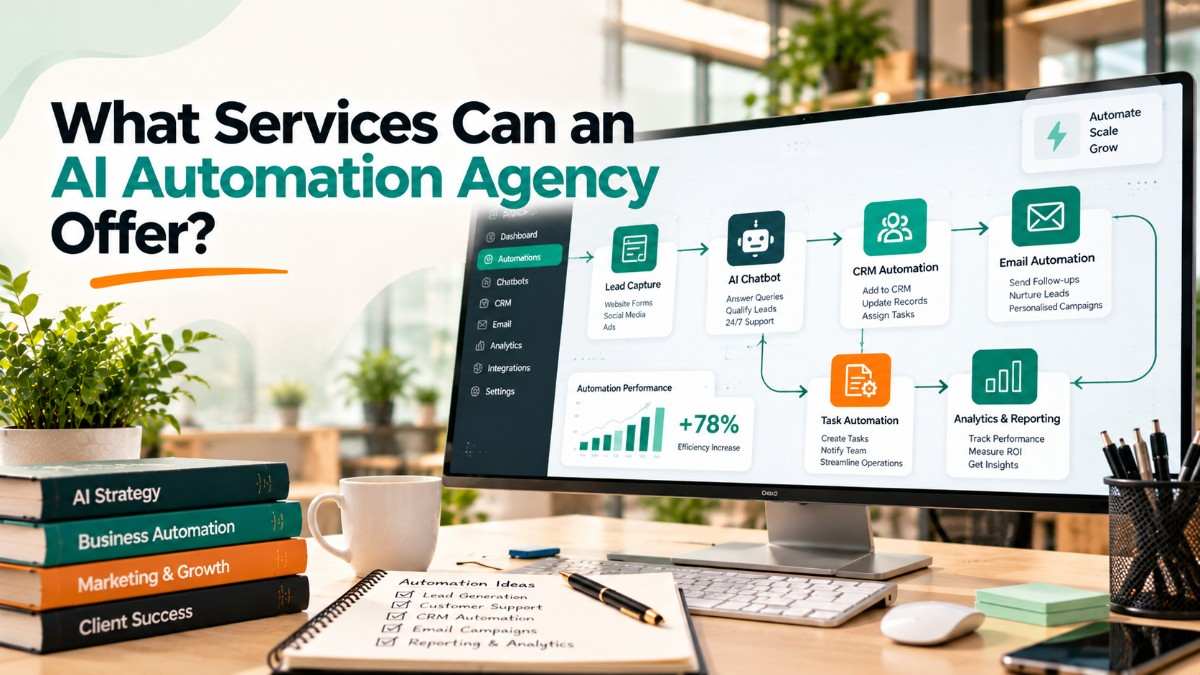
Here are the main areas agencies work in:
Workflow automation: Connecting business apps so repetitive tasks run on their own.
AI customer support: Helping businesses answer common questions faster.
Sales automation: Streamlining lead capture, qualification and follow-ups.
Marketing automation: Supporting content workflows and campaign operations.
Data and document automation: Pulling out, organising and processing information.
AI consulting services: Finding automation opportunities and recommending the right solution.
A useful habit is to sell outcomes, not tools. “We cut your lead response time from a day to a few minutes” is easier for a business owner to say yes to than “we build n8n workflows.” Nobody is buying the software name. They are buying the result.
AI Automation Agency Business Model: How Do You Make Money?
There are a few common ways to charge, and many agencies mix them.
Project-based pricing means a fee to build and set up an automation. Monthly retainers cover monitoring, fixes and improvements after launch. Consulting fees apply to workflow audits and automation roadmaps. Packaged services are standard offers for one industry or use case, which are quicker to sell and deliver. Custom solutions cover more complex integrations, priced on scope.
Your price should reflect how complex the work is, how much value it creates for the client, how much support it needs afterwards and what it costs you to run. Be wary of anyone who promises guaranteed income from an agency. Results depend on your skills, your niche and how well you find and keep clients.
How Much Does It Cost to Start an AI Automation Agency?
The good news is that you can start lean. The main costs are software subscriptions, a website, training, marketing and basic business admin like registration and accounting.
Many tools offer free trials or entry-level plans, so you can build a small portfolio before spending much. Just remember the costs that appear later. AI usage fees, paid integrations, contractors and the time you spend supporting clients all add up as you grow.
We haven’t put exact figures here because tool pricing changes often and varies by plan, so check current pricing on each provider’s website before budgeting. The safest approach is to validate demand first. Land a few paying clients, then invest in better tools or help.
Which Tools Are Needed for an AI Automation Agency?
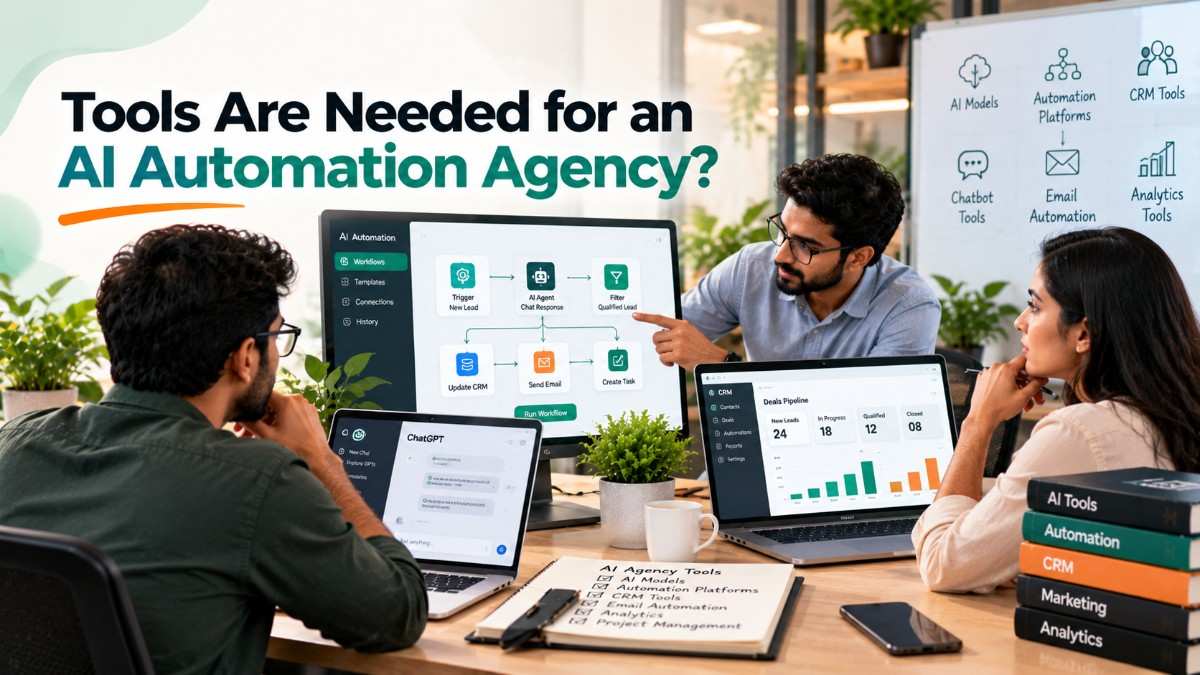
Your stack will usually include:
AI models and assistants for writing, analysis and task support
No-code automation tools to connect applications
CRM and communication platforms for sales and customer workflows
Databases, spreadsheets and project management tools
Testing, monitoring and analytics tools
The right combination depends on what the client already uses, how sensitive their data is, how complicated the workflow is and what they can afford. A good agency adapts to the client’s setup instead of pushing one favourite tool onto everyone.
How to Get Clients for an AI Automation Agency
Finding clients is where many new agencies struggle, so keep it simple and specific.
Pick a clear audience and promise one outcome, such as “fewer missed leads for real estate teams.” Build a portfolio with practical demos and short case studies. Reach out personally to businesses with a visible workflow problem, and say exactly what you noticed rather than sending a generic pitch.
Share useful content too, like short tutorials and examples on LinkedIn, to show that you know the work. Partner with web agencies, consultants and software providers who meet your target clients but don’t do automation themselves.
Offer a discovery call or a workflow audit so you can understand the client’s needs before proposing anything. After the first projects, measure the results and ask for a testimonial, with the client’s permission.
Common Mistakes to Avoid
Offering too many services before you have real expertise in any of them.
Choosing tools before you understand the business problem.
Overpromising what AI can do.
Ignoring privacy, security and human review.
Underpricing the build and the ongoing maintenance.
Skipping real-world testing of your workflows.
Conclusion
The agencies that last aren’t the ones using the most AI tools. They’re the ones that pick a niche, understand a client’s daily headaches and fix them in a way that can be measured.
Start small with a reliable service, test it well, protect client data and keep learning as the tools change. Grow your offer based on what clients ask for. In the end, the value you create for the business is what keeps them paying.
Building a service business takes more than technical skill. You need a clear business model, an offer people want and a plan for growth. Planning to turn your AI expertise into a business? Build a clear business model, validate your offer, and create a growth plan before scaling. Explore Startup Coach for support with your startup journey.
Frequently Asked Questions
How do I start an AI automation agency?
Choose a niche, find problems worth solving, learn the key tools, build a few demos, package your services and start reaching out to clients.
What services can an AI automation agency offer?
Workflow, sales, customer support, marketing and document automation are the most common, along with consulting to help clients find opportunities.
How much does it cost to start an AI automation agency?
It varies with your tools, technical needs, marketing and business setup. You can begin with free trials and entry-level plans, then spend more as you win clients.
Which tools are needed for an AI automation agency?
AI platforms, no-code automation tools, APIs, CRM systems and testing tools make up a typical stack. The exact mix depends on each client.
How can I get clients for an AI automation agency?
Focus on one niche, reach out directly, show your portfolio, build partnerships and ask happy clients for referrals.