Startup Funding Checklist: Step-by-Step Guide to Becoming Investor-Ready
By Toishaa Soni · 27 April 2026
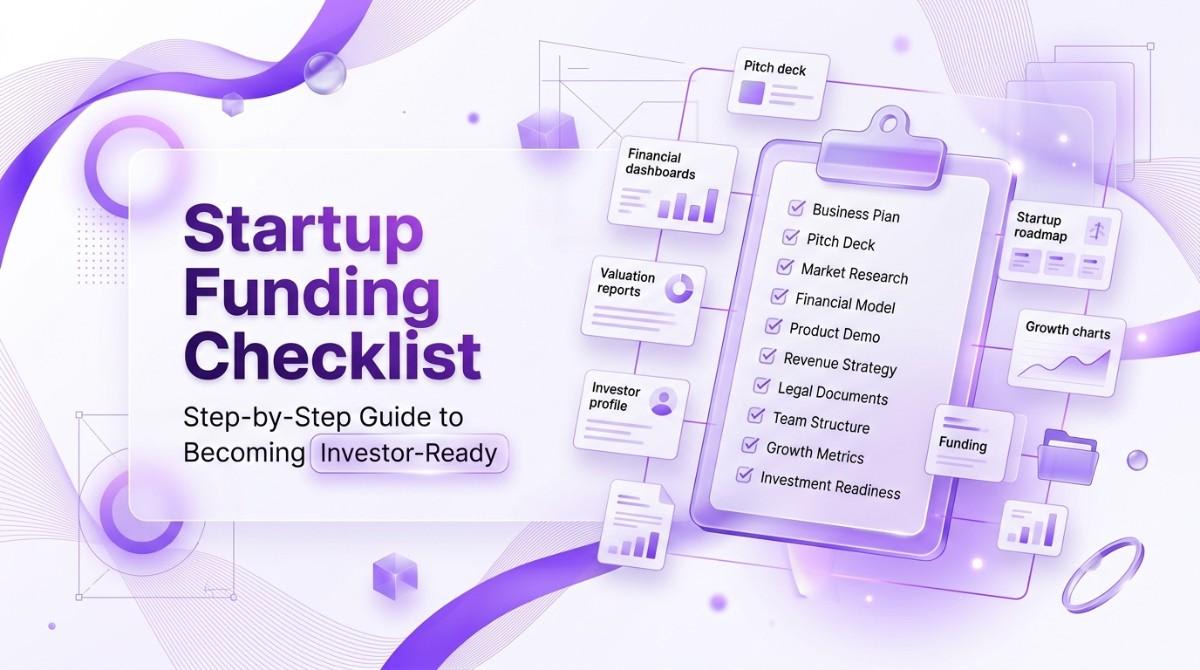
Startup funding checklist, India, to get investor-ready faster. Learn steps, documents, and funding prep tips. Download checklist now.
Most founders don’t struggle with ideas. They struggle with preparation.
Raising capital is not just about pitching. It is about being investor-ready before the conversation even begins. This is where a structured startup funding checklist in India becomes critical. It helps you move from assumptions to clarity, from scattered efforts to a disciplined process.
In our experience working with early- and growth-stage founders, the difference between startups that raise successfully and those that don’t is rarely the idea. It is readiness.
Why Do You Need a Startup Funding Checklist?
Before diving into the checklist, it is important to understand why preparation matters.
Investors do not fund ideas alone. They fund clarity, execution capability, and risk management. A structured pre-funding checklist for startups helps you avoid last-minute scrambling and ensures that every conversation with investors moves forward, not sideways.
Startups that prepare well raise faster, negotiate better, and build stronger long-term relationships with investors.
India Startup Funding Checklist
1. Business & Strategy Readiness
 Before you even think about approaching investors, pause and ask yourself one question: Is my direction crystal clear?
Your startup must have a well-defined problem statement, a strong value proposition, and a clear understanding of your target market. Investors are not just looking for ideas; they are looking for businesses that solve real problems and can scale.
You should also be clear on your go-to-market strategy and growth plan. Because without strategic clarity, even a great idea can struggle to attract funding. This stage is what builds your first layer of investor confidence.
2. Product & Traction Readiness
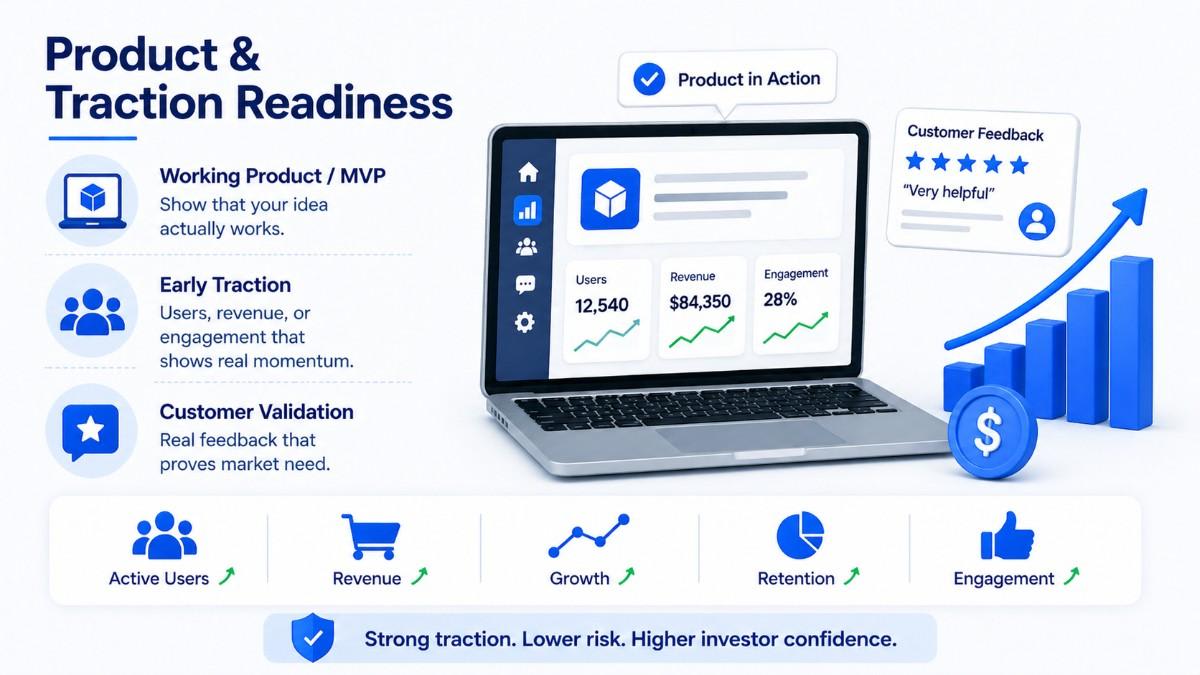 Now comes the reality check. Do you have proof that your idea actually works?
Investors rarely fund just concepts. They want to see a working product or MVP, along with early traction like users, revenue, or engagement. Real customer feedback and validation make your case stronger and more credible.
Traction reduces perceived risk and signals that there is genuine demand in the market. And the stronger your traction, the stronger your position when it comes to negotiation.
3. Financial Readiness
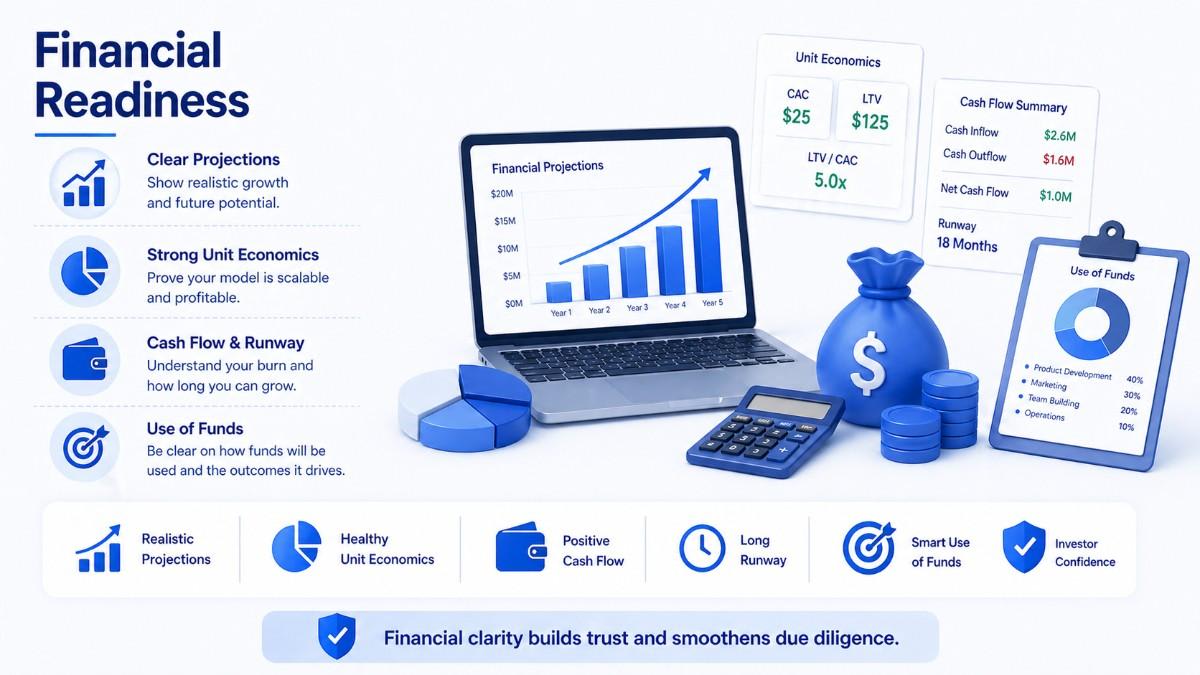 At this stage, investors will start looking beyond your story and into your numbers. Do your financials make sense?
You need clear projections, solid unit economics, and a strong understanding of your cash flow and runway. Investors want to know exactly how their money will be used and what outcomes it will drive.
A well-defined use of funds combined with realistic planning builds trust. Without financial clarity, even strong startups often struggle during due diligence.
4. Legal & Compliance Readiness
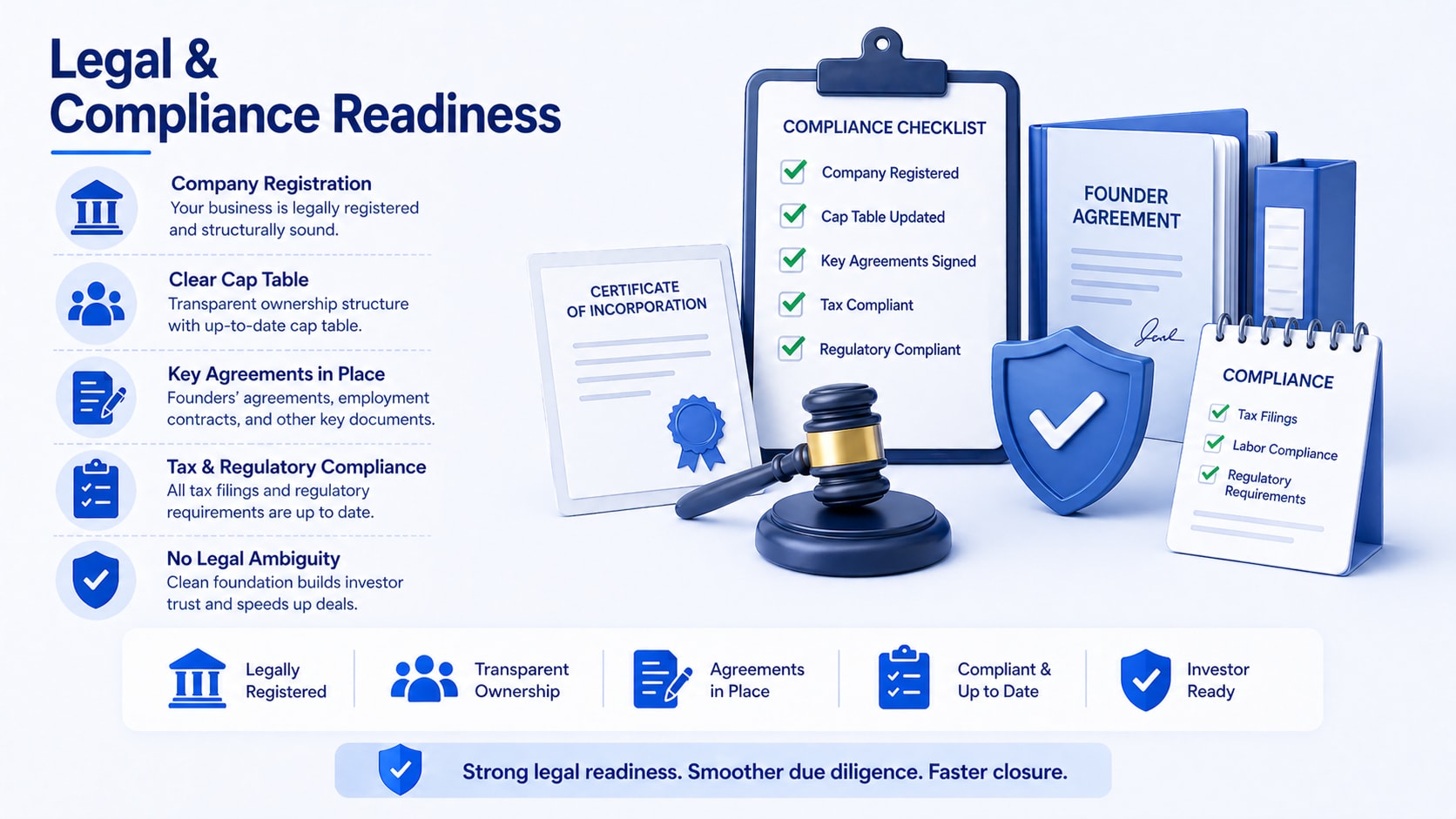 This is where many startups unknowingly lose momentum. Is your foundation clean and structured?
You must have proper company registration, a clear cap table, and all key agreements in place, including founders’ agreements and employment contracts. Compliance with tax and regulatory requirements should also be up to date.
Investors avoid uncertainty. Any legal ambiguity or compliance gap can slow down or even block a deal. Strong legal readiness ensures smoother due diligence and faster closure.
5. Investor & Pitch Readiness
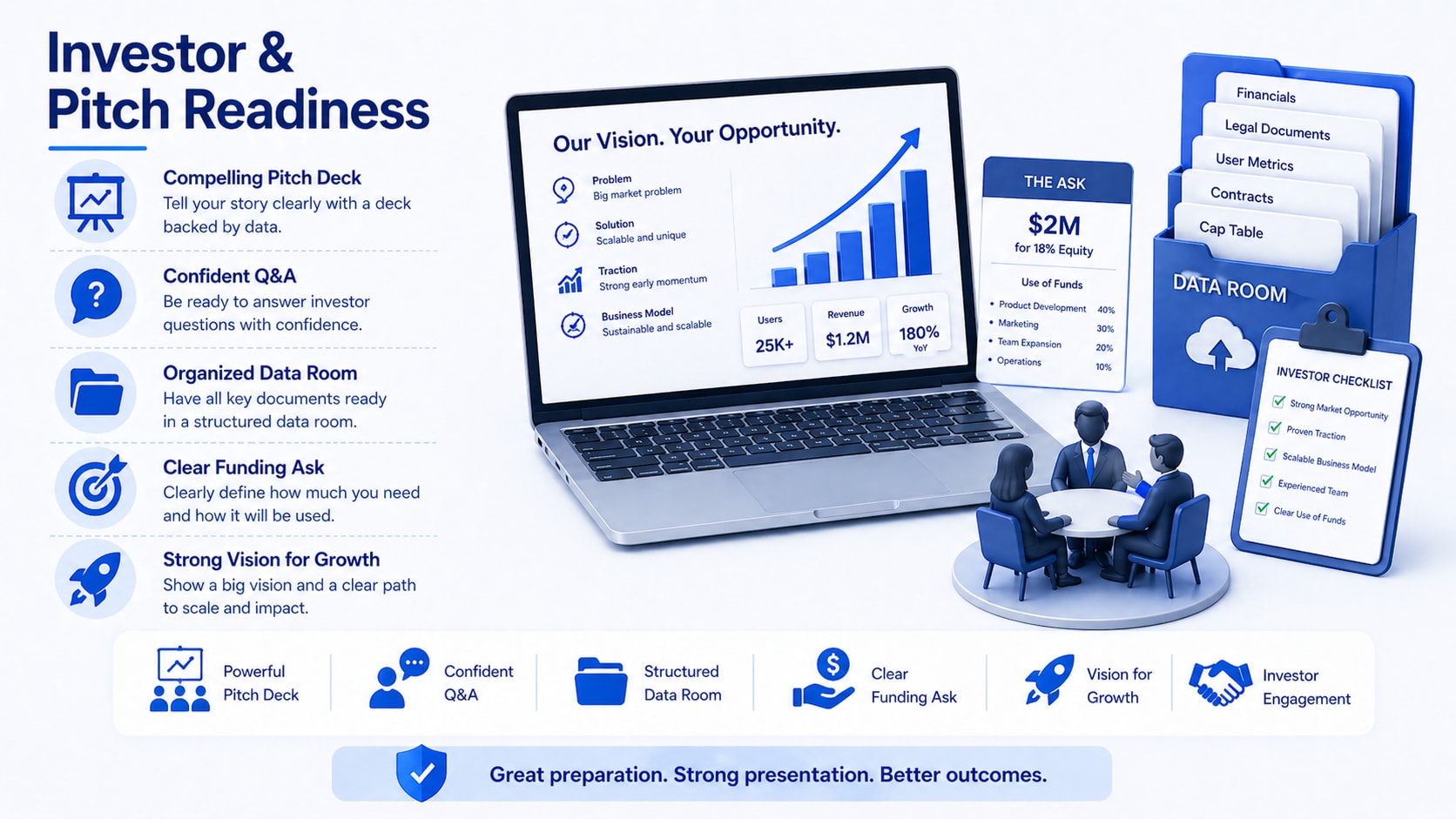 Finally, it all comes down to how well you present your startup. Can you clearly communicate your story and numbers?
You need a compelling pitch deck that tells your story with clarity, backed by data. You should be confident in answering investor questions and ready with supporting documents in a structured data room.
A clear funding ask and a strong vision for growth are essential. This is the stage where preparation meets execution, and it directly determines whether you move forward or get overlooked.
Download Your Complete Funding Checklist (PDF)
At this point, instead of trying to remember everything, it is better to work with a structured system.
- Access the full Startup Funding Checklist PDF here:
This checklist is designed as a working tool so you can track your progress across each stage and ensure nothing is missed before approaching investors.
How to Prepare for Startup Funding the Right Way
Preparing for startup funding is not just about ticking boxes. It is about asking the right questions at the right time.
Start by validating your business fundamentals. Ask yourself: Is my problem real? Is my solution working? Then move to financial clarity. Do I truly understand my numbers, runway, and use of funds? Finally, align your pitch with investor expectations. Can I clearly communicate my story with confidence and data?
Founders who treat funding as a process, not a one-time event, consistently perform better. The right preparation reduces uncertainty, builds confidence, and gives you stronger negotiation power.
Common Mistakes Founders Make Before Fundraising
Even with a checklist in place, founders often make avoidable mistakes. Take a moment and reflect: Are you making any of these?
Approaching investors too early without proper validation
Presenting unclear financials or unrealistic projections
Sharing weak or incomplete documentation
Delivering a confusing or inconsistent pitch story
Lacking clarity on how the funds will actually be used
Avoiding these mistakes is just as important as completing the checklist. Sometimes, what you don’t do matters more than what you do.
Startup Coach Perspective
From Startup Coaching standpoint, fundraising is not about convincing investors. It is about removing their doubts. Startups that follow a structured startup funding requirements India approach consistently perform better because they are prepared before they pitch. They do not rely on last-minute fixes or reactive decisions.
The goal is simple. When an investor evaluates your startup, everything should feel clear, consistent, and reliable.
Conclusion
A strong startup funding checklist in India is not just a preparation tool. It is a competitive advantage.
When your business clarity, financial discipline, legal structure, and narrative are aligned, funding becomes a natural outcome rather than a struggle. If you are serious about raising capital, start by preparing properly. The right preparation does not just help you raise funds. It helps you raise them on the right terms.
For founders who want to strengthen their preparation and approach investors with confidence, connect with our experts for guidance.
FAQs
Q: What is a startup funding checklist?
A startup funding checklist is a structured framework that helps founders prepare their business before approaching investors. It covers strategy, financials, legal readiness, and pitch preparation. This ensures your startup is credible and investor-ready.
Q: Why is investor readiness important?
Investor readiness reduces uncertainty and builds trust during fundraising. It helps investors evaluate your business faster and more confidently. This often leads to quicker funding decisions and better deal terms.
Q: When should a startup start preparing for funding?
Preparation should begin once you have validated your product and achieved early traction. This ensures you are raising funds based on real data, not assumptions. Starting early also gives you time to fix gaps.
Q: What documents are required before fundraising?
You need a pitch deck, financial projections, cap table, legal agreements, and compliance records. These are typically shared during due diligence through a data room. Proper documentation speeds up the process.
Q: Can early-stage startups raise funding without full preparation?
Yes, but it significantly lowers your chances of success. Investors may hesitate due to lack of clarity or incomplete information. Proper preparation improves confidence and increases funding success rates.