How Indian Startups Can Get Funding Through SAMRIDH, GENESIS, and Other Government Programs
By Toishaa Soni · 15 March 2026
A simple guide to startup funding through SAMRIDH, GENESIS, and Startup India schemes that help founders raise capital without heavy dilution.
India's startup ecosystem has emerged as one of the fastest-growing in the world, ranking third globally in terms of unicorn count. But for early-stage founders, the biggest challenge remains the same: securing funding without giving away too much equity or drowning in debt. The good news? The Indian government has rolled out several powerful schemes specifically designed to bridge this gap.
In this guide, we break down how Indian startups can access government funding through programs like SAMRIDH, GENESIS, Startup India Seed Fund, and more; what they offer; who qualifies; and how to apply.
Why Government Funding Matters for Indian Startups
Private investors tend to focus on later-stage, revenue-generating companies. For idea-stage or early-stage startups, especially those in Tier-2 and Tier-3 cities, government schemes provide crucial non-dilutive capital, meaning you keep your equity while still getting the money you need to grow.
Government startup funding programs in India serve three main goals:
Provide seed and early-stage capital to de-risk innovation
Promote deep-tech, social impact, and sustainability-focused startups
Bridge the gap between urban and rural startup ecosystems
1. SAMRIDH Scheme: Startup Accelerators of MeitY for Product Innovation, Development and Growth
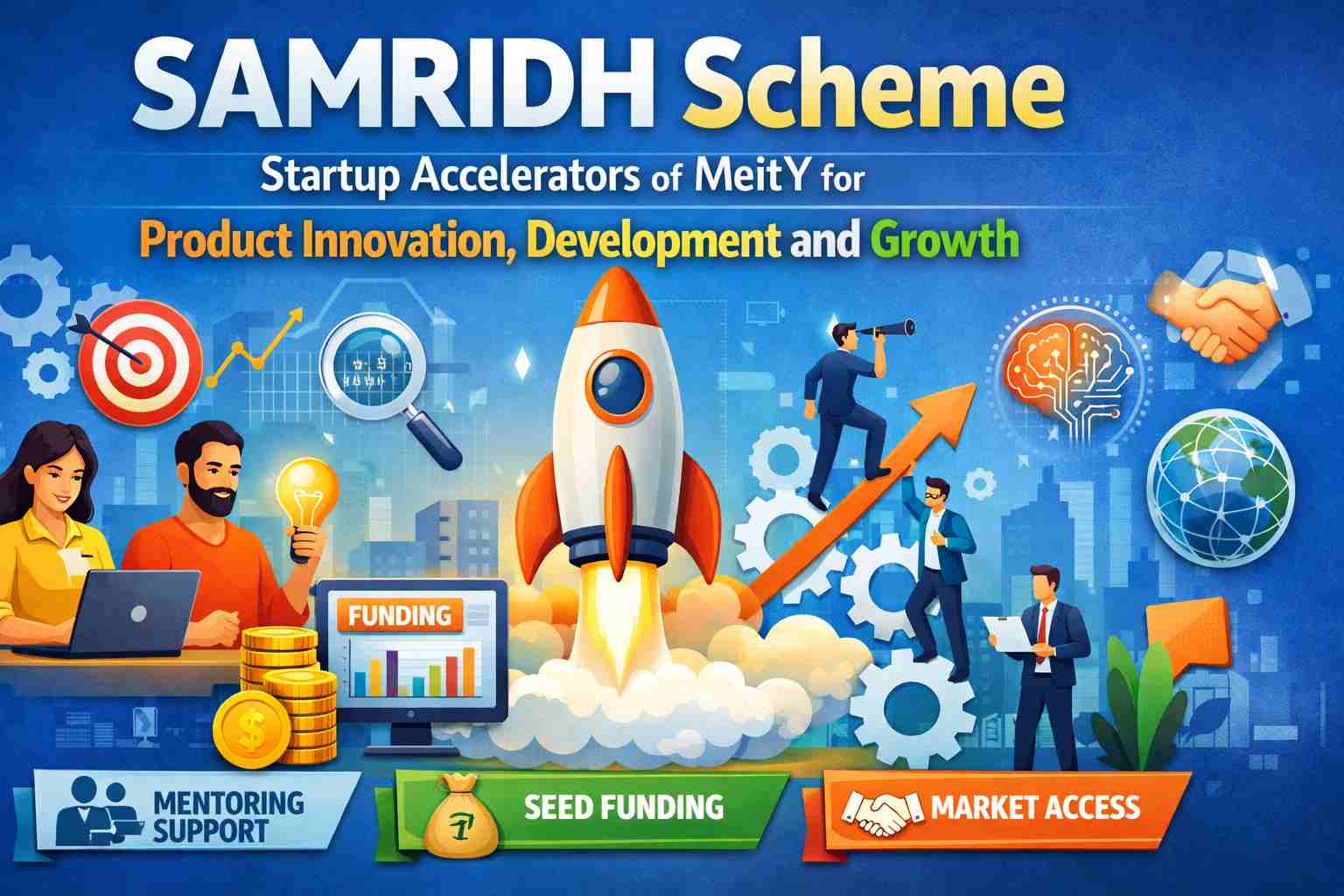 What Is SAMRIDH?
Launched by the Ministry of Electronics and Information Technology (MeitY), SAMRIDH is a flagship accelerator program that supports software product startups. It connects startups with established accelerators and provides both financial and non-financial support to help them scale.
Key Benefits:
Funding support of up to ₹40 lakh per startup
Access to a network of 40+ empanelled accelerators across India
Mentoring, market access, and investor connect programs
Customer discovery workshops and go-to-market strategy support
Who Can Apply?
SAMRIDH targets early-stage startups working on software products. Startups must be registered in India and should ideally have a working prototype or MVP. Priority is given to startups in sectors like fintech, healthtech, edtech, agritech, and govtech.
How to Apply?
Applications are routed through MeitY's empanelled accelerators. Startups can visit the official SAMRIDH portal (samridh.meity.gov.in) to find the list of accelerators, check open cohort dates, and apply directly through the accelerator of their choice.
2. GENESIS: Gen-Next Support for Innovative Startups
 What Is GENESIS?
GENESIS is another MeitY-backed program, but with a distinct mission: to nurture startups from non-metro cities and Tier-2/Tier-3 towns that are often overlooked by mainstream venture capital. The scheme recognizes that innovation doesn't only happen in Bengaluru or Delhi.
Key Benefits:
Financial assistance of up to ₹20 lakh per selected startup
Mentorship from industry experts and successful entrepreneurs
Access to co-working spaces and infrastructure support
Opportunities to pitch at national and international demo days
Exposure to MeitY's broader technology ecosystem
Who Can Apply?
GENESIS specifically targets startups located in Tier-2 and Tier-3 cities. Eligible startups must be DPIIT-recognized and working on technology-driven solutions. Women-led startups and those addressing social challenges are given additional preference.
How to Apply:
The program is implemented through Technology Business Incubators (TBIs) and other incubators empanelled under MeitY. Founders should identify a participating incubator near their city and apply through the respective institution. Details are available on the MeitY Startup Hub portal (msins.in).
3. Startup India Seed Fund Scheme (SISFS)
 Overview:
The Startup India Seed Fund Scheme, launched by DPIIT (Department for Promotion of Industry and Internal Trade), is one of the most accessible government funding programs for early-stage startups. With a total corpus of ₹945 crore, the fund is designed to help startups prove their concept, prototype, and reach product-market fit.
What You Can Get:
Up to ₹20 lakh as grants for proof of concept, prototype development, or trials
Up to ₹50 lakh as investment (convertible debentures or debt) for market entry and commercialization
Eligibility Criteria:
Must be a DPIIT-recognized startup
Incorporated for less than 2 years at the time of application
Must not have received more than ₹10 lakh in monetary support from any other government scheme
Should not have any promoter or director on the board of another company receiving this grant
How to Apply?
Applications are submitted through the Startup India portal (startupindia.gov.in). Startups apply to incubators empanelled under SISFS, who then evaluate and disburse the funds. The portal lists all approved incubators along with their focus sectors and open applications.
4. Atal Incubation Centres (AIC): NITI Aayog NITI Aayog's Atal Innovation Mission (AIM) has set up Atal Incubation Centres across India, offering funding support of up to ₹10 crore per incubation center. Startups housed within these AICs can access seed funding, mentorship, and infrastructure. If you're in an early stage and looking for a structured environment to build your startup, getting incubated at an AIC can be a strong stepping stone before applying to larger programs like SAMRIDH or SISFS.
5. DPIIT Recognition: The Gateway to All Government Schemes 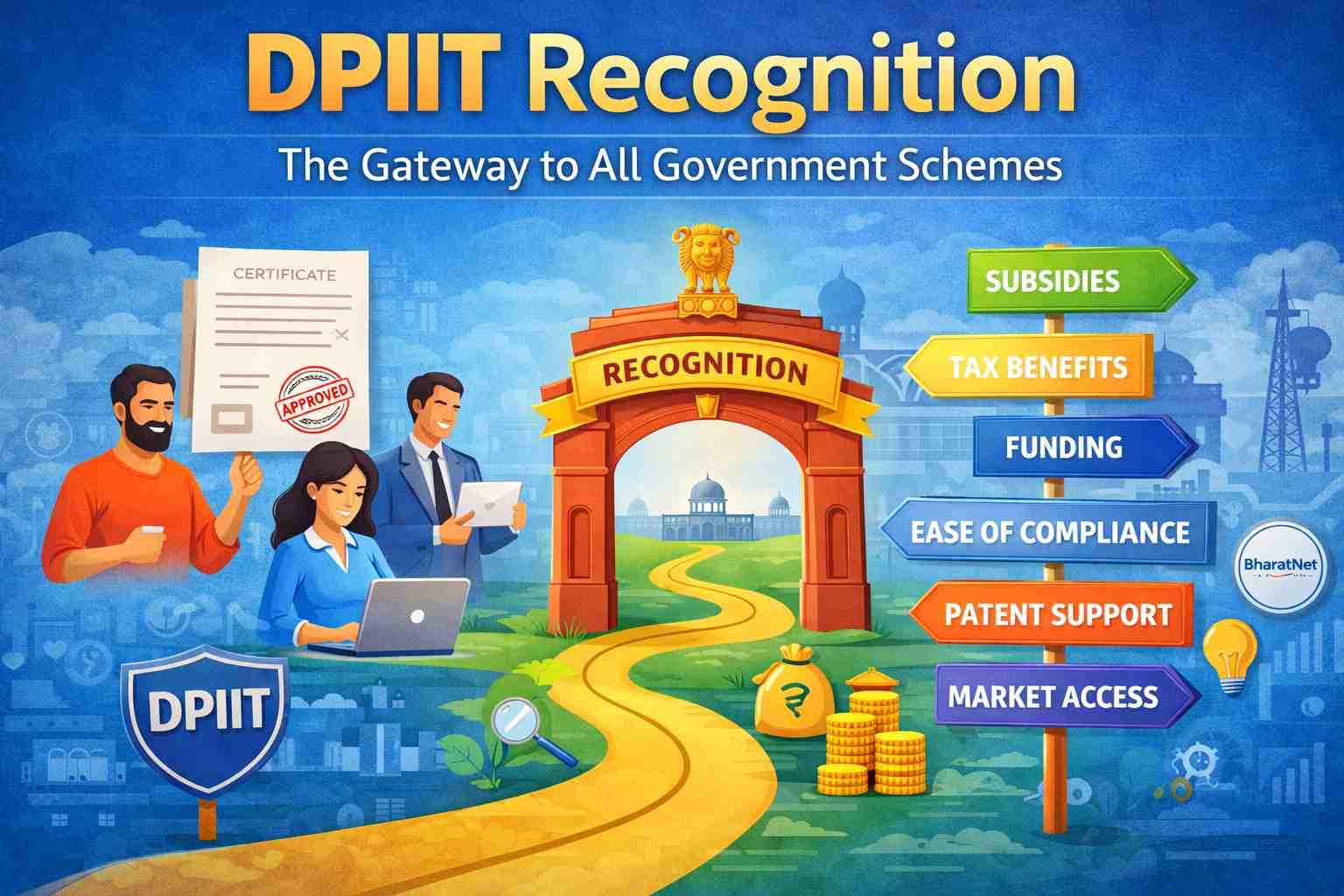 Before applying to any of the above programs, getting DPIIT recognition is non-negotiable. It's the foundational step that unlocks almost every government benefit available to startups in India.
Benefits of DPIIT Recognition:
Eligibility for tax exemptions under Section 80-IAC and 56(2)(viib)
Access to Startup India Seed Fund, SAMRIDH, GENESIS, and other schemes
Self-certification under labour and environmental laws
Faster IPR (Intellectual Property Rights) processing with 80% rebate on patent fees
How to Get Recognized?
Apply online at startupindia.gov.in. The process typically takes 2–4 weeks. Your startup must be incorporated as a private limited company, LLP, or registered partnership, be less than 10 years old, and have an annual turnover below ₹100 crore.
Pro Tips: Maximizing Your Chances of Getting Funded
Apply to multiple programs simultaneously; there is no rule against applying to SAMRIDH and SISFS at the same time, as long as you don't violate individual scheme conditions.
Build a strong pitch deck that clearly articulates your problem statement, market size, solution, and traction.
Get DPIIT recognition first; without it, you'll be disqualified from most government schemes.
Engage with incubators early; many government funds are disbursed through empanelled incubators, so building a relationship before applications open can give you an edge.
Track cohort deadlines on the MeitY Startup Hub and Startup India portals, as many programs have rolling or annual application windows.
Conclusion
India's government funding landscape for startups has matured significantly over the past decade. Programs like SAMRIDH and GENESIS are not just about money; they offer mentorship, market access, and a stamp of credibility that can attract private investors down the line.
If you're an early-stage founder in India, don't wait for the perfect VC pitch to fall into place. Start with your DPIIT recognition, identify the programs that align with your stage and sector, and make government funding work as the launchpad your startup deserves.