Startup India Seed Fund Scheme: Eligibility, Application Process and How to Get Up to ₹50 Lakh
By Rohini Rajpoot · 27 July 2026
Discover the Startup India Seed Fund Scheme (SISFS) a government initiative designed to support early-stage startups with funding, mentorship, and resources to bridge the gap betwe
If you have been searching for real, practical information on the Startup India Seed Fund Scheme, you have probably noticed most articles just repeat the same three lines from the government website. This guide goes deeper. We will walk through what the scheme actually is, who really qualifies, what the incubators are looking for, and how to avoid the mistakes that get most applications rejected in the first round.
What is the startup India seed fund scheme (SISFS)?
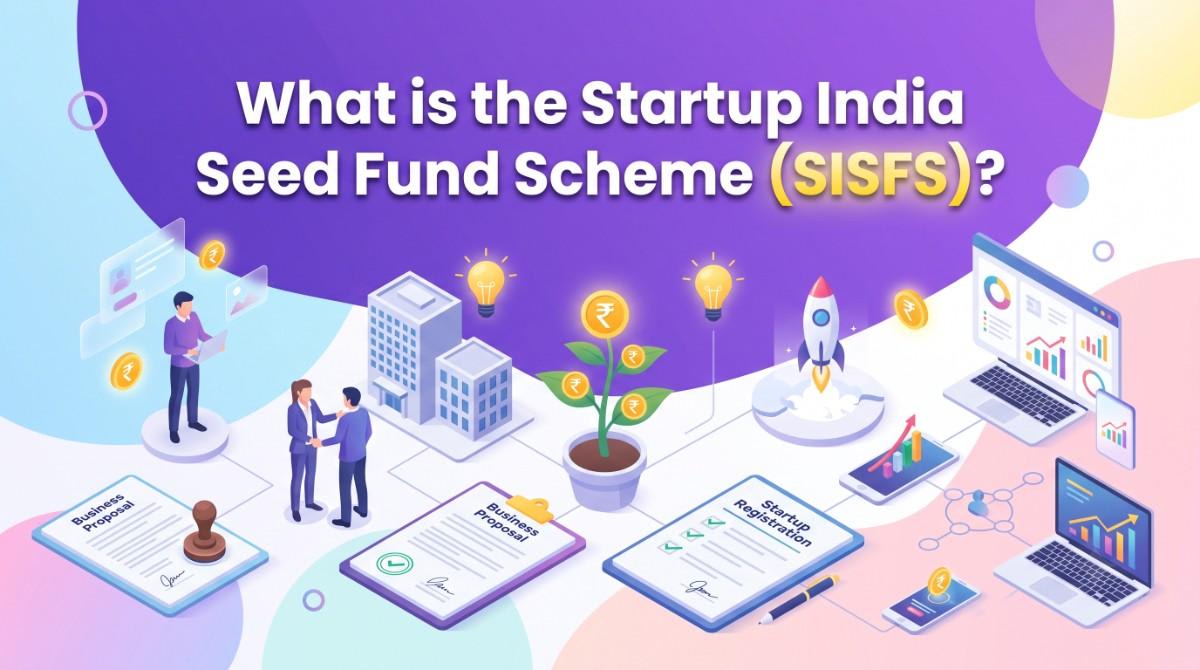 The Startup India Seed Fund Scheme, or SISFS, is a government initiative run by the Department for Promotion of Industry and Internal Trade (DPIIT) under the Ministry of Commerce and Industry. It was launched in April 2021 with a total outlay of ₹945 crore, and the goal was simple: help early-stage startups get through the stage where banks won't lend and investors won't invest because there is nothing concrete to show yet.
This gap has a name in startup circles. People call it the "valley of death," the period between having an idea or a rough prototype and having enough traction to attract a Series A round or serious angel money. SISFS exists to help startups cross that gap.
One important thing to understand up front: the government does not hand money to startups directly. Funds are routed through a network of incubators that DPIIT has approved. These incubators receive funding from DPIIT and then run their own evaluation process before disbursing money to individual startups. So in practice, your incubator is your gatekeeper, your mentor, and your monitoring authority, all in one.
The scheme is sector-agnostic, meaning startups from any industry can apply, though incubators are free to prioritize sectors based on their own focus areas, such as agriculture, health, education, fintech, or clean energy.
Why was this scheme introduced?
Before SISFS, early-stage founders in India had very few good options. Bank loans required collateral most first-time founders simply didn't have. Angel investors and VCs generally wait until there is a working prototype or some market validation before they write a check. That left a large number of genuinely good ideas stuck with no funding path at all.
SISFS was built to plug that specific hole; not to replace venture capital, but to get startups to the point where venture capital becomes an option. It supports:
Building a proof of concept
Developing and testing prototypes
Running product trials
Entering the market
Early-stage commercialization
Key benefits of the Startup India Seed Fund Scheme
Access to capital without giving up significant equity upfront, since a large chunk of the support comes as a grant
Structured mentorship through the incubator you're attached to
A credibility boost, since being selected by an approved incubator signals to future investors that your idea has already passed one round of scrutiny
Reduced dependency on personal savings or high-interest informal borrowing during the earliest, riskiest phase
A milestone-based structure that pushes you to actually hit targets instead of just burning cash
How much funding can you actually get?
The scheme works in two stages, and it helps to think of them as two different products rather than one lump sum.
Funding Stage | Purpose | Maximum Amount | Instrument Type |
Stage 1 | Proof of concept, prototype development, product trials | Up to ₹20 lakh | Grant |
Stage 2 | Market entry and commercialization | Up to ₹50 lakh | Debt or convertible debentures |
The grant portion doesn't need to be repaid, which is why it's aimed squarely at the riskiest, earliest phase of building something. The second tranche, going up to ₹50 lakh, is structured as debt or convertible instruments because by this stage your startup should have something closer to a real product and some early market signal, so the risk profile for both sides looks different.
Disbursement in both stages is milestone-based. You won't get the full amount in one transfer. Your incubator sets checkpoints, and funds are released as you hit them. This is also why incubators keep an eye on your progress throughout, not just at the application stage.
Who Is eligible? Startup India Seed Fund Scheme eligibility explained
This is where most people get tripped up, so let's go through it carefully.
Startup eligibility criteria
Your startup must be DPIIT-recognized. This is non-negotiable and has to happen before you even think about applying for SISFS.
Your startup should be incorporated within the last two years at the time of application. If your date of incorporation is, say, 15 May 2024, you generally need to apply before that two-year window closes. This cutoff is applied strictly, so don't leave your application for the last week.
You need a genuinely innovative product, service, process, or business model. Copy-paste versions of existing businesses without any differentiation tend to get filtered out quickly.
Your solution should use technology in a meaningful way to solve the problem you're targeting, whether that's the core product itself or the business model behind it.
Indian promoters must hold a majority stake in the company, generally 51 percent or more, at the time of application.
Your startup should not have received more than ₹10 lakh in prior monetary support from any other central or state government scheme. Note that this figure applies to direct government grants; prize money from competitions and similar sources is usually treated differently, so check the fine print with your incubator if this applies to you.
Sole-founder startups are eligible too, though evaluation committees will often ask about your plans for building out a co-founding team, since a one-person show does raise questions about bandwidth down the line. LLPs can also apply, though the structure of the convertible instruments works a little differently for them compared to private limited companies.
Incubator eligibility
You don't apply to DPIIT directly. You apply through an approved incubator, and you can typically shortlist and choose up to three incubators from the list available on the Startup India portal. Picking the right incubator matters more than most founders expect. An incubator that specializes in your sector will understand your business faster, ask sharper questions, and be a better long-term mentor than one that's a poor fit just because it happened to be nearby or well known.
Documents you need before applying
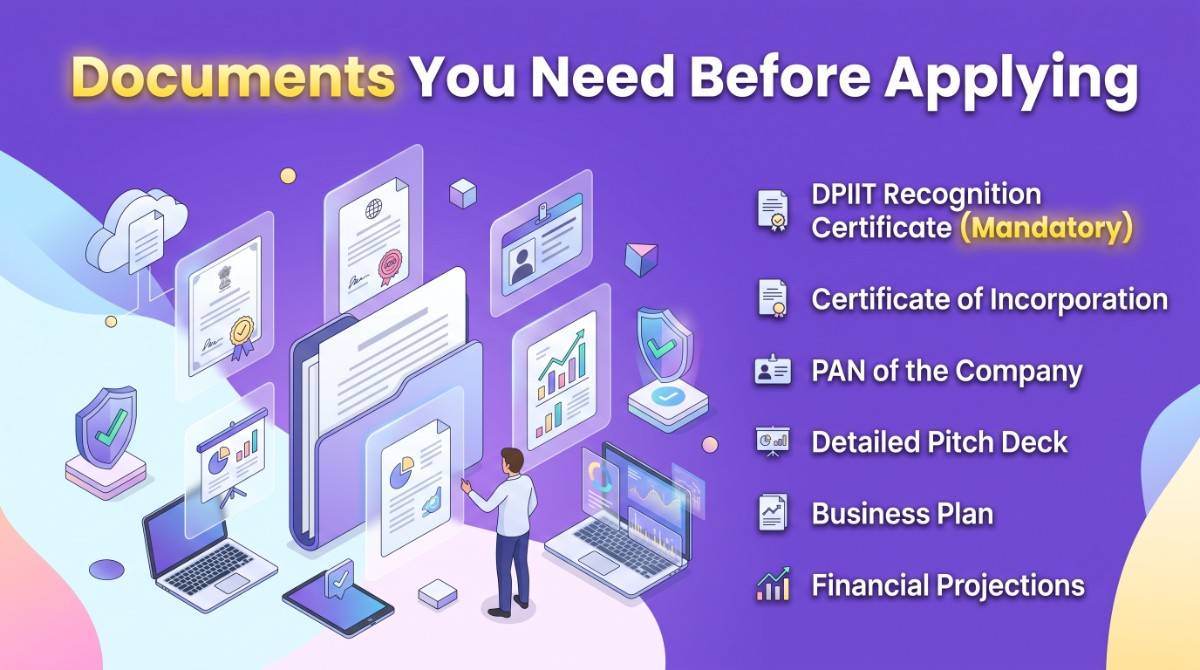
Get these ready before you start the online form, not after:
DPIIT Recognition Certificate (mandatory)
Certificate of Incorporation
PAN of the company
Detailed pitch deck
Business plan
Financial projections
Founder and team details
Product or technology roadmap
Bank account details
Fund utilization plan with clear milestones
Having a sloppy or incomplete document set is one of the most common, and most avoidable, reasons applications stall or get rejected outright.
Step-by-step startup India seed fund scheme application process
Step 1: Get DPIIT recognition first. You cannot apply for SISFS without this. If you haven't registered your startup under Startup India yet, that has to be your first move.
Step 2: Create your profile on the Startup India portal. Use the same login credentials you used during the DPIIT recognition process.
Step 3: Choose your incubators. Browse the list of DPIIT-approved incubators and shortlist up to three based on sector fit, location, and past track record with startups similar to yours.
Step 4: Fill out the application form. This will ask for your team background, the problem you're solving, your product or service, your business model, and how much funding you need and why.
Step 5: Upload your documents. Attach your DPIIT recognition certificate, pitch deck, and financial details.
Step 6: Present to the Seed Management Committee. The incubators you've applied to will review your application, and if shortlisted, you'll be asked to pitch in front of their evaluation committee. This is usually where applications either move forward or get eliminated.
Step 7: Approval and agreement. If approved, you'll sign a funding agreement laying out the milestones tied to each tranche of disbursement, and funds start flowing according to that schedule.
The scheme runs on a rolling basis through the SISFS portal, so there aren't fixed application windows the way there are with some other government schemes.
What are incubators actually looking for?
Since incubators run the evaluation, understanding their lens matters. The Seed Management Committee at each incubator typically weighs:
How genuinely innovative the idea is, not just how well it's pitched
Market potential and whether the problem is big enough to justify the funding
Scalability, meaning whether this can grow beyond a small, local operation
The founding team's capability and commitment
Whether the revenue model is realistic and thought through
How close the prototype is to something actually usable
The broader impact of the solution, especially in priority sectors
Whether there's a credible execution plan behind the vision, not just the vision itself
Why applications get rejected
Most rejections come down to a handful of recurring issues:
A business model that sounds fine in a slide but doesn't hold up under basic questioning
Little to no real market validation, meaning no evidence anyone outside the founding team actually wants this
Missing or inconsistent documentation
Financial projections that are clearly optimistic guesses rather than grounded estimates
No working prototype, or one that's too early to demonstrate anything meaningful
An idea that's too generic or too close to existing solutions without a clear point of difference
A pitch deck that fails to communicate the problem, solution, and opportunity clearly within the first few slides
Tips to improve your chances of approval
Build a working MVP before you apply, even a rough one, rather than relying purely on slides and projections
Get real users to test your product and gather feedback you can actually show the committee
Keep your financial projections grounded in comparable numbers, not best-case fantasy figures
Be specific about how the business scales beyond your first city or first hundred customers
Show actual demand signals: waitlists, pilot customers, letters of intent, anything concrete
Invest real time into your pitch deck. This is often the first and sometimes only impression a committee gets of your startup
Choose an incubator that understands your sector rather than the first one on the list
Be upfront about your team's gaps and have a plan to fill them, rather than pretending they don't exist
Conclusion:
The Startup India Seed Fund Scheme is one of the more genuinely useful government programs available to early-stage founders in India, but it rewards preparation. Founders who go in with a clear prototype, honest financial numbers, and a well-researched incubator choice tend to do far better than those who treat the application as a formality. If you're serious about applying, spend real time getting your documentation, pitch deck, and business plan in order before you start the process. It makes a measurable difference in how your application is received.
Frequently Asked Questions
1. What is the Startup India Seed Fund Scheme?
It's a government scheme run by DPIIT that provides financial support, up to ₹20 lakh as a grant and up to ₹50 lakh through debt or convertible instruments, to help early-stage startups with prototype development, product trials, and market entry.
2. Who is eligible for the Startup India Seed Fund Scheme?
DPIIT-recognized startups incorporated within the last two years, with majority Indian ownership and an innovative, technology-driven idea, are generally eligible. There are also caps on how much prior government funding you can have received.
3. How much funding can a startup receive?
Up to ₹20 lakh as a grant for proof of concept and prototype work, and up to ₹50 lakh through debt or convertible debentures for market entry and commercialization.
Is the ₹50 lakh amount a grant?
No. Unlike the ₹20 lakh proof-of-concept component, the ₹50 lakh tranche is structured as debt or convertible instruments, not a grant.
5. How do I apply for the Startup India Seed Fund Scheme?
You get DPIIT recognition first, create a profile on the Startup India portal, shortlist up to three approved incubators, submit your application with the required documents, and then pitch to the incubator's evaluation committee if shortlisted.
6. Do I need DPIIT recognition before applying?
Yes, this is mandatory and has to be in place before you submit your SISFS application.
7. Can service-based startups apply?
Yes. The scheme is sector-agnostic, so service-based businesses can apply as long as they meet the innovation and technology-usage criteria.
8. How long does the approval process usually take?
Timelines vary by incubator, but most applicants can expect the pitch and evaluation stage to take a few weeks once shortlisted. Disbursement delays sometimes happen due to documentation issues on the utilization certificate side, so keeping your paperwork clean speeds things up considerably.