Startup Lifecycle and Exit Events: Every Term Every Founder Must Know
By Rohini Rajpoot · 26 June 2026
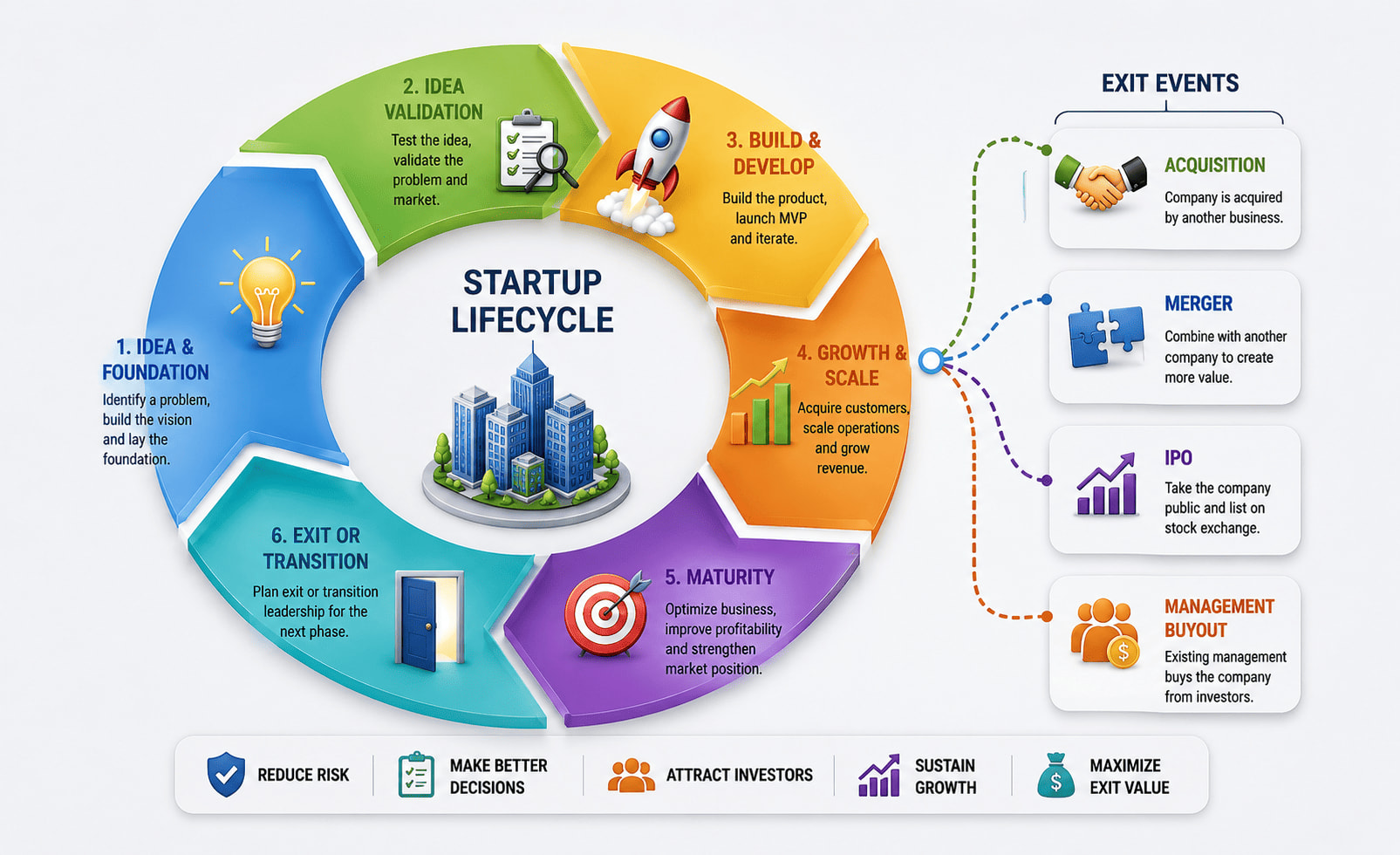
Learn the startup lifecycle, from incubators and unicorns to IPOs and acquisitions, with essential terms every founder should know.
Most founders know the beginning of the story well. You have an idea, you build something, you try to get customers. But the middle and the end of that journey are far less understood: the programmes that shape early growth, the milestones that define ambition, and the exit events that determine how value is ultimately realised.
This guide covers every major term in the startup lifecycle from the earliest support structures through to the exit events that close the chapter.
Every stage of the startup lifecycle comes with different challenges, from validating an idea to preparing for fundraising and planning an exit. Having the right startup coaching can help founders make better decisions throughout this journey.
The Earliest Stage: Where Startups Get Shaped
Incubator
An incubator is a programme that supports very early-stage startups, often before they even have a product. Incubators typically provide workspace, mentorship, and sometimes a small amount of seed funding in exchange for equity or a programme fee.
The defining characteristic is that it works with ideas still being formed. Founders in an incubator are often still figuring out whether their problem is real and who their customer actually is. The environment is designed to reduce friction during that uncertain early period, giving teams time and structure to think clearly before they start spending. As ideas begin taking shape, product development support can help founders transform early concepts into scalable products with a clear roadmap.
Accelerator
 An accelerator takes companies that already have some proof of concept and puts them through an intensive, time-limited programme designed to compress growth. The typical accelerator runs for three to six months, provides capital in exchange for a small equity stake, and ends with a demo day where companies pitch to investors. Since accelerators often prepare startups for investor meetings, many founders also seek professional fund raising support to strengthen their pitch and investment readiness.
The model is built on speed and pressure. Founders are expected to make more progress in three months than they might otherwise make in a year. Unlike incubators, accelerators work best with companies that already know what they are building and need to move faster, not teams still searching for an idea.
YC
YC, or Y Combinator, is the world's most well-known accelerator. Based in Silicon Valley, it has backed companies including Airbnb, Stripe, and Dropbox since 2005. Getting in is genuinely competitive and carries real signal for investors.
YC runs two cohorts a year. Each company receives a standard investment in exchange for equity, plus access to an alumni network that is one of the most valuable resources in the startup world. YC is mentioned separately because it has shaped how the entire industry thinks about early-stage building, from the emphasis on talking to users to the structure of the safe note used across the industry today.
Milestone Labels: What Size Means in Startup Culture
As startups grow, the industry uses a set of terms to describe them by valuation. These labels are shorthand for where a company sits in its journey and how rare that position actually is.
Pony
A pony is a startup valued at over 100 million dollars but below unicorn status. Reaching this milestone requires genuine scale, defensible revenue, and investor conviction in the long-term trajectory. Most startups never get here, which makes it a meaningful marker even if it rarely gets celebrated the way the next label does.
Unicorn
 A unicorn is a privately held startup valued at one billion dollars or more. The term was coined by venture capitalist Aileen Lee in 2013, when companies at this valuation were genuinely rare enough to deserve a mythical name.
Today there are hundreds of unicorns globally, which has diluted the label somewhat. But reaching a billion-dollar valuation still represents a real threshold in the startup growth stages framework, signalling meaningful scale, strong investor backing, and a credible path to a significant exit or public listing. Reaching this level of growth also depends on consistent customer acquisition and brand visibility, making marketing support an important part of scaling successfully.
Centaur
A centaur is a SaaS startup that has reached 100 million dollars in annual recurring revenue. Where unicorn status is about valuation, centaur status is about actual revenue. For B2B software companies especially, 100 million ARR is a meaningful proof point that the business model works at scale.
Decacorn
A decacorn is a startup valued at ten billion dollars or more. These are rare and represent companies with significant market influence while still remaining private. Getting here requires multiple large funding rounds, strong revenue growth, and a market opportunity large enough to justify the number.
Dragon
 A dragon is a venture capital fund that has returned its entire fund through a single investment. The term applies to the company that generated that return as much as to the fund itself. A dragon investment means a startup grew large enough that the return from that one bet covered everything the fund deployed across its entire portfolio. They are extraordinarily rare, which is why the name carries the weight it does.
Exit Events: How the Story Ends
For investors and founders alike, the exit is when value built in a company converts to real, distributable returns. Understanding the different exit paths is central to thinking clearly about startup exit strategies.
IPO
 An IPO, or Initial Public Offering, is when a private company sells shares to the public on a stock exchange for the first time. It creates significant liquidity and visibility but is a demanding process involving regulators, investment banks, financial disclosures, and a roadshow where leadership pitches institutional investors across major financial centres. Preparing for major financial milestones often requires expert financial planning, which is where a virtual CFO becomes valuable for growing startups
Public companies face quarterly reporting requirements, shareholder scrutiny, and market volatility that private companies do not. The startup IPO journey replaces one kind of pressure with another. Still, an IPO creates liquidity for early investors and employees who have been holding equity for years and represents genuine validation at scale.
Acquisition
An acquisition is when one company buys another, taking full ownership of its assets, team, product, and intellectual property. For many startups, acquisition is the most realistic exit path and a genuinely good outcome.
The startup acquisition process varies by acquirer. Strategic acquisitions happen when a larger company buys a startup for its product or market position. Acquihires are driven by the team rather than the product. Financial acquisitions involve investors buying the company for its cash flows. Acquisitions can happen at any stage of the startup lifecycle, from early teams absorbed into larger organisations through to mature businesses sold for significant sums.
Merger
A merger is when two companies combine to form a single new entity, with both sets of shareholders retaining a stake. They typically occur between companies in adjacent markets looking to consolidate or expand reach more efficiently than either could alone. Mergers are more complex than acquisitions because both cultures and systems need to integrate rather than simply be absorbed.
Buyout
A buyout is when an investor or group of investors purchases a controlling stake in a company. In the startup world, buyouts most commonly involve private equity firms acquiring companies at meaningful scale that are not on a clear path to IPO. Management buyouts, where the leadership team purchases control from existing investors happen when founders want to regain ownership from their shareholders.
Two Categories That Sit Outside the Standard Path
 Social Venture
A social venture is a business designed to generate both financial returns and measurable social or environmental impact. It is not a charity. A social venture has a revenue model, serves customers, and operates like a business. The difference is that profit maximisation is not the only goal. Impact is built into the core purpose.
Social ventures sit within the startup lifecycle framework but are evaluated differently. Impact investors, development finance institutions, and grant-making bodies are often more relevant than traditional venture capital. Exits may involve acquisition by a larger impact-focused organisation or a conventional trade sale.
Zombie
A zombie startup is one that is neither growing nor dying. It generates just enough revenue to keep operating but not enough to attract new investment, return capital to investors, or work toward a meaningful exit. The team stays employed, the product keeps running, and the company continues to exist while going nowhere.
Zombie startups are more common than most people acknowledge. They often result from a market smaller than projected, a product that solves a problem but not urgently enough, or a team that has lost conviction but has not yet made the decision to wind down. For investors, a zombie is a capital trap. For founders, it raises difficult questions about opportunity cost.
Conclusion
The startup lifecycle is not a straight line. It moves through early support in incubators and accelerators, through the grind of building toward meaningful valuations, and eventually toward exit events that determine how value is actually distributed.
Knowing the difference between an incubator and an accelerator tells you which programme fits your stage. Understanding the milestone labels from 'pony' to 'decacorn' gives you a shared language for ambition and progress. And knowing the difference between an IPO, an acquisition, a merger, and a buyout helps you think clearly about startup exit strategies long before you need to act on any of them. Using a scenario planning calculator allows founders to evaluate different growth, fundraising, and exit possibilities before making strategic decisions.
Every startup follows a different path from idea to exit. If you need personalized guidance on fundraising, scaling, product strategy, or preparing for major business milestones, connect with our team for expert support.
Frequently Asked Questions
1. What is the difference between incubators and accelerators?
The main distinction lies in the fact that incubators cater to companies in very early stages, before even the product itself comes into existence, with no time constraints. Meanwhile, accelerators help those companies that have some traction, and their programs involve a specific period and culminate with Demo Day.
2. What is meant by a unicorn startup?
'Unicorn' is the term used to describe a startup whose valuation surpasses one billion dollars. This is purely a matter of valuation, not of revenues earned.
3. Is IPO always the right choice? Not necessarily?
An IPO results in liquidity and visibility; however, it involves regulatory compliance, quarterly pressures, and volatility. For many startups, a properly executed acquisition is often a better choice without the need for going public.
4. What defines a zombie startup?
A zombie generates just enough income to keep it alive but not enough to allow it to scale, obtain additional funding, or move toward a proper exit. It survives, but it does not advance, which poses challenging decisions for all involved parties.
5. What are the main differences between acquisition and merger?
Acquisition implies that one company purchases another company. Merger is when two companies unite into a new venture, with both companies remaining as shareholders in the newly formed venture.