Startup Operations & Business Strategy: Every Term Every Founder Must Know
By Toishaa Soni · 19 June 2026
Learn key startup operations and business strategy terms, from bootstrapping and OKRs to market penetration and exit strategies.
Building a startup is not just about creating a product. It is about developing a sustainable business model, executing efficiently, managing resources wisely, and making strategic decisions that support long-term growth. As founders begin working with investors, advisors, accelerators, and Business Strategy Consulting experts, they quickly encounter a vocabulary that can feel unfamiliar.
From understanding business models and growth strategies to fundraising terminology and operational frameworks, these concepts appear throughout the startup journey. This guide breaks down the most important startup operations and business strategy terms in plain language so founders can communicate more effectively, make smarter decisions, and build stronger businesses.
Understanding Business Models and Customers
Before a startup can grow, it needs to understand who it serves and how value reaches the customer.
B2B, B2C, and B2B2C
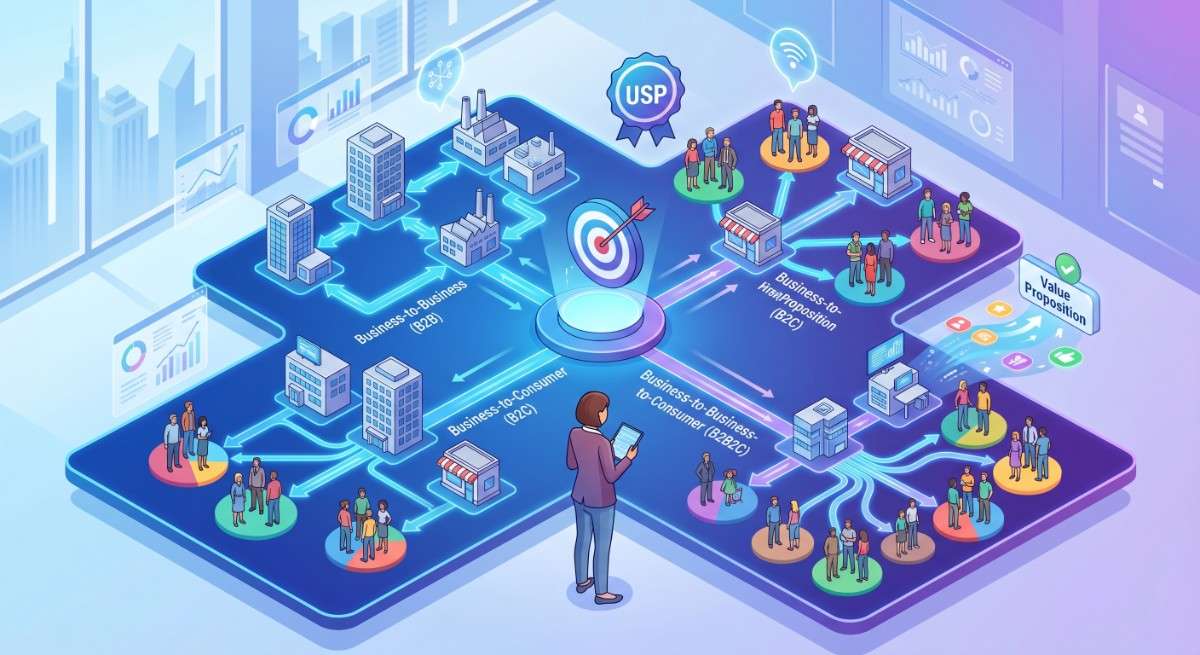 B2B, or Business-to-Business, refers to companies that sell products or services to other businesses. Software platforms, consulting firms, and enterprise solution providers typically operate under this model.
B2C, or Business-to-Consumer, describes businesses that sell directly to individual customers. Retail brands, food delivery platforms, and streaming services are common examples.
B2B2C combines both approaches. A company sells through another business while ultimately serving the end consumer. Payment gateways, marketplace platforms, and certain SaaS products often use this model.
Choosing the right model is one of the first decisions addressed during Strategic Business Planning because it influences sales, marketing, operations, and growth strategy.
Target Market, USP, and Value Proposition
A target market is the specific group of customers a business aims to serve. Defining this audience clearly helps startups focus their resources and messaging.
A USP, or Unique Selling Proposition, explains what makes a business different from competitors. It answers the question: "Why should customers choose us?"
A value proposition goes further by clearly communicating the benefit customers receive. While a USP highlights differentiation, a value proposition explains the value delivered.
These concepts sit at the heart of Startup Business Consulting because even great products struggle when positioning is unclear.
Vision, Goals, and Strategic Direction
Every successful company needs a destination before it can build a roadmap.
Visionary and BHAG
A visionary is someone who sees future opportunities before others do and inspires people to pursue them.
A BHAG, or Big Hairy Audacious Goal, is a bold long-term objective designed to unite and motivate an organisation. Examples include becoming the global leader in a category or transforming an entire industry.
Moonshot and The X of Y
A moonshot refers to an ambitious goal that seeks breakthrough innovation rather than incremental improvement.
The phrase "The X of Y" is commonly used by startups to quickly explain their concept. For example, calling a company "the Airbnb of office spaces" helps people understand the business through a familiar comparison.
OKRs (Objectives and Key Results)
OKRs are a goal-setting framework used by startups and large companies alike.
Objectives define what the business wants to achieve.
Key Results define how success will be measured.
Operational Efficiency Consulting often uses OKRs to ensure teams remain aligned around measurable outcomes rather than vague ambitions.
Running the Business Day-to-Day
A startup's success depends not only on strategy but also on execution.
BAU and Startup Operations Management
BAU stands for Business As Usual. It refers to routine activities that keep the company operating smoothly every day.
As startups grow, balancing innovation with BAU becomes increasingly important. Effective Startup Operations Management ensures that daily operations continue functioning while new opportunities are pursued.
The Two-Pizza Rule
Popularised by Amazon, the Two Pizza Rule suggests that teams should remain small enough to be fed by two pizzas. Smaller teams generally communicate faster, move quicker, and maintain accountability more effectively.
Intrapreneur
An intrapreneur is an employee who behaves like an entrepreneur inside an existing organisation. They identify opportunities, launch initiatives, and drive innovation without leaving the company.
Cottage Industry
A cottage industry refers to small-scale production typically carried out by individuals or families. While the term originates from traditional manufacturing, it is often used to describe businesses operating at a very small scale before significant growth occurs.
Starting with Limited Resources
Many startups begin with more ambition than capital.
 Bootstrapping
Bootstrapping means building a company using personal funds and business-generated revenue rather than external investment.
Bootstrapped founders retain ownership and control but often face resource constraints during growth.
Ramen Profitable
A startup is considered ramen-profitable when it generates just enough revenue for founders to cover basic living expenses while continuing to grow the business.
In-Kind Support and Non-Equity Assistance
In-kind support refers to non-cash contributions such as office space, software subscriptions, mentoring, or professional services.
Non-equity assistance provides support without requiring founders to give up ownership. Many incubators and startup programs offer this type of assistance.
Soft Landing
A soft landing programme helps startups enter new markets by providing resources, local connections, mentorship, and operational support.
These programmes are especially valuable for international expansion strategies.
Understanding Markets and Growth
Growth rarely happens in a straight line.
Market Penetration
Market penetration measures how much of a target market a company has captured. Increasing market penetration is often a key component of any Business Growth Strategy.
First Mover Advantage
First mover advantage refers to the benefits gained by being the first company to enter a market. These advantages may include brand recognition, customer loyalty, and market leadership.
However, being first does not guarantee success if execution is weak.
Early Adopters and Chasm
Early adopters are customers willing to try new products before the mainstream market accepts them.
The chasm describes the difficult transition between attracting early adopters and winning mainstream customers. Many startups achieve early success but struggle to cross this gap.
Valley of Death and Trough of Sorrow
The valley of death refers to the period when a startup has significant expenses but insufficient revenue to sustain itself.
The trough of sorrow describes the emotional and operational challenges founders face when growth is slower than expected despite substantial effort.
Both phases test resilience and strategic decision-making.
Bubble
A bubble occurs when valuations or market enthusiasm rise beyond realistic business fundamentals. Eventually, the bubble bursts and valuations return to more sustainable levels.
Pitching, Fundraising, and Investor Communication
A pitch is a more detailed presentation designed to persuade investors, customers, or partners..
Elevator Pitch, Pitch, and Deck
An elevator pitch is a short explanation of a business that can be delivered in under a minute.
A pitch is a more detailed presentation designed to persuade investors, customers, or partners.
A deck refers to the presentation slides used during the pitch.
Pitch Deck
A pitch deck is the visual presentation that explains the startup's problem, solution, market opportunity, business model, traction, and funding requirements.
Business Strategy Consulting firms frequently help founders refine their pitch decks before investor meetings.
Demo Day
Demo Day is an event where startups present their businesses to investors, usually after completing an accelerator or incubator program.
Pitch Competition and Business Plan Competition
A pitch competition evaluates startups based on their presentation, business model, and growth potential.
A business plan competition focuses more heavily on strategy, planning, market research, and execution frameworks.
Party Round and Pay to Play
A party round occurs when multiple investors participate with relatively small investments.
Pay to play provisions require existing investors to continue investing in future rounds or risk losing certain rights or protections.
Building Credibility and Market Influence
Growth depends heavily on trust and reputation.
 Social Proof
Social proof is evidence that others trust or use your product. Reviews, testimonials, customer logos, case studies, and user numbers all contribute to social proof.
Buying the Logo
Buying the logo refers to acquiring a well-known customer primarily because their brand name adds credibility and helps attract future customers.
Thought Leader and Evangelist
A thought leader is recognised as an authority within a particular industry.
An evangelist actively promotes a product, idea, or company because they genuinely believe in its value.
Both can significantly accelerate market awareness and customer adoption.
Ecosystem
A startup ecosystem includes founders, investors, accelerators, universities, mentors, service providers, and corporations that collectively support entrepreneurship and innovation.
Competitive Strategy and Long-Term Planning
Competition is inevitable, but strategy determines who wins.
Eat Their Lunch
The phrase "eat their lunch" means outperforming competitors and capturing their customers or market share.
Loss Leader Pricing
Loss leader pricing involves selling a product at little or no profit to attract customers who later purchase more profitable products or services.
Problem-Founder Fit
Problem-founder fit exists when founders have unique knowledge, experience, or passion related to the problem they are solving. Investors often view strong problem-founder fit as a positive signal because it increases credibility and commitment.
Exit Strategy
An exit strategy outlines how founders and investors may eventually realise returns on their investment. Common exits include acquisitions, mergers, or public offerings.
Conclusion
Startup success depends on far more than a great idea. Founders must understand customers, define a compelling value proposition, manage operations effectively, communicate with investors, and execute a clear growth strategy. Terms like B2B2C, bootstrapping, OKRs, market penetration, social proof, and exit strategy are not simply startup jargon. They represent the frameworks and concepts that shape real business decisions every day.
Whether you are building your first company or scaling an existing venture, understanding these concepts will help you communicate more effectively with investors, advisors, and Business Strategy Consulting professionals while creating a stronger foundation for long-term growth.
Frequently Asked Questions
1. What is the difference between a USP and a value proposition?
A USP explains what makes your business unique compared to competitors, while a value proposition focuses on the benefits customers receive from choosing your solution.
2. What does bootstrapping mean in a startup?
Bootstrapping means building and growing a company using personal funds and business revenue rather than raising external investment.
3. Why are OKRs important for startups?
OKRs help startups align teams around clear objectives and measurable outcomes, making it easier to track progress and maintain focus.
4. What is the difference between an elevator pitch and a pitch deck?
An elevator pitch is a short verbal explanation of a business, while a pitch deck is a presentation used to provide a more detailed overview to investors.
5. What is first-mover advantage?
First mover advantage' refers to the benefits a company gains by entering a market before competitors, such as brand recognition and customer loyalty.
6. What is problem-founder fit?
Problem-founder fit exists when founders possess personal experience, expertise, or insights that make them particularly well suited to solve a specific problem.
7. What is a startup ecosystem?
A startup ecosystem is the network of founders, investors, mentors, incubators, universities, and service providers that support entrepreneurial growth.
8. Why is market penetration important?
Market penetration helps measure how much of the available market a company has captured and identifies future growth opportunities.