Top Government Grants in India for Startups in 2026
By Toishaa Soni · 16 February 2026
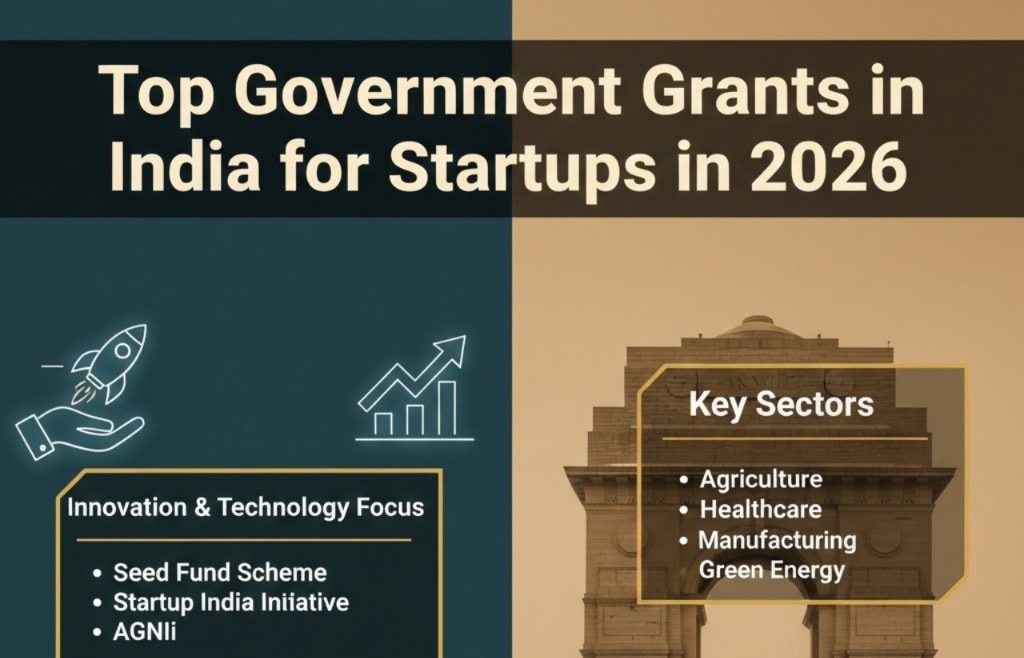
A practical guide to the best government grants and funding schemes available for Indian startups in 2026, covering eligibility, benefits, and how to apply.
India’s startup ecosystem has grown rapidly over the past decade, emerging as a global hub for innovation and entrepreneurship. With supportive government policies and a slew of funding schemes tailored to early-stage ventures, Indian startups now have access to financial assistance that helps them ideate, develop, scale, and commercialize their products and services. In 2026, government grants and funding schemes continue to be a cornerstone of this ecosystem, empowering founders to build, grow, and compete globally.
In this comprehensive guide, we’ll explore the top government grants and funding opportunities available to startups in India in 2026, their objectives, eligibility criteria, benefits, and how to leverage them effectively.
1. Startup India Seed Fund Scheme (SISFS)
 The Startup India Seed Fund Scheme (SISFS) is one of the flagship grant-oriented programs under the Startup India initiative launched by the Department for Promotion of Industry and Internal Trade (DPIIT). The primary aim of SISFS is to support early-stage startups with financial assistance for activities such as proof of concept, prototype development, product trials, market entry, and commercialization.
Key Features:
Objective: Address early-stage capital challenges and help startups validate innovative ideas.
Funding: Financial support through DPIIT-approved incubators.
Eligibility: DPIIT-recognized startups working on innovative products or technologies.
Use Cases: Prototype development, customer validation, early market tests.
SISFS is ideal for founders who are in the initial phases of their startup journey and need capital to transition from idea to market readiness. The scheme significantly reduces risk for entrepreneurs by offering non-equity-dilutive capital in the critical early stages.
2. GENESIS EIR – MeitY’s Support for Emerging Innovators
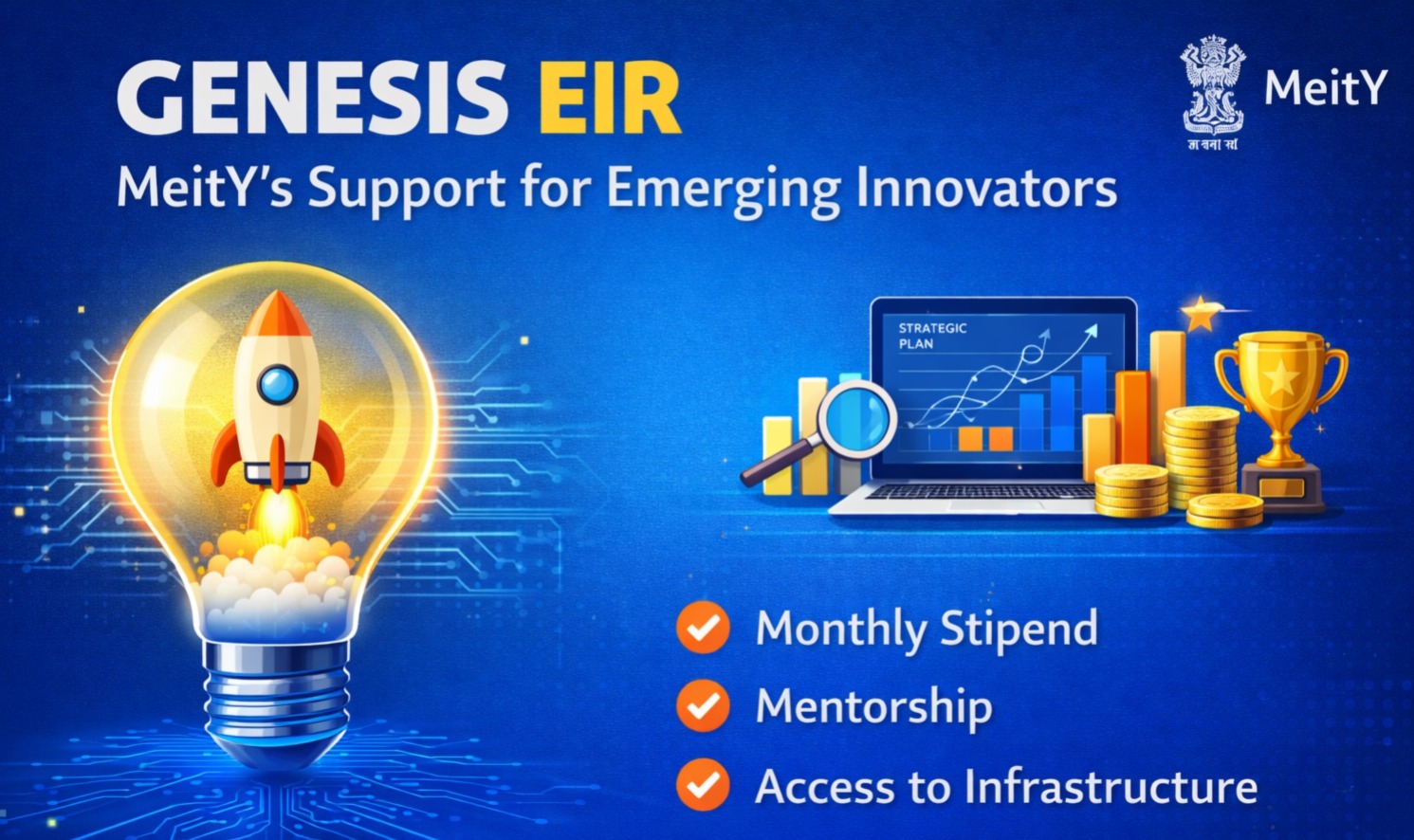 The GENESIS EIR (Entrepreneur-in-Residence) program by the Ministry of Electronics & Information Technology (MeitY) is designed to support tech-driven startups and innovators, particularly from tier-2 and tier-3 cities. According to recent summaries of government grant programs for 2026, GENESIS EIR provides both grant and pilot funding along with mentorship and infrastructure support.
Benefits at a Glance:
Up to ₹10 lakh in grant funding for prototype development and validation.
Additional ₹40 lakh for pilot funding to help startups commercialize market-ready products.
Mentorship from industry experts and access to co-working spaces.
This scheme is ideal for founders who have a solid proof of concept and are ready to refine and scale their solutions.
3. SAMRIDH – Startup Accelerator of MeitY
 The SAMRIDH initiative (Startup Accelerator of MeitY for Product Innovation, Development, and Growth) is a key accelerator program supporting technology startups. It offers funding, global market access, investor networking, and customer linkage support.
Program Highlights:
Matching investment funding of up to ₹40 lakh per startup through partner accelerators.
Sector-agnostic support for product-based software and electronics ventures.
Access to international exposure and mentorship.
SAMRIDH blends capital with structured acceleration support, making it a strong choice for startups working on scalable tech products.
4. Fund of Funds for Startups (FFS)
 The Fund of Funds for Startups (FFS) is a major government initiative launched under the Startup India action plan and managed by the Small Industries Development Bank of India (SIDBI). Its objective is to catalyze investment into Indian startups by co-investing in SEBI-registered venture capital funds, which in turn invest directly in startups.
Why It Matters:
Corpus of ₹10,000 crore managed by SIDBI.
Indirect funding through VC funds expands access to capital for startups.
Enables early-stage and growth-stage ventures to attract private investments.
Although not a direct grant, FFS boosts the ecosystem by ensuring that high-potential startups have access to patient capital through venture funds supported by government funding.
5. Credit Guarantee Scheme for Startups (CGSS)
 For startups needing access to loans without collateral, the Credit Guarantee Scheme for Startups (CGSS) offers an important safety net. Under this scheme, the government acts as a guarantor for loans taken by startups, making banks more willing to extend credit.
Key Benefits:
Collateral-free loans up to ₹5 crore.
A government guarantee reduces risk for lenders.
Funds can be used for working capital or business expansion.
CGSS is particularly useful for startups in growth mode that need credit to scale operations but lack tangible assets to offer as security.
6. Biotechnology Ignition Grant (BIG)
 The Biotechnology Ignition Grant (BIG) is an initiative by the Biotechnology Industry Research Assistance Council (BIRAC) to support early-stage biotech startups.
What It Offers:
Funding support of ₹50 lakh as grant-in-aid for up to 18 months.
Helps startups translate innovative biotech ideas into proof of concept.
Ideal for ventures working on biomedical, agricultural, environmental, or health tech solutions.
BIG is essential for scientific startups that require lab resources and financial backing to validate complex biological solutions.
7. Atal Innovation Mission (AIM)
 While not solely a funding program, the Atal Innovation Mission (AIM) plays a significant role in supporting startup culture in India by fostering innovation, entrepreneurship, and incubation centers across the country.
AIM’s Role:
Sets up Atal Tinkering Labs and Atal Incubation Centres (AICs).
Provides mentorship, network access, and idea-to-prototype support.
Enables startup growth in collaboration with government and industry stakeholders.
Startups that engage with AIM ecosystems often find easier access to grant opportunities and capital, making it a strategic part of their funding roadmap.
8. State-Level Startup Grants and Policies
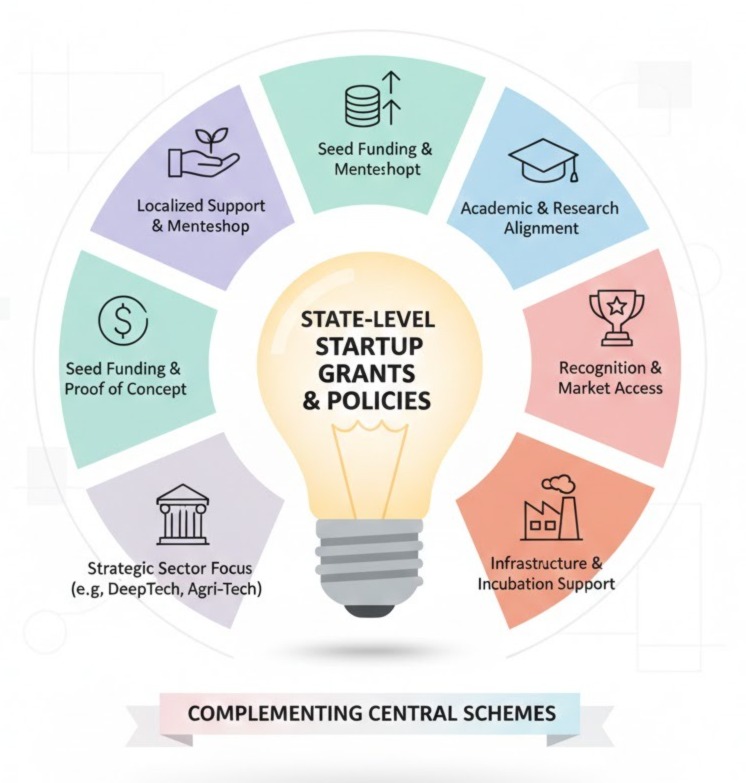 In addition to central government schemes, many Indian states offer their own grant programs and policy incentives to attract innovation and entrepreneurship. For example, initiatives like ELEVATE NXT in Karnataka provide funding and scaling support to startups within the state.
Benefits of State Programs:
Localized support closer to founders.
Funding for proof of concept and validation phases.
Alignment with state priorities (e.g., deep tech, manufacturing, agri-tech).
State policies often complement central schemes, opening additional avenues for startups to secure financial support.
Tips to Maximise Government Grants for Your Startup
To make the most of government grants in 2026, here are a few practical tips:
Get DPIIT Recognition First: Many funding schemes require your startup to be recognised under Startup India.
Prepare a Solid Business Plan: Clear proof of concept and growth strategy strengthens your application.
Use Government Portals: Apply through designated portals like Startup India and Myscheme.gov.in for official submission tracking.
Engage with Incubators: Partnering with recognised incubators improves access to programs like SISFS and SAMRIDH.
Keep Financials Transparent: Accurate accounting and compliance make due diligence easier when applying for funds.
Conclusion
In 2026, Indian startups have unprecedented access to government grants and funding programs spanning early idea stages to growth phases. From seed support through SISFS and GENESIS EIR to acceleration with SAMRIDH, indirect capital via the Fund of Funds, and sector-specific programs like BIG for biotech ventures, the ecosystem is equipped to fuel innovation across industries. With strategic planning and effective use of these schemes, founders can secure the backing needed to turn ideas into impactful, scalable businesses—all while fostering economic growth and technological advancement in India.
FAQs
Q: What are the top government grants available for startups in India in 2026?
Some of the top government grants in 2026 include the Startup India Seed Fund Scheme (SISFS), GENESIS EIR, SAMRIDH Accelerator Program, Biotechnology Ignition Grant (BIG), and various state-level startup grants.
Q: Who is eligible to apply for government startup grants in India?
Most government grants require startups to be DPIIT-recognized under the Startup India initiative. Eligibility usually depends on factors like innovation level, business stage, sector focus, and incorporation period.
Q: Are government startup grants in India equity-free?
Many government grants such as SISFS and BIG are non-dilutive, meaning they do not require founders to give up equity. However, some funding schemes may include structured support through incubators or accelerators.
Q: How can startups apply for government funding schemes in 2026?
Startups can apply through official portals like the Startup India website, respective ministry portals, or approved incubators and accelerators managing the scheme.
Q: What documents are required to apply for government startup grants?
Commonly required documents include DPIIT recognition certificate, business plan, pitch deck, incorporation certificate, financial projections, and proof of concept or prototype details.