Trademark Registration in India: Step-by-Step Guide
By Toishaa Soni · 22 August 2025
Learn how to register a trademark in India with steps, requirements, classes, and key benefits to protect your brand and strengthen its identity.
Your brand name, logo, tagline, or other distinctive identity can become one of your business's most valuable assets. But simply using a brand name does not give you the same level of legal protection as registering it as a trademark.
Trademark registration in India gives the registered proprietor statutory rights over the mark in relation to the goods or services for which it is registered. It can help businesses protect their brand identity, prevent unauthorized use, and build a stronger foundation for long-term growth.
If you are considering brand name registration for your business, trademark registration can help provide legal protection for your distinctive brand identity.
If you are wondering how to register a trademark in India, which documents you need, how much trademark registration costs, or how long the process takes, this guide explains the process step by step. Whether you're looking for trademark registration India services or simply want to understand the registration process, this guide covers the key steps, requirements, fees, and timelines.
Quick answer: To register a trademark in India, you generally need to search for conflicting marks, select the appropriate trademark class, prepare the application details, file Form TM-A, undergo examination by the Trade Marks Registry, respond to any objections if raised, and wait through the publication and opposition stage before registration.
What Is a Trademark?
A trademark is a sign that can distinguish the goods or services of one business from those of another. Depending on the circumstances, a trademark may include a brand name, word, logo, symbol, label, shape, sound, or other distinctive representation capable of identifying the source of goods or services.
For example, a business may seek protection for:
A brand name
A company or product name
A logo or graphic mark
A tagline or slogan
A distinctive label or packaging element
Other eligible distinctive marks
Trademark protection is connected to the specific goods or services covered by the registration. Therefore, choosing the correct class and clearly describing the goods or services is an important part of the application process.
Why Is Trademark Registration Important?
A business can use a brand name without registering it, but registration provides important legal and commercial advantages.
A registered trademark can help you:
Protect your brand identity from unauthorised use
Establish statutory rights over the registered mark
Take legal action against trademark infringement, subject to applicable law
Build credibility with customers, investors, and business partners
Create an intangible business asset
Support licensing and franchising opportunities
Strengthen your brand during business expansion
Reduce the risk of investing heavily in a brand that conflicts with an existing mark
Trademark registration is therefore not just a compliance exercise. For many businesses, it is an important part of protecting the value they are building around their brand.
Who Can Apply for Trademark Registration in India?
The Indian trademark system allows a wide range of applicants to apply for registration. According to the current IP India guidance, eligible applicants can include:
Individuals
Small and medium enterprises
Companies
Partnership firms
Trusts and societies
Foreign applicants
An applicant can file directly or through a registered trademark agent or attorney.
A trademark application may also be filed on a “proposed to be used” basis. If an applicant claims prior use of the mark, appropriate supporting evidence and a user affidavit may be required.
What Are the Trademark Classes in India?
Trademark registration is not automatically granted for every possible product or service.
Goods and services are categorized under the Nice Classification system, which contains 45 classes:
Classes 1–34: Goods
Classes 35–45: Services
For example, the appropriate class for a business selling physical products may differ from the class applicable to a business providing professional or commercial services.
Choosing the correct class is critical because trademark protection is connected to the goods or services specified in the application.
If your business operates across multiple categories, you may need protection in more than one class.
How to Register a Trademark in India?

The trademark registration process in India involves several stages. Here is a step-by-step explanation.
Step 1: Search for Existing Trademarks
Before filing your application, search the existing trademark database for identical or similar marks.
This is one of the most important steps because an existing mark that is identical or deceptively similar may create an obstacle during examination.
The official IP India filing guidance recommends checking trademark availability, assessing similarity and conflicts, and deciding whether you need a word mark or logo mark.
Tip: Do not search only for an exact spelling. Consider similar-sounding, visually similar, and conceptually similar marks as well.
Step 2: Choose the Correct Trademark Class
Once you have checked the availability of your mark, identify the appropriate class or classes for your goods or services.
India follows the Nice Classification system:
Classes 1–34 → Goods
Classes 35–45 → Services
Selecting the wrong class can limit the usefulness of your registration, so the description of your goods or services should be prepared carefully.
Step 3: Decide What You Want to Register
Before preparing the application, determine what form of your brand you want to protect.
For example:
Word mark: Protects the word/name itself, subject to the scope of registration.
Logo/device mark: Protects the specific graphical representation.
Other eligible marks: Depending on the nature and distinctiveness of the mark.
If your business has a distinctive brand name and a separate logo, you may need to consider whether separate applications are appropriate.
Step 4: Prepare the Required Information and Documents
The application generally requires information such as:
Applicant's name
Applicant's address
Applicant category
Representation of the trademark
Description of goods or services
Relevant trademark class or classes
Details of use, where applicable
User affidavit and supporting evidence, where prior use is claimed
Power of Attorney, where an agent is filing on the applicant's behalf
Supporting certificate where the applicant claims startup or small-enterprise status
IP India's current filing guidance specifically lists applicant details, trademark representation, goods/services description, user affidavit where applicable, and Power of Attorney where applicable.
Step 5: File Form TM-A
A new standard trademark application is filed using Form TM-A.
Applications can be filed online through the official IP India e-filing system. After filing, the applicant receives an application number that can be used to track the application. Applicants looking for trade mark registration online can submit their application through the official IP India e-filing system and track the application using the allotted application number.
The current official filing process confirms that applicants can file a new single-class or multi-class application through Form TM-A.
How Much Does Trademark Registration Cost in India?
The official government fee depends on the applicant category and the number of classes/marks covered.
For online filing of a TM-A application, the current official fee is:These are the official filing fees listed by IP India and are subject to applicable rules and notifications.
Professional fees charged by trademark attorneys or consultants, if you use one, are separate from the government filing fee.
Step 6: Examination by the Trade Marks Registry
After filing, the Trade Marks Registry examines the application.
The examination can include checking the application against earlier trademarks and assessing whether there are grounds for objection under the applicable provisions of the Trade Marks Act and Rules. There are two broad possibilities:
Application accepted
If there are no objections preventing acceptance, the application can move forward toward publication.
Examination objection raised
If the Registrar raises objections, an examination report is issued.
The applicant must respond within the prescribed period. Under Rule 33 of the Trade Marks Rules, 2017, failure to respond to the examination report within one month from receipt may result in the application being treated as abandoned. (IP India)
If the response does not resolve the objections, a hearing may be scheduled.
Step 7: Publication in the Trade Marks Journal
Once the application is accepted, it is published in the Trade Marks Journal.
This publication gives third parties an opportunity to oppose the registration.
Under the current IP India filing guidance, third parties may oppose a published application within four months of publication. (IP India)
If an opposition is filed, the application enters opposition proceedings and the applicant must respond according to the applicable procedure and timelines.
Step 8: Trademark Registration Certificate
If the application clears the applicable examination and opposition stages, the trademark proceeds toward registration.
Once registered, the proprietor receives the registration certificate and can use the ® symbol for the registered mark.
Remember:
™ can be used to indicate a claimed/unregistered trademark.
® should be used only after the trademark has been registered.
How Long Does Trademark Registration Take in India?
There is no single guaranteed timeline for every trademark application.
The total time can vary depending on factors such as:
Examination of the application
Whether objections are raised
Whether a hearing is required
Publication
Whether a third party files an opposition
The complexity of the proceedings
Processing timelines at the Trade Marks Registry
Therefore, businesses should avoid assuming that every trademark application will be registered within a fixed number of months.
For eligible applications, the Trade Marks Rules also provide a mechanism for requesting expedited processing subject to the prescribed requirements and fees.
What Are the Benefits of Trademark Registration?
Trademark registration can provide several long-term advantages to a business.
1. Brand protection
Registration helps protect the registered mark in relation to the goods or services covered by it.
2. Legal rights
A registered proprietor receives statutory rights under the Trade Marks Act and can take appropriate legal action against infringement.
3. Business credibility
A protected brand can create greater confidence among customers, partners, investors, and other stakeholders.
4. Valuable business asset
A trademark can become an intangible asset that may support licensing, franchising, assignment, or other commercial arrangements.
5. Protection against unauthorised use
Registration can make it easier to establish your rights when dealing with unauthorised use of a conflicting mark.
6. Long-term brand building
As a business grows, its trademark can become closely associated with its reputation and customer recognition.
7. Renewable protection
A registered trademark is valid for 10 years from the date of application and can be renewed for further 10-year periods indefinitely, subject to the applicable renewal requirements and fees.
Common Mistakes to Avoid During Trademark Registration
A poorly prepared application can create unnecessary delays or complications. Some common mistakes include:
Choosing a generic or descriptive brand name
Names that are too generic or descriptive may face difficulties in obtaining registration depending on the circumstances.
Skipping the trademark search
Filing without checking existing marks can increase the risk of objections.
Selecting the wrong class
Your trademark protection is linked to the goods or services covered by your registration.
Providing an unclear description
The description of goods or services should accurately reflect the business activity for which protection is sought.
Ignoring an examination report
If an examination objection is raised, the applicant must respond within the prescribed timeline.
Using ® before registration
The ® symbol should not be used as though the mark is registered when registration has not yet been granted.
Assuming registration protects the brand everywhere
Indian trademark registration provides protection within the applicable Indian trademark framework and for the registered goods/services. International protection requires consideration of the relevant countries and filing systems.
Trademark Registration vs. Brand Name Registration
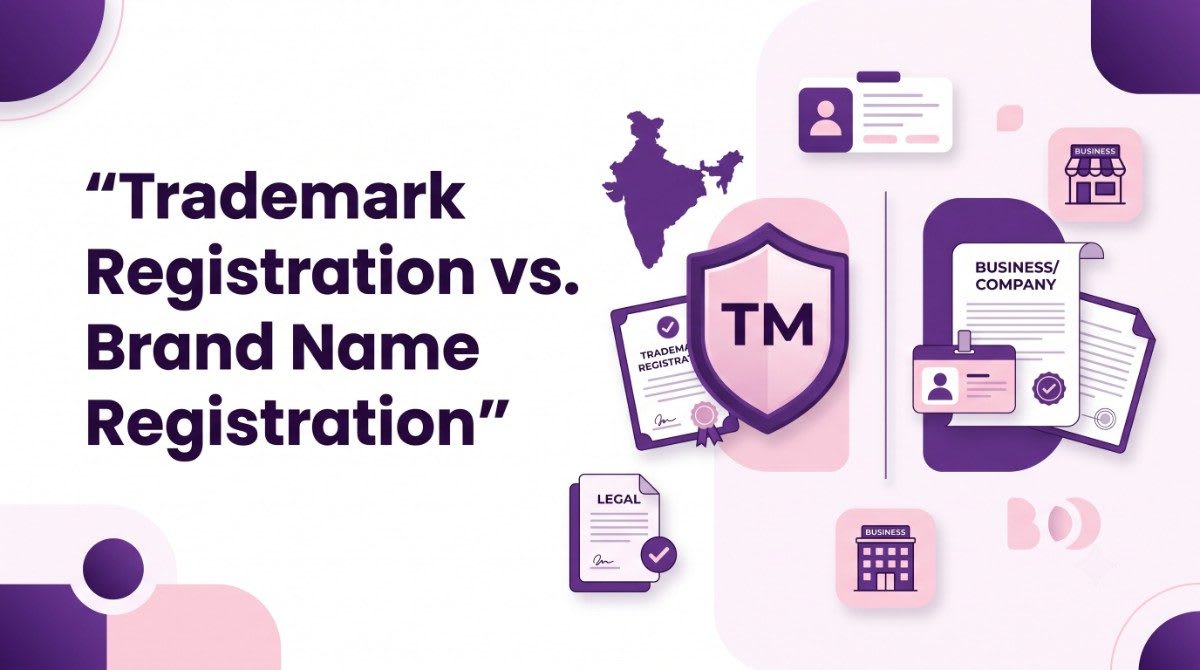
People often search for “brand name registration” when they actually mean trademark registration.
A business name being registered with another authority does not automatically mean that the name is protected as a trademark.
If you want legal protection for a distinctive brand name, you should consider trademark registration for the relevant goods or services.
This distinction is particularly important for startups and growing businesses because incorporating a company or registering a business does not by itself guarantee that the same name is available as a trademark.
Trademark Registration for Startups
Startups often invest significant time and money in developing a brand before considering intellectual property protection.
Registering the brand early can help reduce the risk of building market recognition around a name that later faces a trademark conflict.
Startups and small enterprises may also qualify for a reduced official trademark filing fee, subject to the applicable eligibility requirements and supporting documentation. IP India's current fee schedule lists ₹4,500 for online TM-A filing per class/mark for individuals, startups and small enterprises, compared with ₹9,000 for other applicants.
Conclusion
Trademark registration in India is an important step for businesses that want to protect the identity they are building around their brand.
From conducting a trademark search and selecting the correct class to filing Form TM-A, responding to examination objections, completing publication, and obtaining registration, every stage can affect the strength and usefulness of your trademark protection.
For startups, SMEs, entrepreneurs, and established businesses, registering a trademark can help protect brand value and provide a stronger legal foundation for future growth.
If you are planning to register a brand name, logo, or other eligible trademark and need professional assistance, connect with our experts for guidance on the trademark registration process.
FAQs
1. Is trademark registration mandatory in India?
No. Trademark registration is not mandatory simply to use a brand name. However, registration provides important statutory protection and legal advantages that an unregistered mark does not provide in the same way.
2. How do I register a trademark in India?
You can apply by searching for existing marks, selecting the appropriate class, preparing the required information, filing Form TM-A, responding to examination objections if any, and completing the publication and opposition stages before registration.
3. Can I register my brand name as a trademark?
Yes, a distinctive brand name can be applied for trademark registration, subject to the requirements and restrictions under the applicable trademark law.
4. Can I trademark my logo in India?
Yes. A logo can be filed as a trademark if it meets the applicable requirements for registration.
5. What is the trademark registration fee in India?
For online filing of Form TM-A, the current official government fee is ₹4,500 per class per mark for individuals, startups and small enterprises and ₹9,000 for other applicants.
4. How many trademark classes are there in India?
There are 45 classes under the Nice Classification system: Classes 1–34 cover goods and Classes 35–45 cover services.
5. How long is a registered trademark valid in India?
A registered trademark is valid for 10 years from the date of application and can be renewed indefinitely for additional 10-year periods, subject to the applicable requirements and fees.
6. Can I change my trademark after registration?
A registered trademark cannot simply be redesigned or substantially changed through an ordinary amendment. If you want protection for a materially different name or logo, a fresh application may be required. The appropriate approach depends on the nature of the proposed change.
7. Can I use the ® symbol after applying for a trademark?
No. Filing an application does not mean the trademark is registered. The ® symbol should be used only after registration. Until then, businesses commonly use the ™ symbol to indicate a claimed trademark.