What Investors Actually Look for in an Indian Startup in 2026
By Rohini Rajpoot · 14 September 2026

A good idea used to be enough to get a meeting. It is not enough to get a cheque anymore.
India's venture capital market has entered what most investors now call a disciplined phase. The growth at all costs era, where a big vision and a slick deck could carry a founder through several rounds, is fading. In its place is a market that rewards capital efficiency, defensible technology, and clear paths to profitability over sheer ambition. Series A benchmarks alone have moved up sharply since 2021, and due diligence at every stage has gotten sharper.
None of this means capital has dried up. It means investors have gotten more selective about where it goes. They want evidence of market potential, execution, and sustainable growth, not just a founder's confidence that all three will eventually show up.
This article walks through exactly what investors evaluate before writing a cheque in 2026, from the founding team to the fine print in your due diligence folder.
What investors look for in startups in 2026
Before getting into each factor individually, here is the shortlist most investors are actually working through, whether or not they say it out loud during a pitch meeting.
Founder and team
Market opportunity
Product and problem-solution fit
Traction
Business model
Unit economics
Scalability
Competitive advantage
Financial health
Fund utilisation
Every section below unpacks one of these in more detail.
The founder and team behind the startup
Investors fund people before they fund products. This is not a cliche, it is closer to how due diligence actually works. In early rounds especially, the technology and the market can still change shape several times, but the founding team rarely does.
What investors are really assessing here:
Industry knowledge and founder-market fit: Do the founders have a specific insight into the problem that gives them an edge over everyone else who might try to solve it? A founder who has lived inside the problem for years is a very different bet than a founder who read about it.
Ability to execute: Ideas are cheap. Investors are trying to gauge whether this particular team can actually ship, iterate, and survive the inevitable setbacks that come with building a company.
Adaptability and decision-making: Markets shift. Investors want founders who can change course without losing conviction in the underlying mission.
Complementary skills within the team: A technical cofounder paired with someone who understands distribution and sales tends to inspire more confidence than two people with identical backgrounds.
Founder credibility during due diligence: This shows up in small ways, how consistent your story is across conversations, how transparent you are about weaknesses, and whether your numbers match what you claimed in the pitch.
A real problem with a large market
No matter how strong the team is, investors still need to believe the opportunity is big enough to justify the risk of a venture-scale bet.
Key questions they are asking:
Is this a real, painful problem, or a nice-to-have?
Who is the target customer, and will they actually pay for a solution?
What is the total addressable market, the serviceable addressable market, and the realistic serviceable obtainable market?
Is the market growing, shrinking, or staying flat?
Most Indian VCs today are looking for a total addressable market of around 1 billion dollars or more, with a believable thesis for how the startup captures a meaningful slice of it. A brilliant product built for a tiny market rarely clears the bar for venture funding, even if it is profitable.
Product-market fit: Is anyone actually buying?
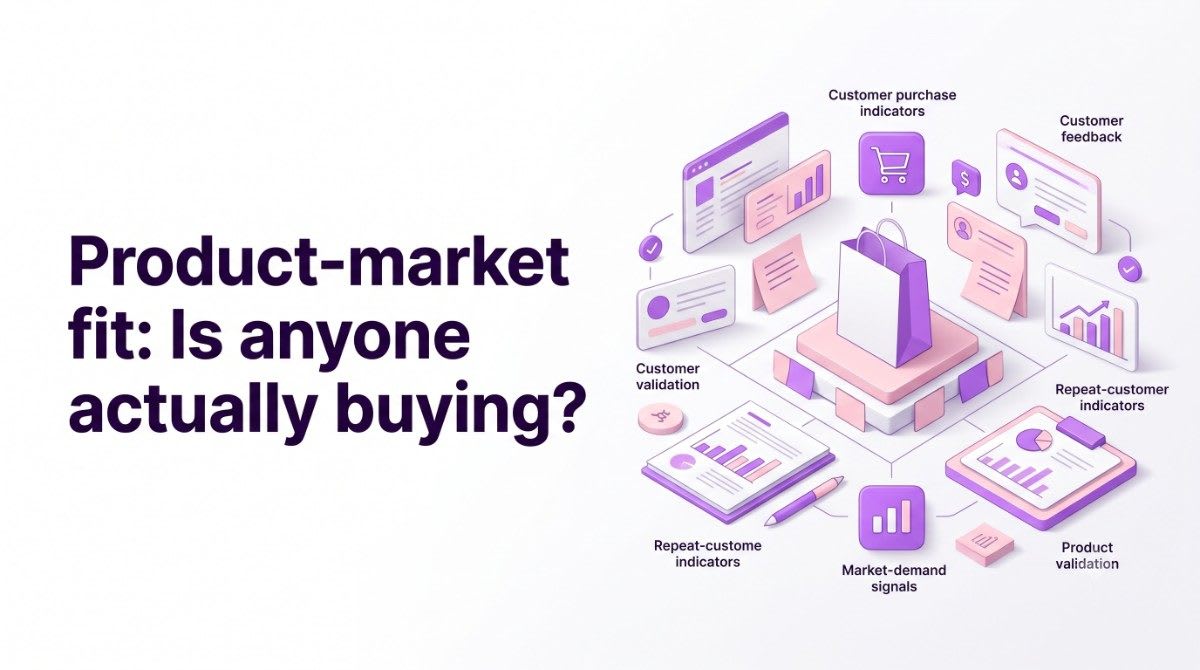 There is a real difference between an idea people say they like and a product people actually pay for and keep using. Investors have learned to be skeptical of the first and to look hard for the second.
Signs they are checking for:
Genuine customer adoption, not just sign-ups
Retention and repeat usage over time
Direct customer feedback, ideally in the founder's own words, not filtered through a survey
Usage patterns that suggest the product has become part of someone's workflow, not just something they tried once
A large user base alone is not proof of product-market fit. Investors have seen plenty of startups with impressive top-line numbers and almost no retention underneath them. What they are really looking for is evidence that customers come back on their own, without being pulled back by discounts or reminders.
Traction: The numbers that get investor attention

This is where most pitch conversations eventually land. Investors will ask for specific metrics, and how comfortable you are with these numbers tells them almost as much as the numbers themselves.
Metrics commonly reviewed:
Revenue growth, month over month and year over year
User or customer growth
Retention and churn
Monthly and annual recurring revenue, MRR and ARR
Customer acquisition cost, CAC
Lifetime value, LTV
Conversion rate through the funnel
Gross margin
For context, current Series A expectations for SaaS founders in India tend to sit around 1.5 to 3 million dollars in ARR, with year over year growth of at least 2x and gross revenue retention above 90 percent. Consumer startups are increasingly judged on organic CAC payback under 12 months, and deeptech startups are expected to show a credible technical moat backed by at least a couple of paying pilot customers. These are not hard rules, but they show how much the bar has moved since the last funding cycle.
A business model that can actually make money
Investors want to understand exactly how the startup makes money, not just that it eventually will.
Areas they dig into:
How revenue is actually generated
Pricing strategy, and whether it reflects real value delivered
Recurring revenue versus one-time transactions
Gross margins, and whether they improve as the business scales
Unit economics, does each new customer add value or add cost
A believable path to profitability, even if the company is not profitable yet
"We'll figure out monetisation later" is one of the fastest ways to lose credibility in a pitch meeting in 2026. Investors have funded enough startups that never quite figured it out to treat this answer as a genuine red flag rather than an acceptable placeholder.
Scalability: Can This Become a Big Business?
Investors are not funding a good year. They are funding what the business could look like five to ten years out.
What they evaluate:
Whether the technology and operations can handle 10x or 100x the current volume without breaking
Whether the business can expand geographically, or whether it is tied to one city or region
Whether customer acquisition gets easier or harder as the company grows
Whether the team, processes, and infrastructure can scale alongside revenue
Whether growth requires proportionally more capital, or whether the model gets more efficient with scale
A startup that needs to hire and spend in a straight line with revenue is a much harder venture bet than one where each new dollar of revenue costs less to acquire than the last.
Competitive Advantage: Why You?
Every market has competitors, even if you cannot see them yet. Investors want to understand what stops someone else, better funded or faster moving, from copying you within a year.
What they are looking for:
A clear view of both direct and indirect competitors
What genuinely differentiates the startup, not just marketing language
Proprietary technology or intellectual property
Brand strength and customer trust
Distribution advantages that are hard to replicate
Network effects that get stronger as more users join
Switching costs that keep customers from leaving
A data advantage that compounds over time
"We have no competitors" is one of the more reliable red flags investors mention. It usually signals either an underdeveloped market, in which case the opportunity might be too small, or a founder who has not done the research, in which case the diligence process tends to get a lot more uncomfortable.
Financials and Capital Efficiency
This is where the discipline of the 2026 funding environment shows up most clearly. Investors are scrutinizing burn and runway far more closely than they did during the growth at all costs years.
What gets reviewed:
Revenue and expenses, month by month
Burn rate, and whether it is trending toward or away from sustainability
Cash runway, calculated at the current burn rate, not an old or optimistic one
Financial projections, and how realistic the assumptions behind them are
Planned use of funds
Overall capital efficiency, how much growth the startup generates per dollar raised
Most active investors in 2026 want to see at least 18 months of runway calculated against current burn, not historical burn. Founders who show up with financial models built on last year's spending patterns tend to get sent back to redo the numbers.
Startup Due Diligence: What Investors Check Before Investing
Once an investor is genuinely interested, due diligence begins. This is the practical checklist most Indian VCs work through before a deal closes.
Company incorporation and ownership, confirming the legal structure is sound
Cap table, checking for clean ownership records and no unexplained dilution
Financial statements, historical revenue, expenses, and cash position
Revenue and contracts, verifying that claimed revenue is real and recurring, not one-off
Intellectual property, confirming that IP is properly assigned to the company, not sitting with an individual founder or a former employer
Legal compliance, including registrations, licenses, and regulatory filings
Employee agreements, contracts, ESOP documentation, and confidentiality terms
Existing investors, understanding who is already on the cap table and on what terms
Debt and liabilities, any outstanding loans or obligations
Tax and regulatory records, including GST and MCA filings
Diligence tends to be lighter and more confirmatory at the seed stage, focused mainly on the founders, the product, and early traction. At growth stage, it becomes a full legal, financial, tax, and technical exercise, often running for four to eight weeks before a deal closes. Founders who keep these documents current, rather than assembling them under pressure once a term sheet lands, tend to close rounds noticeably faster.
The Pitch Deck: What Investors Want to See
A pitch deck will not close a round on its own, but a weak one can end the conversation before it starts. Investors generally expect these sections, in some order:
Problem
Solution
Market
Product
Business model
Traction
Competition
Go-to-market
Financials
Team
Funding ask
Use of funds
The deck's job is not to convince an investor to write a cheque on the spot. It is to convince them the opportunity is worth a real conversation. Keep it tight, back every claim with a number where you can, and be honest about the sections that are still works in progress.
How to Attract Investors in India in 2026
A few practical steps that consistently improve a founder's odds:
Build measurable traction before you fundraise. Investors respond to evidence, not intentions. A few months of real growth data will do more for your raise than any amount of pitch polish.
Know your numbers cold. Founders who hesitate on their own CAC, churn, or burn rate lose credibility fast, even if the underlying business is solid.
Create a clear, honest pitch. Investors have sat through thousands of decks. The ones that stand out are specific and grounded, not the ones with the most ambitious slide about total addressable market.
Target the right investors. A fintech founder pitching a climate tech fund is wasting everyone's time. Research each fund's thesis and stage focus before reaching out.
Build relationships before you actually need the money. Warm introductions from portfolio founders convert far better than cold outreach, and that relationship usually needs to exist well before the fundraise starts.
Keep your documents investor-ready at all times. A clean cap table and current financials should not be something you scramble to prepare after a term sheet arrives.
Demonstrate why your startup can specifically win. Not just why the market is big, but why you, with this team and this approach, are positioned to capture it.
Red Flags That Can Make Investors Walk Away
Some patterns show up again and again in investor post-mortems on deals they passed on.
Unrealistic financial projections that do not connect to current performance
A weak or unclear business model, especially around how revenue actually gets generated
No real understanding of the competitive landscape
Visible conflict or misalignment between cofounders
Poor or disorganized financial records
High burn paired with low traction
Overvaluation relative to actual stage and metrics
Lack of genuine customer validation
Incomplete or messy legal documentation
The "we have no competition" mindset
Any one of these might not sink a deal on its own, but investors tend to treat them as signals worth digging into further, and a few of them together are usually enough to end the conversation.
What Makes an Indian Startup Investor-Ready in 2026?
A quick way to check where you stand before your next round.
Area | Investor-Ready Signal |
Founder | Strong execution capability |
Market | Large and growing opportunity |
Product | Clear customer problem |
Traction | Measurable growth |
Revenue | Sustainable business model |
Unit Economics | Improving economics |
Competition | Clear differentiation |
Financials | Strong financial visibility |
Legal | Clean documentation |
Fundraising | Clear use of funds |
If you can honestly check most of these boxes, you are in a strong position to start real conversations with investors. If several are still open questions, that is useful information too. It tells you where to focus before your next pitch, not after it.
Conclusion
Every factor covered here points toward the same underlying shift. Investors in 2026 are not evaluating how exciting your idea sounds. They are evaluating how much evidence you can offer that the idea is already working, even in a small, early way.
That means a strong founding team with real market insight. A problem big enough to justify venture-scale ambition. Product-market fit you can actually demonstrate, not just describe. Traction, a working business model, and unit economics that improve as you grow. A competitive edge that holds up under scrutiny. Clean financials and documentation that do not slow down a deal once an investor is interested.
None of this happens by accident, and none of it happens overnight. It comes from founders who treat investor readiness as an ongoing discipline, not a scramble before a pitch meeting.
Building a startup and preparing for funding? Startup Coach can help you strengthen your business, pitch, and investor readiness.
FAQs
1. What do investors look for in startups?
Primarily the founding team, market size, product-market fit, traction, business model, unit economics, scalability, and competitive advantage, backed by clean financials and documentation.
2. What do investors look for in Indian startups in 2026?
The same fundamentals as always, but with sharper scrutiny. Indian VCs in 2026 are placing more weight on capital efficiency, realistic burn and runway, and defensible technology than they did during the earlier growth at all costs cycle.
3. What makes a startup attractive to investors?
A combination of a large real market, a strong founding team, evidence that customers actually want the product, and a business model with a believable path to profitability.
4. How do I attract investors in India?
Build measurable traction first, know your numbers thoroughly, target investors whose thesis actually matches your sector and stage, and build relationships before you formally start fundraising.
5. What metrics do VCs look at before investing?
Revenue growth, MRR or ARR, customer acquisition cost, lifetime value, retention and churn, conversion rates, and gross margin are among the most commonly reviewed.
6. What are the main startup investment criteria in India?
Founder-market fit, market opportunity size, product-market fit, traction, unit economics, scalability, and competitive differentiation, evaluated together rather than in isolation.