What Is the Startup India Seed Fund Scheme (SISFS)? — A Complete Overview
By Toishaa Soni · 11 November 2025
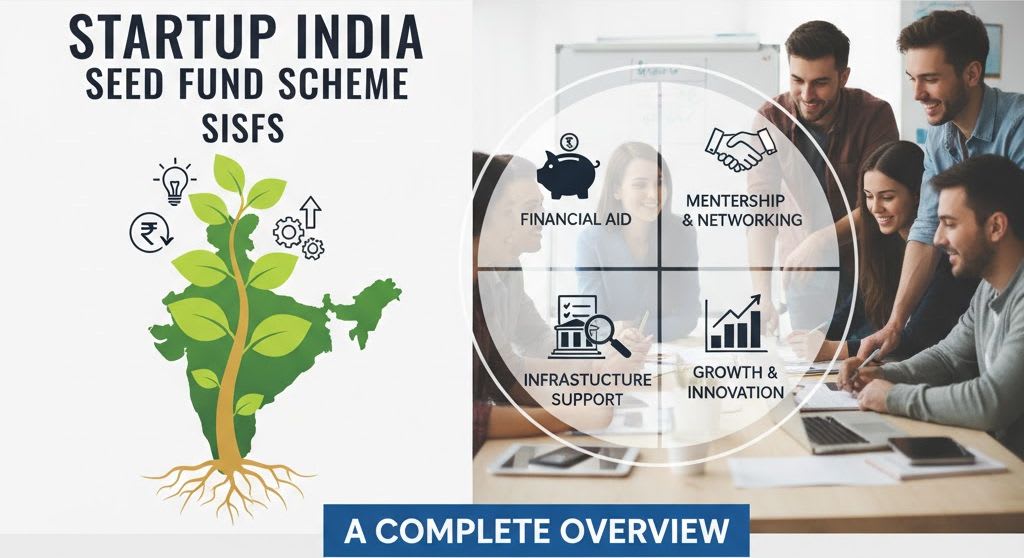
Learn how the Startup India Seed Fund Scheme supports early-stage startups in India with grants, mentorship, and incubation for innovation and growth.
Every startup starts with an idea, but even the best ideas require the right funding. Investors and venture capitalists usually come when the concept has been proven, while banks only lend to applicants with collateral. That leaves early founders struggling to find the capital they need to test, refine, and most importantly, launch their products.
To address this gap, the Government of India introduced the Startup India Seed Fund Scheme. This initiative has been aimed at providing financial support to innovative startups at the most critical stage in their journey from the validation of ideas to the development of prototypes and the conducting of early market tests for better startup growth and business scaling.
What is the Startup India Seed Fund Scheme (SISFS)?  Access to early-stage capital is often the toughest challenge for new entrepreneurs. Investors usually come in only after a proof of concept is shown, and banks lend mainly to asset-backed applicants. To bridge this gap, the Department for Promotion of Industry and Internal Trade (DPIIT) launched the Startup India Seed Fund Scheme (SISFS) with a fund of ₹945 crore.
The scheme assists the startups in developing prototypes, product trials, market entry, and commercialization. It is expected to support approximately 3,600 entrepreneurs through 300 incubators over four years across India. Announced by the Honorable Prime Minister in January 2021, SISFS channels funds to eligible startups through recognized incubators nationwide.
What Are the Objectives of SISFS?
The Startup India Seed Fund Scheme (SISFS) supports early-stage startups in India with seed funding for proof of concept, prototype development, product trials, market entry, and commercialization. It aims to bridge the early-stage funding gap where startups struggle to secure capital from banks and investors.
By enabling the startup funding stage, SISFS helps founders scale, attract investment, and drive innovation and job creation. The scheme also promotes entrepreneurship in Tier 2 and Tier 3 cities, making India’s startup ecosystem more inclusive and growth-driven.
Key Features of SISFS
1. Implemented by the Department for Promotion of Industry and Internal Trade with a total outlay of ₹945 crore.
2. It invests funds through selected incubators across India, which evaluate, select, and mentor startups.
3. It provides up to ₹20 lakh as a grant for proof of concept or prototype development.
4. Up to ₹50 lakh investment support for market entry and commercialization will be provided through debt, convertible debentures, or debt-linked instruments.
5. Digital application and management of funds on the Startup India portal, with transparency and accessibility.
6. Combines financial support with mentorship and monitoring for sustainable growth in startups.
What Are the Eligibility Criteria for Startups?
The Startup India Seed Fund Scheme (SISFS) is available to DPIIT-recognized startups incorporated within the last 2 years, working on innovative, market-fit ideas with strong commercialization potential. Startups must not have received more than ₹10 lakh in prior government funding and should have at least 51% shareholding held by Indian promoters.
The scheme prioritizes high-impact sectors like clean energy, deep tech, agriculture, healthcare, and social innovation, where early-stage funding can drive significant growth.
How does the funding process work under SISFS?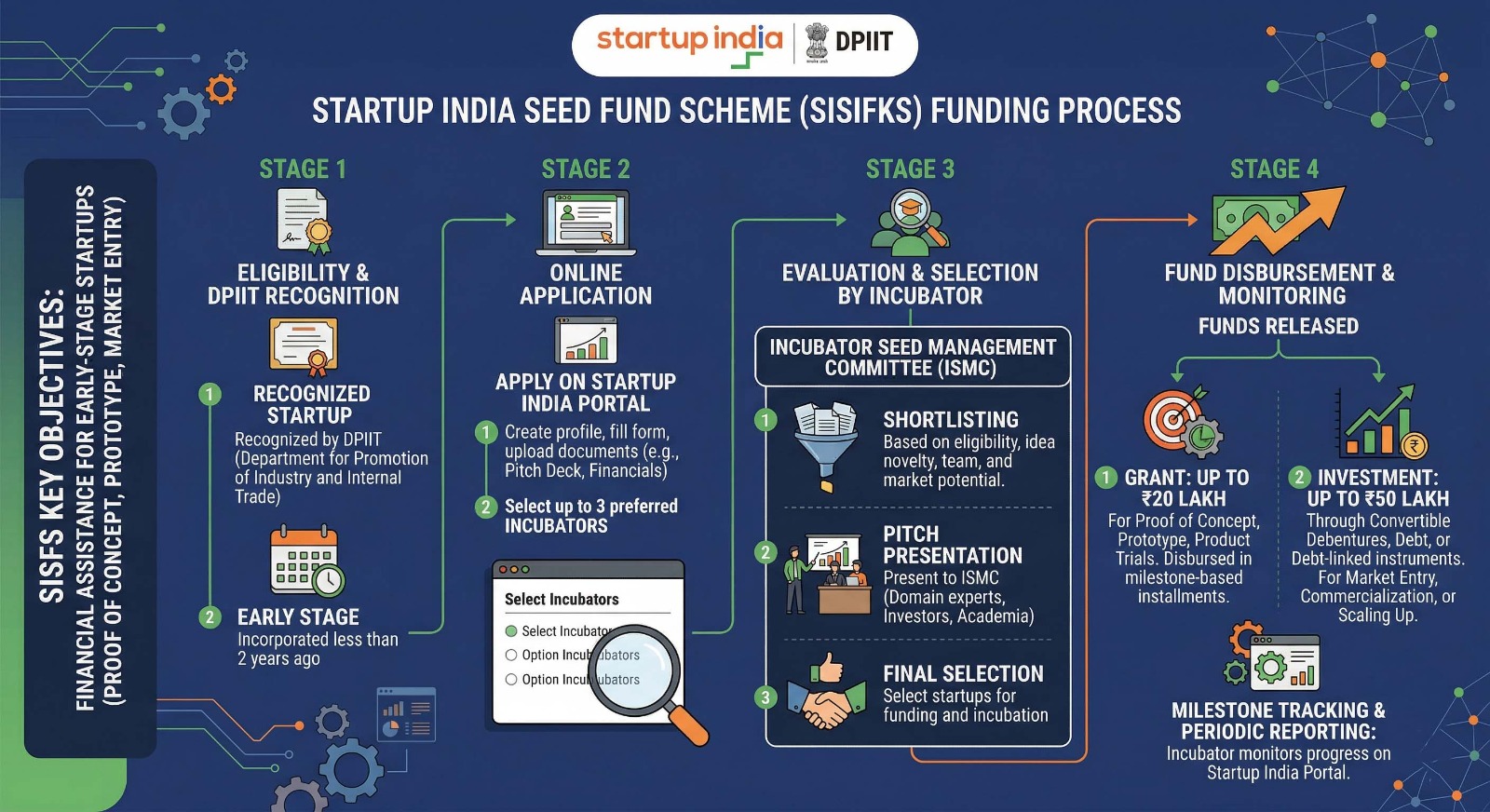
Startups apply online through the Startup India portal and choose a suitable incubator.
Incubators review applications based on innovation, feasibility, and potential impact.
Shortlisted startups pitch their ideas to the Incubator Seed Management Committee (ISMC).
Selected startups receive funding in stages (tranches) based on milestones like prototype development and product trials.
Incubators also provide mentorship and track progress to ensure effective use of funds.
This structured process combines funding with guidance, helping startups grow responsibly during their early stages.
What Does an Incubator Do?
Incubators form the backbone of the Startup India Seed Fund Scheme, mentoring, evaluating, and enabling startups selected under the scheme. Their role is much more than just that of a fund distributor; it involves linking up the startups for strategic growth.
Incubators can provide support to founders on anything from refining business models and product designs to finding investors, mentors, and technical experts. They offer a host of services ranging from affordable physical space to networking and business support services. The incubators involved in this initiative include some of India's best-known ones, like T-Hub in Hyderabad, SINE at IIT Bombay, NSRCEL at IIM Bangalore, and CIIE.CO at IIM Ahmedabad. Being incubated at one of these places gives start-ups credibility and access to resources that are important to accelerating their success.
What Are the Benefits for Founders?
Non-dilutive funding: Access seed funding without equity dilution, helping founders retain full control.
Early-stage startup funding support: Ideal for startups in the ideation and growth phase under SISFS.
Mentorship & network access: Connects founders with experienced mentors, incubators, and investors.
Startup credibility boost: Government-backed recognition improves trust with investors and partners.
Structured growth guidance: Helps founders make informed decisions and avoid early-stage mistakes.
Challenges and Considerations
While the Startup India Seed Fund Scheme opens up enormous opportunities, it also brings many challenges. The competition is going to be high, as the number of eligible startups is going to far outnumber the incubator slots available. Founders should ensure that their business plans are realistic, innovative, and have strong execution potential. Preparation of a clear prototype, proof of concept, and financial plan increases the chances of selection.
It is equally important to note that SISFS represents a seed-stage support system and not any kind of long-term funding. The startups that scale under this program will also need to look for further funding for scaling and expansion. However, the validation and mentorship provided with SISFS make that process much easier.
If you are planning your startup funding journey or need the right support to raise capital and scale, connect with our experts to get the right guidance.
Conclusion
Among the most effective government programs boosting India's entrepreneurial ecosystem is the Startup India Seed Fund Scheme. This empowers founders to bring their ideas into reality at the most crucial stage, in addition to key financial assistance, mentorship, and incubation, to prepare them for long-term growth.
SISFS is, therefore, much more than funding for early-stage entrepreneurs; it's a launchpad that can bring direction, structure, and credibility. Whether you're a first-time founder, a student innovator, or an entrepreneur from a smaller city, this could be the very stepping stone you need for your big idea to transform into a sustainable and scalable business. With proper preparation, a clear vision, and a strong application, the Startup India Seed Fund Scheme indeed has the potential to turn innovation into impact.
FAQs
Q- What is the Startup India Seed Fund Scheme?
It is a scheme by DPIIT to fund proof of concept, prototype development, product trials, market entry, and commercialization for startups.
Q-Who can apply for SISFS?
Any DPIIT-recognized startup that is less than two years old with an innovative, scalable idea can apply.
Q- How much funding can a startup receive?
The startups can receive a maximum grant of ₹20 lakh and a maximum investment support of ₹50 lakh through incubators.
Q- Is the funding repayable?
Whereas grants are not repayable, the investment-linked funds may be designed to be repayable or convertible upon agreement.
Q- Do startups from smaller cities apply?
Yes, SISFS actively encourages participation from startups in Tier-II and Tier-III cities to promote inclusive entrepreneurship across India.