Why Investors Invest in Startups: Key Factors Explained
By Rohini Rajpoot · 17 November 2026

Discover why investors invest in startups and explore key factors such as founder-market fit, market opportunity, scalability and growth potential.
Most startups reach a point where growth needs more capital than the founders can supply. Hiring a team, building a product, entering new markets and acquiring customers all cost money, and external investment is one way to fund them. That is where investors come in.
But investors do not fund ideas on enthusiasm alone. They evaluate people, markets, business models and the ability to scale, and they compare each opportunity against many others. Understanding why investors invest in startups can help founders prepare better and set realistic expectations. This guide explains the reasons behind investment, the key factors investors consider before investing, how venture capitalists evaluate startups, and why some companies get funded while others do not. It is written to inform, not to promise any outcome, because funding decisions always depend on the specific startup and investor.
Why Do Investors Invest in Startups?

Investors back startups for a mix of financial and strategic reasons:
Participation in early-stage growth: Getting in early can mean holding a stake in a business before its value rises.
Potential for high returns: Successful exits, such as an acquisition or a public listing, can generate large returns, though many startups do not reach that stage.
Access to innovation and emerging markets: Investors want exposure to new products, technologies and customer segments.
Portfolio diversification: Startups add a different risk and return profile to a broader investment portfolio.
Supporting founders who solve real problems: Many investors are motivated by backing businesses that address meaningful needs.
It is important to be honest about risk. Startup investing is high risk, and many investments return little or nothing. Investors accept this because a few big successes can offset many losses, which is why they look so carefully for specific signs of potential.
What Do Investors Look for in Startups? Key Investment Factors
There is no universal checklist, and each investor weighs factors differently. These seven areas, however, come up again and again in startup investment criteria.
1. Strong Founder-Market Fit
Founder-market fit is the match between the people building the company and the problem they are solving. Investors often say they back people first. They look at:
The founder's understanding of the industry
Relevant experience and expertise
The ability to identify real market problems
Leadership and decision-making ability
A founder who has lived with a problem, or worked in the industry for years, usually brings credibility and insight that is hard to fake. This does not mean first-time founders cannot succeed. It means they should be able to show why they are the right team for this problem.
2. A Clear and Scalable Business Model
A startup business model evaluation focuses on how the company makes money and whether that can grow efficiently. Investors ask:
How does the startup generate revenue?
What is the pricing and monetisation strategy?
How will it acquire and retain customers?
Can it expand without costs rising at the same rate?
Scalability is the key idea. A business that needs to double its costs to double its revenue is harder to scale than one where additional customers cost relatively little to serve.
3. Market Opportunity and Demand
A good product in a tiny market limits what an investor can earn. Investors look at the market opportunity for startups by considering:
The size of the target market
Evidence of existing customer demand
Market trends and growth opportunities
Competition and the startup's positioning
They are usually sceptical of claims that a market is huge simply because it includes everyone. A credible, bottom-up estimate of reachable customers is more convincing.
4. Startup Growth Potential
Investors want to see room to grow. They consider opportunities for customer acquisition and business expansion, possibilities for revenue growth, the demand for the product or service and the potential to enter new markets. Growth potential is not just a forecast. It is supported by early evidence and a plan for how growth will happen.
5. Product-Market Fit
Product-market fit means that customers genuinely want what the startup offers. Signals include:
The product solves a real problem
Positive customer feedback and adoption
Repeat usage and retention
Early traction that shows demand
Retention is often more persuasive than sign-ups. Customers who keep coming back suggest the product delivers lasting value.
6. Financial Performance and Profitability
Even early-stage investors look at the numbers, within reason. They review:
Revenue and the expense structure
Cash flow and burn rate, meaning how quickly cash is being spent
Customer acquisition cost (CAC), the cost of winning a customer
Customer lifetime value (LTV), the revenue expected from a customer over time
The path towards sustainable profitability
A healthy relationship between LTV and CAC suggests that growth can be financed sustainably. Startup scalability and profitability are increasingly viewed together, since funding conditions can change and disciplined spending protects a company during slower periods.
7. Competitive Advantage
Investors ask what will stop others from copying the business. A competitive advantage might come from:
A unique value proposition
Clear differentiation from competitors
Technology, intellectual property or operational strengths
Long-term defensibility, such as network effects or strong customer relationships
No advantage lasts forever, but a startup should be able to explain why it is better placed than others to win.
How Venture Capitalists Evaluate Startups Before Investing
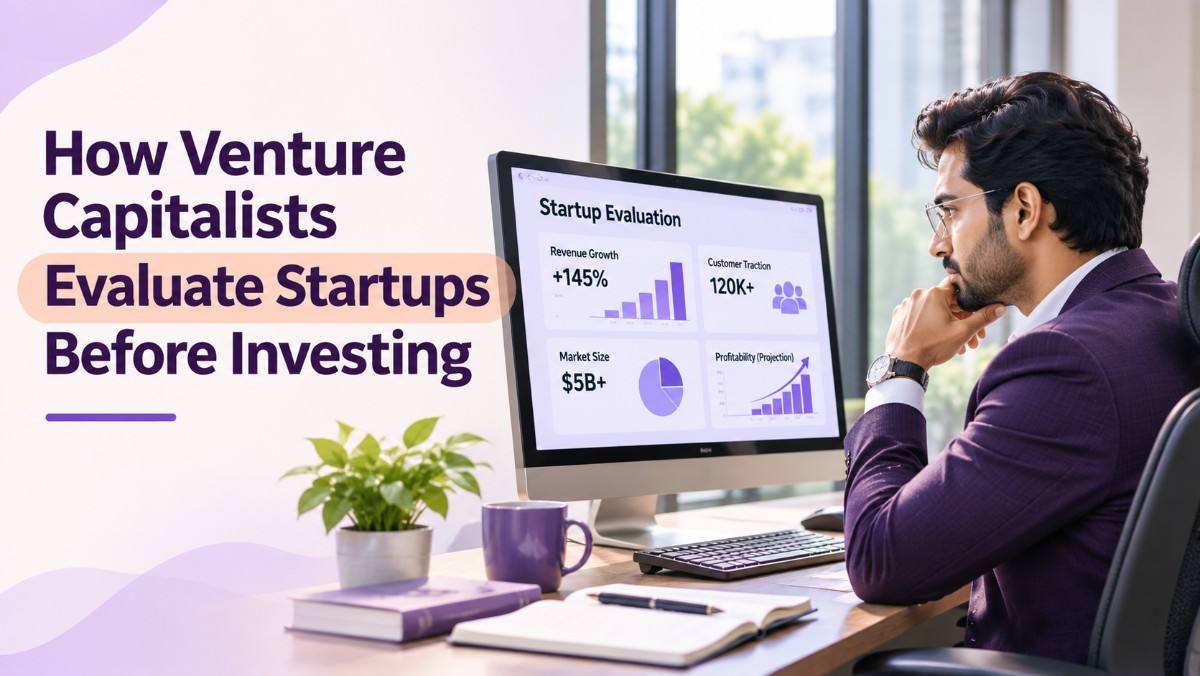
The exact process varies, but many venture capital firms follow a path like this:
1. Initial screening: The firm reviews the startup and its idea to see whether it fits its focus, stage and cheque size.
2. Assessment of founders and management: Investors meet the team and judge its capability and coachability.
3. Market and competitor research: They test the claims about market size, demand and competition.
4. Business model and financial evaluation: They examine revenue, costs, unit economics and projections.
5. Review of traction and growth potential: They look at customer data, growth rates and retention.
6. Due diligence and risk assessment: Legal, financial and operational checks verify the information provided.
7. Valuation and negotiation: If the investor is still interested, both sides negotiate the valuation and terms.
This process can take weeks or months, and many startups drop out at each stage. A rejection often reflects fit, timing or stage and not necessarily the quality of the business.Why Do Some Startups Attract Investment While Others Don't?
It is rarely one factor. Common differences include:
Strong market demand versus an unclear problem: Investors want evidence that people need the solution.
Experienced founders versus limited industry understanding: Relevant insight builds trust.
Sustainable business models versus unclear revenue plans: A defined way of earning money matters.
Demonstrated traction versus unsupported projections: Real customers outweigh optimistic forecasts.
Scalable operations versus limited expansion opportunities: Investors need room for growth.
Financial discipline versus uncontrolled spending: Careful use of capital signals good judgement.
Other factors also matter, including timing, the investor's current focus and general market conditions. Not receiving funding does not mean a startup lacks merit, and many strong businesses grow without outside investment.
What Makes a Startup Investment-Ready?
 Being investment-ready means being prepared to answer an investor's questions with evidence. Typically, this includes:
A clearly defined problem and solution
A well-developed business model
A realistic financial plan
Evidence of customer demand
A capable founding team
A clear growth strategy
A structured pitch deck and supporting documents
Preparing these in advance helps founders also decide whether external investment is right for them, how much they need and what they will use it for.
Conclusion
Investor decisions rest on a combination of market opportunity, founder capability, business fundamentals and growth potential. No single factor guarantees funding, and each investor has their own priorities. For founders, the most useful approach is to focus on building a sustainable business with real customers and sound economics and to treat investment as one possible tool, not the goal. If you do seek funding, preparing thoroughly and understanding how investors think will put you in a stronger position.
Frequently Asked Questions
Why do investors invest in startups?
Investors seek the potential for high returns, early participation in growth, exposure to innovation, portfolio diversification and the chance to support founders. Startup investing carries significant risk, and returns are not guaranteed.
What do investors look for before funding a startup?
They typically look at the founding team, business model, market size and demand, traction, financial health and competitive advantage.
How do venture capitalists evaluate startups?
They screen opportunities, assess the team, research the market, evaluate the business model and financials, review traction, run due diligence and then negotiate valuation and terms.
Why is founder-market fit important for startup investment?
Because early-stage companies change quickly, investors rely heavily on the team's insight, experience and ability to adapt. A strong match between founders and their problem suggests they can navigate challenges.
What makes a startup attractive to investors?
A clear problem, real customer demand, a scalable business model, a capable team, a defensible advantage and disciplined financial management.
Do investors prefer profitability or growth?
It depends on the investor, the stage and the market. Early-stage investors often prioritise growth and potential, while others emphasise unit economics and a path to profitability. Many want evidence of both.
How can a startup become investment-ready?
Define the problem and solution clearly, build a sound business model, gather evidence of demand, prepare realistic financials and create a structured pitch deck.
This article is for general information only and is not investment or financial advice.