Zetwerk IPO Journey: What Startups can Learn From Its Rise to Unicorn
By Rohini Rajpoot · 17 October 2026

Explore Zetwerk's IPO, business model, funding, FY26 financials and five startup lessons for founders planning to scale.
Most startup stories we hear are about apps. Food in ten minutes, a ride at the tap of a button, one more payments product. Zetwerk's story starts somewhere far less glamorous: a project manager, hundreds of vendors and a spreadsheet that refused to stay under control.
That unglamorous problem turned into a Bengaluru company with reported FY26 revenue of ₹15,913 crore, a unicorn badge earned in 2021, and a Zetwerk IPO that opens for bidding on October 15, 2026. For founders, the numbers are interesting. The path that led to them is more useful.
A quick note on how we handle IPO news here, since it moves fast. We keep four things apart: an IPO plan, a filed offer document, regulatory approval and an actual listing. Everything below is accurate as of October 13, 2026, and any date can still change.
Where the Zetwerk IPO stands right now
The easiest way to avoid confusion is to look at each stage on its own.
Stage | What it means | Where Zetwerk is |
IPO plan | The company says it intends to go public | Done. Draft papers were first filed confidentially in spring 2026 |
Filed offer document | A draft prospectus goes to the regulator | Done. An updated draft was filed with SEBI on August 13, 2026 |
Regulatory approval | SEBI clears the company to proceed | Done. SEBI approved the original filing on July 9, 2026 |
Actual listing | Shares start trading on BSE and NSE | Not yet. Tentative date is October 23, 2026 |
The offer itself is a ₹5,012 crore issue made up of a fresh issue of ₹2,830 crore and an offer for sale of about 14.45 crore shares worth roughly ₹2,182 crore. The price band is ₹143 to ₹151 per share, with a minimum bid of 99 shares. Anchor investors bid on October 14, the public issue runs from October 15 to October 19, and allotment is expected around October 21. At the top of the band, the company is being valued at about ₹25,583 crore.
Until shares actually list, none of this is a result. It's a plan with a date on it.
The Zetwerk startup journey: from vendor spreadsheets to a company
Amrit Acharya started his career at ITC, where his first big job was building a factory. That meant working with a crowd of suppliers at once. In a podcast with Prime Venture Partners, he described managing hundreds of vendors on Google Sheets or Excel while a very large amount of money moved through them. He didn't leave that job thinking about software. He left it thinking about how messy manufacturing coordination is.
Zetwerk was founded in 2018 by Acharya with Srinath Ramakkrushnan, Vishal Chaudhary and Rahul Sharma (reports vary slightly on the founding list). The first idea was a software product to help large companies manage suppliers. It didn't stay that way for long. The founders found that big buyers struggled to find good manufacturers, so they turned the product into a marketplace that onboarded smaller manufacturers to serve large customers. Acharya has said the pivot happened before their seed round closed.
There was a second shift that matters even more. A pure marketplace only introduces a buyer to a supplier. Zetwerk moved toward being the party responsible for the order, including specifications, quality and delivery. If you're a founder, that's the part to underline. The company got bigger when it stopped saying 'we connect you' and started saying 'we'll get it done'.
Zetwerk business model, explained plainly
Imagine a company that needs a few thousand tonnes of fabricated steel, or a batch of components with tight tolerances. It could call twenty workshops, compare quotes, chase progress and hope the quality holds. Or it can hand the order to Zetwerk, which finds manufacturing capacity, manages production, runs quality checks and handles delivery. Zetwerk does this through partner suppliers and its own facilities, with a platform called Zetwerk OS for workflow and visibility.
According to reporting on its prospectus, the business has two arms. The manufacturing business earned ₹9,374.68 crore in FY26, up about 50%. The Ecosystem segment earned ₹6,538.65 crore, which is large in revenue but runs on thin margins. In FY26 the company served 1,802 customers, about 80% of manufacturing revenue came from repeat customers, and its manufacturing order book stood at ₹12,370 crore.
Two details tell you where the model is heading. First, energy products made up roughly 69% of manufacturing business revenue in FY26, so one category does a lot of the work. Second, the share of revenue from products sourced from third-party suppliers fell from 96.51% in FY24 to 80.46% in FY26 as the company leaned more on its own capacity. The early version was very asset-light. The current version wants more control over execution.
Why does that matter for a startup? Because technology alone didn't make Zetwerk valuable. It solved an expensive, repeating problem for large buyers, and technology made that easier to run at scale.
Zetwerk funding and valuation: the unicorn story
 The Zetwerk unicorn story moves faster than most. Kae Capital and Sequoia Capital India (now Peak XV) backed the early rounds. Accel and Sequoia came in at Series A in 2019, followed by Lightspeed and Greenoaks. In February 2021 it raised $120 million in a Series D at a reported valuation of $600 million to $700 million. In August 2021, a $150 million Series E led by D1 Capital Partners valued the company at $1.33 billion, which made Zetwerk a unicorn about three years after its founding.
More capital followed. Ahead of the IPO, Zetwerk reportedly raised ₹500 crore in a pre-IPO round from Bharat Value Fund at a valuation of around $4 billion. Funding data from different trackers doesn't always agree on later rounds, so check any specific figure against company filings before you quote it.
It's worth remembering what a valuation is. A private valuation is the price a few investors agreed on in a negotiated round. A public price band is where the market gets a say. The ₹25,583 crore at the top of the IPO band is a different kind of number from a private round, and neither one tells you whether the business is healthy.
What Zetwerk's financials say about its growth
It's easy to stop at the revenue number. We'd suggest reading the whole table.
Figure (₹ crore) | FY24 | FY25 | FY26 |
Revenue from operations | 12,364.37 | 11,331.86 | 15,913.32 |
Adjusted EBITDA | 97.03 | 322.59 | 421.34 |
Loss before exceptional items and tax (continuing operations) | 426.63 | 121.00 | 80.60 |
Total restated loss | 917.95 | 370.71 | 1,606.17 |
Revenue grew about 40% in FY26 after dipping about 8% in FY25. The continuing business has been losing less money before exceptional items. But the total restated loss widened to ₹1,606.17 crore in FY26, and reporting attributes most of that to exceptional items and discontinued operations, which alone accounted for a ₹641.78 crore loss. Losses narrowed in the June quarter of FY27 to ₹732.98 crore from ₹1,368.47 crore a year earlier, which is progress without profit.
Cash tells another side of the story. Reported net operating cash outflow rose to ₹681.5 crore in FY26 from ₹386.3 crore in FY25. That's not unusual for a manufacturer, where you often pay suppliers before customers pay you. It's the same working capital squeeze that catches smaller startups, just with more zeros. It also explains why debt repayment features so heavily in the plans for the money raised. In the updated draft, about ₹1,800 crore of a ₹2,600 crore fresh issue was earmarked for repaying borrowings. The fresh issue has since grown to ₹2,830 crore, so check the final prospectus for the current split.
A large IPO and strong revenue don't prove a company is profitable or that its shares are attractively priced. They tell you it has scale.
The challenges behind the growth
It's tempting to tell this as an unbroken success story. The prospectus numbers say otherwise.
Customer concentration has risen: the top ten customers made up 35.90% of FY26 revenue, up from 22.37% in FY24. The top ten suppliers accounted for 38.18% of expenses. India provided 82.54% of revenue and the US 14.33%, which exposes the company to tariffs and trade changes. Net revenue retention was 120.24% in FY26 but 87.13% in FY25, so retention hasn't been steady. These figures come from reports of the prospectus. Any investor, or any founder studying the company, should read the risk factors in the filed document itself.
The bigger point is that growth creates complexity. Systems that handle a few orders won't handle thousands, whether you're tracking suppliers, quality or cash.
Five startup-to-IPO lessons from Zetwerk
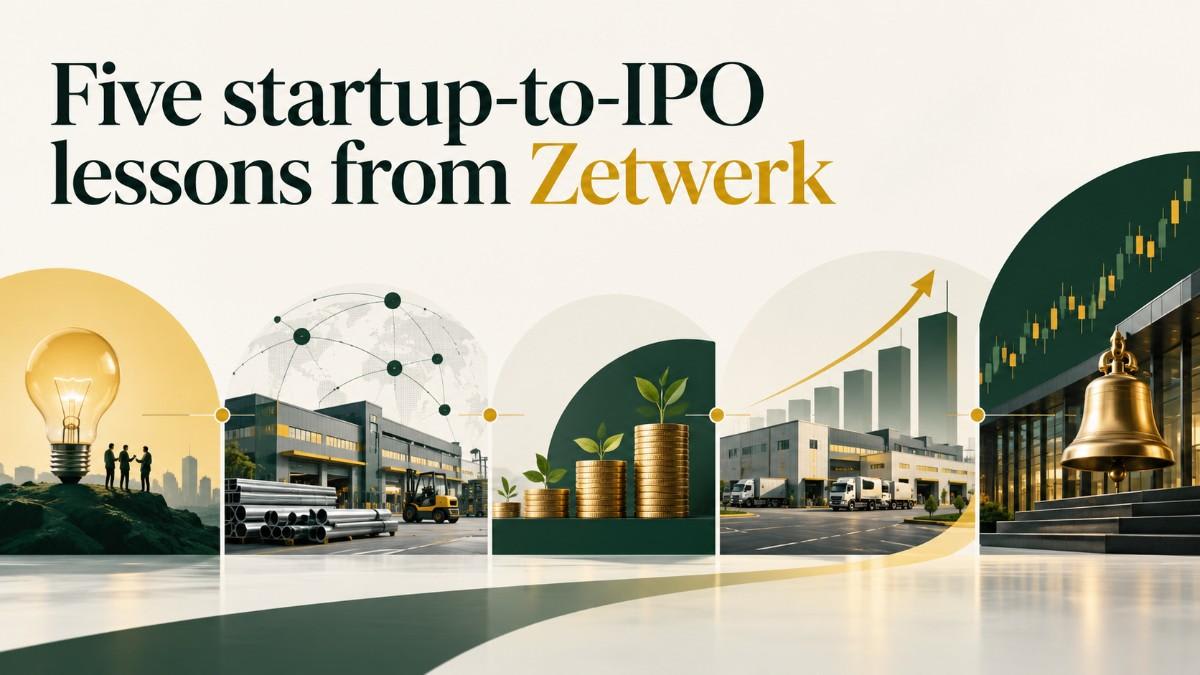
1. Solve a real, expensive problem: Zetwerk went after something large companies already spend heavily on. Ask yourself: who is already paying for this problem in time or money?
2. Know the industry before you build: Acharya's years inside a factory project shaped the idea. Ask yourself: what do you understand about your customer's day that an outsider wouldn't?
3. Don't confuse the software with the business: The platform helps, but trust, delivery, and quality keep customers. Ask yourself: if the product vanished tomorrow, what would customers still pay you for?
4. Build for repeat business: About 80% of manufacturing revenue came from repeat customers. Ask yourself: why would a customer come back without being chased?
5. Scale operations along with revenue: Zetwerk's cash and working capital pressures grew alongside its sales. Ask yourself: would your finance, supplier, and quality processes survive five times the volume?
What early-stage founders can take from Zetwerk's IPO
If you're nowhere near an IPO, good. Most companies shouldn't be. What matters earlier is finding a problem customers will pay to solve, proving demand before expanding, building revenue that repeats, understanding your unit economics, and keeping clean financial reports. Raise capital when it supports a clear plan, not because a round is available.
If unit economics and cash flow still feel fuzzy, start with our guide to startup profitability, which covers margins, burn rate, and break-even in plain language.
How Startup Coach can help
Founders often need help with business strategy, fundraising preparation, financial planning and decisions about when to scale. Startup Coach works with founders on exactly those questions, so growth plans rest on numbers and not hope.
Building a startup with ambitions to scale? Focus on the business fundamentals before chasing the next milestone. Startup Coach can help you approach fundraising and growth with a clearer plan.
Frequently asked questions
1. What is Zetwerk?
Zetwerk is a Bengaluru-based, technology-led manufacturing company that connects industrial and consumer customers with partner suppliers and its own facilities, and manages execution from order to delivery.
2. How did Zetwerk become a unicorn?
It grew quickly by taking on large manufacturing orders for enterprise customers. A $150 million Series E led by D1 Capital Partners in August 2021 valued it at $1.33 billion.
3. What is the Zetwerk business model?
It takes manufacturing orders, matches them to partner suppliers or its own plants, and manages specifications, quality and delivery, supported by its Zetwerk OS platform.
4. What is the Zetwerk IPO date?
The issue is scheduled to open on October 15, 2026 and close on October 19, with a tentative listing on October 23. Dates are subject to change, and the company has not listed yet.
5. What can startups learn from Zetwerk?
Solve an expensive problem, know the industry, build for repeat business, and scale operations alongside revenue.
Conclusion
Zetwerk shows that a large business can be built around a problem most consumers never notice, as long as companies depend on it every day. Its IPO adds a new test: what changes when a private startup answers to public-market investors.
The takeaway isn't to copy Zetwerk's exact model or chase unicorn status. It's to find a meaningful problem, build something customers rely on, and put in the systems you'll need to scale.
Build a business that deserves to grow before worrying about how big its valuation can become.