Why AI Infrastructure Could Be India's Next Billion-Dollar Startup Opportunity
By Rohini Rajpoot · 25 September 2026
Explore AI infrastructure in India, from GPU cloud and data centers to AI chips, hardware and networking, and the opportunities for startups.
For the last few years, most of the excitement around Indian AI startups has centered on applications: chatbots, automation tools, SaaS products built on top of large language models. But a quieter, less flashy shift is happening underneath all of that noise. The real bottleneck in India's AI ecosystem isn't a shortage of ideas for AI products. It's a shortage of the computing power, data centers, and hardware needed to actually run them.
This is where AI infrastructure comes in, and it's quickly becoming just as important as the applications built on top of it. As demand for GPUs, cloud infrastructure, and specialized data centers grows across the country, a new question is emerging for founders and investors alike: could AI infrastructure, not AI apps, be India's next billion-dollar startup category?
This blog breaks down what AI infrastructure actually means, why India needs more of it, where the biggest opportunities lie, and what it would take for a founder to build a serious business in this space.
What is AI infrastructure?
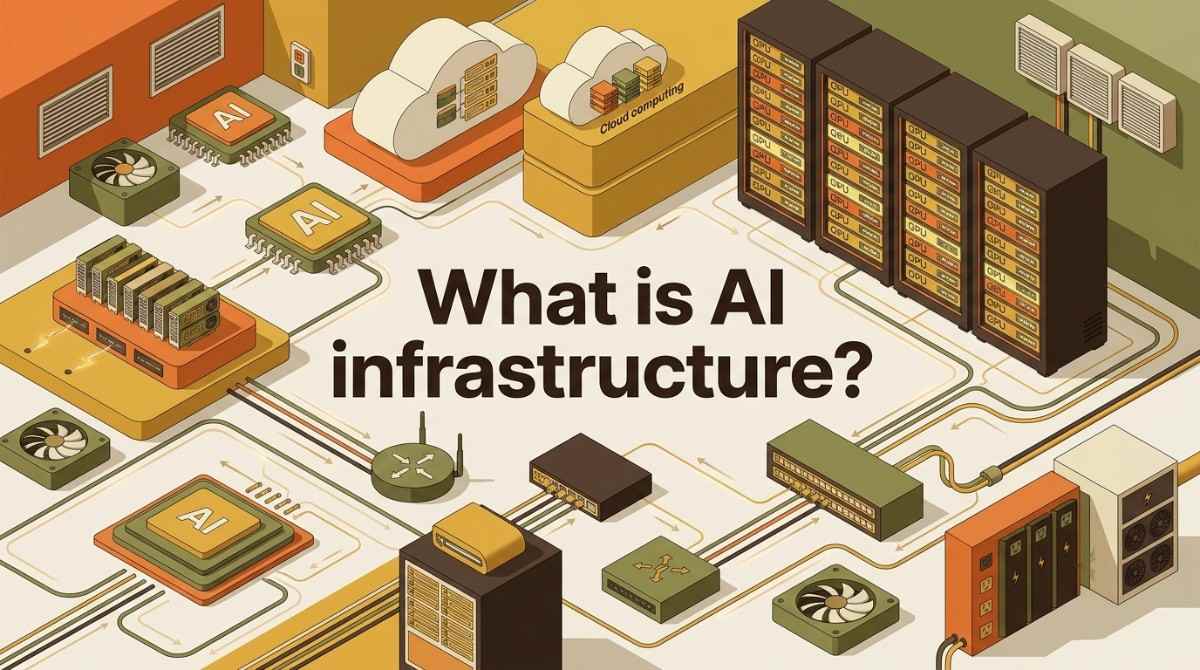 Before diving into opportunities, it helps to define the term clearly. AI infrastructure refers to the underlying technology stack that makes AI development, training, and deployment possible. It includes:
GPUs and AI accelerators, the specialized chips that power model training and inference
Data centers, the physical facilities that house servers and computing hardware
Cloud computing platforms, which provide on-demand access to compute resources
AI chips, custom-built processors designed specifically for AI workloads
Storage and networking, the systems that move and hold massive datasets
Model training and deployment infrastructure, the tools and platforms that let companies actually put AI models into production
AI infrastructure differs from traditional cloud infrastructure in one key way: AI workloads are far more compute-intensive, power-hungry, and specialized. A standard web hosting server isn't built to train a large language model. This gap between traditional infrastructure and AI-ready infrastructure is exactly where the opportunity lives.
Why does India need more AI infrastructure?
India's AI adoption curve is steep and getting steeper. A few forces are driving this:
Rapid growth in AI adoption across both consumer and enterprise segments
Rising computing demand as more companies move from experimenting with AI to deploying it at scale
A growing number of AI startups that all need affordable, reliable compute to build and train their models
Enterprise adoption of AI, with large businesses integrating AI into operations, customer service, and product development
The need for faster, more affordable compute that doesn't force Indian startups to rely entirely on expensive overseas providers
Reducing dependence on foreign infrastructure, which matters both economically and strategically
Right now, a large share of India's AI compute needs are served by international cloud providers. That's not sustainable long-term, either financially or strategically, which opens the door for domestic players to step in.
GPU cloud computing: the infrastructure AI startups need
 If there's one resource every AI company needs and struggles to get enough of, it's GPUs. GPU cloud computing refers to on-demand access to graphics processing units, the chips that make AI model training and inference possible at scale.
GPUs are critical because training large models requires massive parallel processing power that traditional CPUs simply can't deliver efficiently. But GPU availability in India remains a real challenge. Global shortages, high import costs, and limited domestic supply all make access expensive and inconsistent.
This creates a clear opportunity for Indian startups offering GPU-as-a-service, renting out compute capacity to startups, enterprises, researchers, and developers who need it without the massive upfront cost of buying hardware outright.
Sovereign AI infrastructure: why India wants its own AI stack
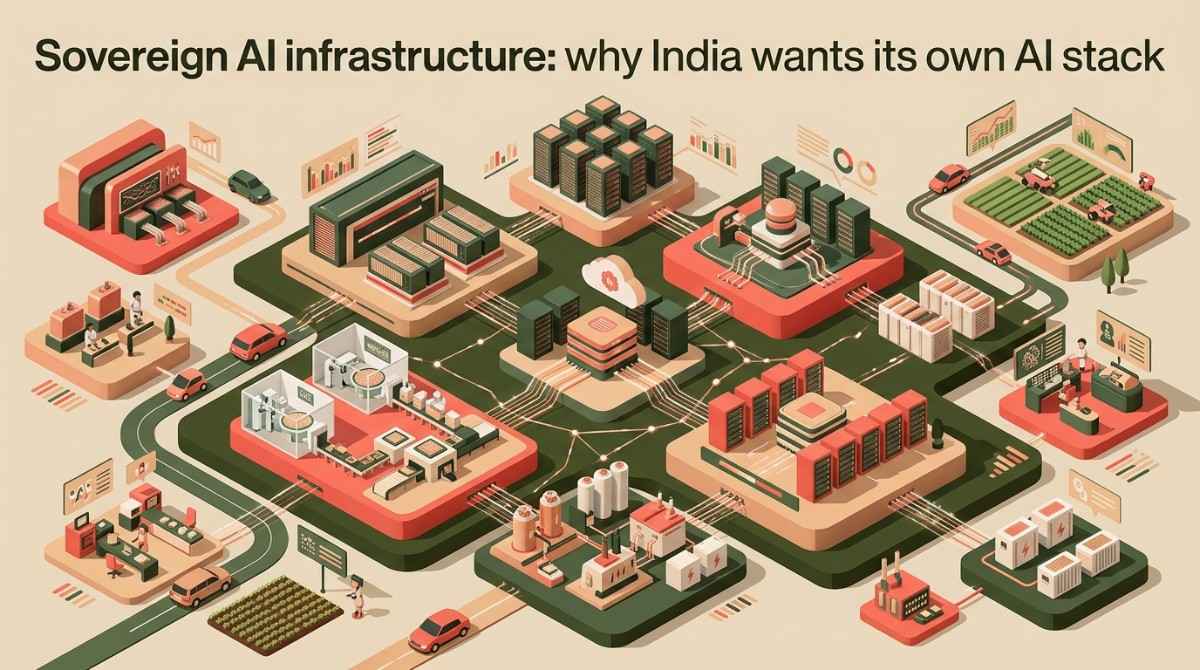 Sovereign AI infrastructure refers to a country's ability to build, train, and run AI models using its own compute, data, and infrastructure, without depending on foreign providers.
This matters for a few reasons. Data privacy and national security concerns mean sensitive information shouldn't always have to leave the country to be processed. Strategic independence means India's AI capabilities shouldn't be hostage to another nation's export policies or pricing decisions. And economic value means building infrastructure domestically keeps investment, jobs, and expertise within the country.
India's government and private sector are both pushing toward greater domestic AI capability, and this push creates real openings for startups building local AI infrastructure, particularly those that can partner with government initiatives or serve enterprise clients who need data to stay within Indian borders.
AI data centers: A massive infrastructure opportunity
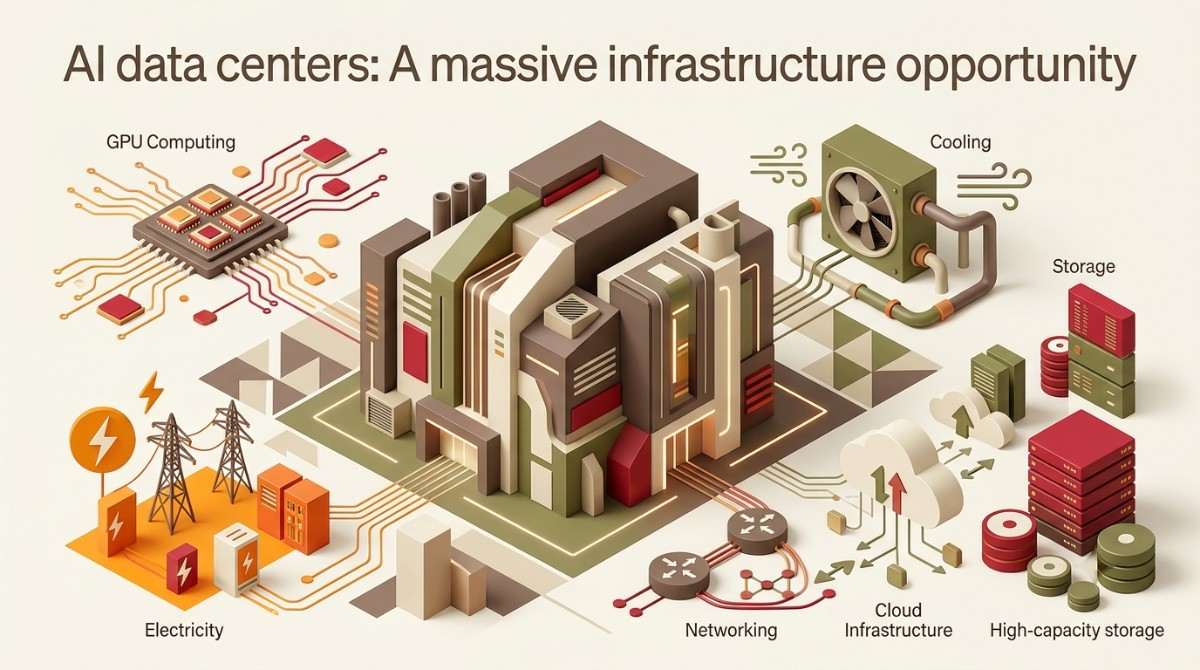 Not all data centers are created equal. Traditional data centers were built for web hosting, storage, and general computing. AI workloads demand something different: higher power density, advanced cooling systems, and hardware optimized for parallel processing.
Building AI-focused data centers involves solving problems that traditional data centers never had to deal with, including massive power and cooling requirements, high-performance computing infrastructure, and specialized hardware configurations for training versus inference.
Demand for this kind of infrastructure is growing fast, driven by AI companies scaling their operations and enterprises wanting dedicated, secure capacity. For founders with the capital and technical expertise to build in this space, AI data centers represent one of the most capital-intensive but potentially defensible opportunities in the entire AI infrastructure category.
AI chips and hardware: the next layer of the opportunity

Beyond cloud and data centers sits an even deeper layer of opportunity: the chips themselves. AI chips matter because general-purpose processors are increasingly inefficient for AI-specific tasks. Specialized accelerators, whether GPUs or custom AI chips, deliver far better performance per watt.
Opportunities in this layer include chip design for AI-specific applications, AI hardware manufacturing suited to India's growing semiconductor ambitions, participation in the broader semiconductor ecosystem India is trying to build, and hardware built for AI inference and edge computing, where models run locally on devices rather than in the cloud.
This is a harder, longer-term category to break into. It requires deep technical expertise and significant capital. But it's also a category where India's semiconductor push could create meaningful first-mover advantages for the startups that get there early.
Where are the biggest AI infrastructure startup opportunities?
Pulling it all together, here are the areas where founders have the clearest openings right now:
GPU cloud platforms
AI data centers
AI chip design
AI hardware manufacturing
AI networking infrastructure
AI storage solutions
Edge AI infrastructure
Model deployment platforms
AI security infrastructure
Cooling and energy solutions for AI facilities
Some of these are accessible to smaller, leaner startups. Others require serious capital and infrastructure partnerships from day one. Understanding which layer fits a founder's resources and expertise is the first step toward building something real.
Why investors are paying attention to AI infrastructure
Venture capital interest in AI infrastructure has been climbing steadily, and for good reason. A few factors make this category attractive from an investment standpoint:
Demand for AI compute isn't slowing down; it's accelerating. Infrastructure businesses create high barriers to entry, since competitors can't easily replicate capital-intensive assets like data centers or chip fabrication. These businesses often generate recurring enterprise revenue rather than one-time sales. The addressable market is large, spanning startups, enterprises, government, and research institutions. And demand for compute is a long-term structural trend, not a short-term fad.
For investors looking at venture capital AI investment in India, infrastructure plays offer something applications often can't: durable, defensible market positions.
AI infrastructure vs, AI applications: where is the bigger opportunity?
AI Applications | AI Infrastructure |
Consumer and enterprise products | Compute and infrastructure |
Faster product cycles | Longer development cycles |
Easier market entry | Higher barriers to entry |
Often dependent on infrastructure | Provides the underlying layer |
Competition can be high | Infrastructure can create stronger moats |
Neither category is inherently better than the other. Applications move fast and can reach product market fit quickly. Infrastructure moves slower but tends to build deeper, harder to replicate competitive advantages. The right choice depends heavily on a founder's resources, timeline, and risk tolerance.
The business models behind AI infrastructure startups
AI infrastructure startups can generate revenue in several ways, including GPU-as-a-Service subscriptions, cloud subscription pricing, usage-based or pay-as-you-go pricing, enterprise contracts and long-term service agreements, infrastructure leasing arrangements, data center services, direct hardware sales, and infrastructure management and maintenance services.
What makes these models compelling to investors is scalability combined with high switching costs. Once an enterprise builds its systems around a particular infrastructure provider, moving away becomes expensive and disruptive, which creates sticky, recurring revenue over time.
The challenges of building AI infrastructure in India
It wouldn't be fair to paint this opportunity without acknowledging the real obstacles founders face:
Extremely high capital requirements sit at the top of the list, since data centers, hardware, and chip development all demand significant upfront investment. GPU availability remains inconsistent due to global supply constraints. Electricity and cooling costs can make operations expensive, particularly at scale. Data center infrastructure itself takes time and money to build properly. Semiconductor supply chains are complex and often dependent on international partners. Hardware manufacturing complexity requires specialized technical knowledge that's still scarce in India. Skilled technical talent in this specific niche is limited compared to demand. Payback periods tend to be long, testing investor patience. And competition from established global cloud providers like AWS, Google Cloud, and Microsoft Azure is intense.
None of these challenges are disqualifying, but founders need to go in with realistic expectations about the capital and time required.
What investors will look for in AI infrastructure startups
Given the capital intensity of this space, investors tend to be selective. They typically look for a strong technical team with real domain expertise, a clearly defined infrastructure problem being solved, proprietary technology or a genuine technical edge, reliable and scalable infrastructure, a demonstrable cost advantage over alternatives, proven enterprise demand, strong unit economics even at an early stage, a credible path to scalability, strategic partnerships with hardware or cloud providers, and a clear path to revenue rather than just a compelling vision.
Founders who can check most of these boxes stand a much better chance of raising the capital this category demands.
Read More: Startup Strategy Terms
How Indian founders can enter the AI infrastructure market
For founders considering this space, here's a practical roadmap:
Identify an infrastructure bottleneck. Find a specific, painful gap in India's current AI infrastructure landscape.
Validate enterprise demand. Talk to potential customers before building anything at scale.
Choose the right infrastructure layer. Decide whether GPU cloud, data centers, hardware, or another layer fits your resources and expertise.
Build technical expertise. This category rewards deep technical credibility, not just business acumen.
Develop a proof of concept. Prove the technology works before scaling capital-intensive operations.
Partner with hardware and cloud providers. Strategic partnerships can offset some of the capital burden.
Understand capital requirements upfront. Know exactly how much funding this path demands before committing.
Build a scalable revenue model. Design pricing and contracts that grow predictably with usage.
Target enterprise customers. Enterprises typically offer more stable, higher-value contracts than smaller clients.
Plan for long-term infrastructure growth. This isn't a fast exit category. Build with patience in mind.
Is AI infrastructure India's next billion-dollar opportunity?
The honest answer is: it depends on execution. Demand for AI compute in India is genuinely increasing, and several infrastructure layers, from GPU cloud to data centers to chip design, offer real startup opportunities. Infrastructure businesses can be difficult to build, but that difficulty is exactly what makes them defensible once established.
Success in this category will come down to capital, technology, and execution working together. Founders shouldn't jump into AI infrastructure simply because it's trending. The opportunity is real only for those who identify an actual infrastructure problem worth solving and have the resources and patience to solve it properly.
Conclusion
India's AI opportunity is expanding well beyond the applications layer. GPUs, data centers, cloud platforms, chips, networking, and the supporting technologies around them are becoming critical parts of the country's broader AI ecosystem.
This opportunity is significant, but it isn't easy. Building AI infrastructure requires capital, technical expertise, patience, and disciplined execution. The founders who succeed here won't be the ones chasing a trend. They'll be the ones who identify real bottlenecks in India's AI stack and build businesses capable of solving them at scale.
Building an AI infrastructure startup? Startup Coach can help you turn your technology opportunity into a scalable, investor-ready business.
Frequently Asked Questions
Q1. What is AI infrastructure in India?
AI infrastructure refers to the computing resources, including GPUs, data centers, cloud platforms, chips, and networking systems, that support the training and deployment of AI models within India.
Q2. Why does India need AI infrastructure startups?
India's growing AI adoption has outpaced its domestic infrastructure capacity, creating dependence on foreign providers and driving demand for local, affordable, and reliable compute solutions.
Q3. What are the biggest AI infrastructure opportunities in India?
Key opportunities include GPU cloud platforms, AI data centers, chip design, AI hardware manufacturing, edge AI infrastructure, and model deployment platforms.
Q4. What is sovereign AI infrastructure?
Sovereign AI infrastructure refers to a country's ability to independently build and run AI systems using its own compute, data, and infrastructure, reducing reliance on foreign providers.
Q5. Are AI data centers a good startup opportunity in India?
Yes, though they require significant capital investment. Demand for AI-specific data center capacity is rising quickly as more companies scale their AI operations.
Q6. What are AI infrastructure startups?
These are companies that build and provide the underlying technology, including compute, storage, networking, and hardware, that other AI companies rely on to function.