Bootstrapping vs Fundraising: Which Strategy Works Best for Your Startup?
By Toishaa Soni · 27 January 2026
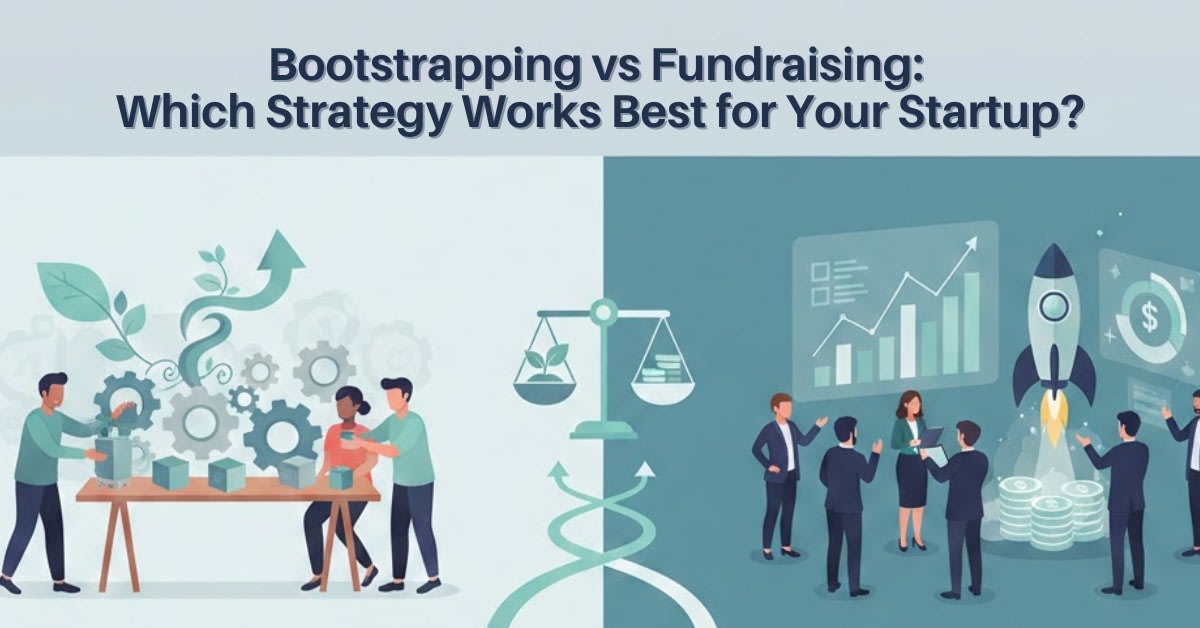
Bootstrapping or fundraising? Compare control, growth speed, dilution, and funding options to choose the right strategy for your startup.
Starting a business is exciting, but one of the earliest and most critical decisions founders face is how to finance that journey. Should you bootstrap and grow at your own pace, or raise external capital to scale faster?
The debate around bootstrapping vs fundraising is not about which option is better. It is about which option fits your startup’s goals, market, and growth strategy. Understanding this distinction early can save founders years of misalignment and unnecessary pressure.
What Is Bootstrapping?
Bootstrapping refers to building a startup using personal savings, internal cash flows, or early revenues without relying on external investors. Some of the most well-known companies started this way, focusing on profitability and sustainability before scale.
The biggest advantage of bootstrapping is control. Founders retain full ownership, make decisions independently, and build the company according to their vision rather than investor expectations. This approach naturally enforces financial discipline, as every expense is closely tied to cash flow.
However, bootstrapping also comes with limitations. Growth is slower, access to resources is constrained, and founders often take on higher personal financial risk. This model works best for startups with lower capital requirements, clear paths to early revenue, and founders who value independence over speed.
What Is Fundraising?
Fundraising involves raising capital from external sources such as angel investors, venture capital firms, accelerators, or strategic partners. Startups typically raise funds in stages, beginning with pre-seed or seed rounds to build products and validate the market.
The primary advantage of fundraising is speed. Capital enables startups to hire faster, invest heavily in product development, expand marketing efforts, and capture market share quickly. Investors also bring mentorship, networks, and credibility, which can significantly accelerate growth.
The trade-off is dilution and reduced control. Founders give up equity and often face pressure to grow aggressively and deliver returns within defined timelines. Strategic decisions may need investor alignment, and the business can shift from long-term sustainability to valuation-driven execution.
Bootstrapping vs Fundraising: How They Differ in Practice
At a practical level, bootstrapped startups prioritize profitability, efficiency, and steady growth, while funded startups prioritize scale, speed, and market dominance.
A SaaS or service-based business with predictable revenue and low infrastructure costs may thrive through bootstrapping. In contrast, deep-tech, Artificial Intelligence, hardware, or large consumer platforms often require significant upfront capital, making fundraising a necessity rather than a choice.
Neither approach is inherently superior. The right choice depends on the nature of the business and the ambition behind it.
Exploring Funding Options for Startups
For founders who decide to raise capital, it is important to choose funding sources aligned with the startup’s stage and needs.
Angel investors and venture capital firms are well-suited for scalable, technology-driven startups targeting large markets. Crowdfunding platforms work better for consumer-facing products with strong storytelling potential. Accelerators and incubators combine funding with mentorship and infrastructure support.
In India, government-backed funding options are often overlooked but increasingly powerful. Schemes such as the Startup India Seed Fund Scheme and the Credit Guarantee Scheme for Startups provide early-stage capital, grants, and collateral-free debt, allowing founders to raise funds while preserving equity.
These government initiatives offer a middle path for founders who want financial support without excessive dilution, especially in the early stages.
The Hybrid Approach: What Many Successful Startups Do
In reality, many successful startups do not choose just one path. They begin by bootstrapping to validate their idea, build early traction, and strengthen unit economics. Once the model is proven, they raise external capital to scale.
This hybrid approach allows founders to raise funding from a position of strength, negotiate better terms, and retain more control. It also reduces the risk of raising capital too early, before the business fundamentals are clear.
Which Strategy Should You Choose?
If your goal is to build a sustainable, profitable business with long-term independence, bootstrapping may be the right fit. If your ambition is to build a category-defining company in a competitive market where speed matters, fundraising can unlock that opportunity.
The real mistake is choosing fundraising as a default or bootstrapping out of fear. Capital is a tool, not a milestone. It should be used intentionally to accelerate a working model, not to compensate for unclear execution.
Startup Coach Perspective
Bootstrapping and fundraising are not opposing choices, they are strategic tools. Many founders either raise funds too early or avoid it without understanding their needs.
Startup Coach believes the focus should be on building a strong, validated business first. Capital should only support growth, not compensate for lack of clarity.
Conclusion
The decision between bootstrapping and fundraising shapes not just how you grow, but how you operate, make decisions, and define success. Both strategies have produced iconic companies, and both can fail if misaligned with the business model.
The winning strategy is the one that aligns with your startup’s capital needs, growth ambition, and founder mindset. With more funding options available today than ever before, founders have the flexibility to design a path that truly works for them. Choose thoughtfully, execute deliberately, and build with clarity.
FAQs
Q- Is bootstrapping suitable for early-stage startups?
Yes, especially for startups with low capital needs and early revenue potential.
Q- When should founders consider fundraising?
When rapid scaling, heavy R and D, or market capture requires significant capital.
Q- Can startups bootstrap first and raise funds later?
Yes, many startups validate first through bootstrapping and raise capital to scale.
Q- Does fundraising reduce founder control?
It involves equity dilution, but control depends on deal structure and alignment.
Q- Which startups benefit most from fundraising?
Deep-tech, AI, hardware, and large-scale platform businesses.