Convertible Notes Simplified for Indian Startups | Advantages, Disadvantages & Legal Guide
By Toishaa Soni · 21 October 2025

Find out what convertible note features, benefits, drawbacks, and legal principles are applicable under Indian law.
Fundraising is one of the greatest challenges startups face, particularly in the initial years. The traditional equity funding involves a lot of time, legal work, and negotiations. Convertible notes are a widely used alternative because they enable startups to quickly raise funds while delaying complex valuation talks, making them a smart startup funding strategy. In simple terms, a convertible note is essentially a loan that gets converted to equity in the future. It allows startups to access funds they need without giving away too much ownership too early.
What is a Convertible Note?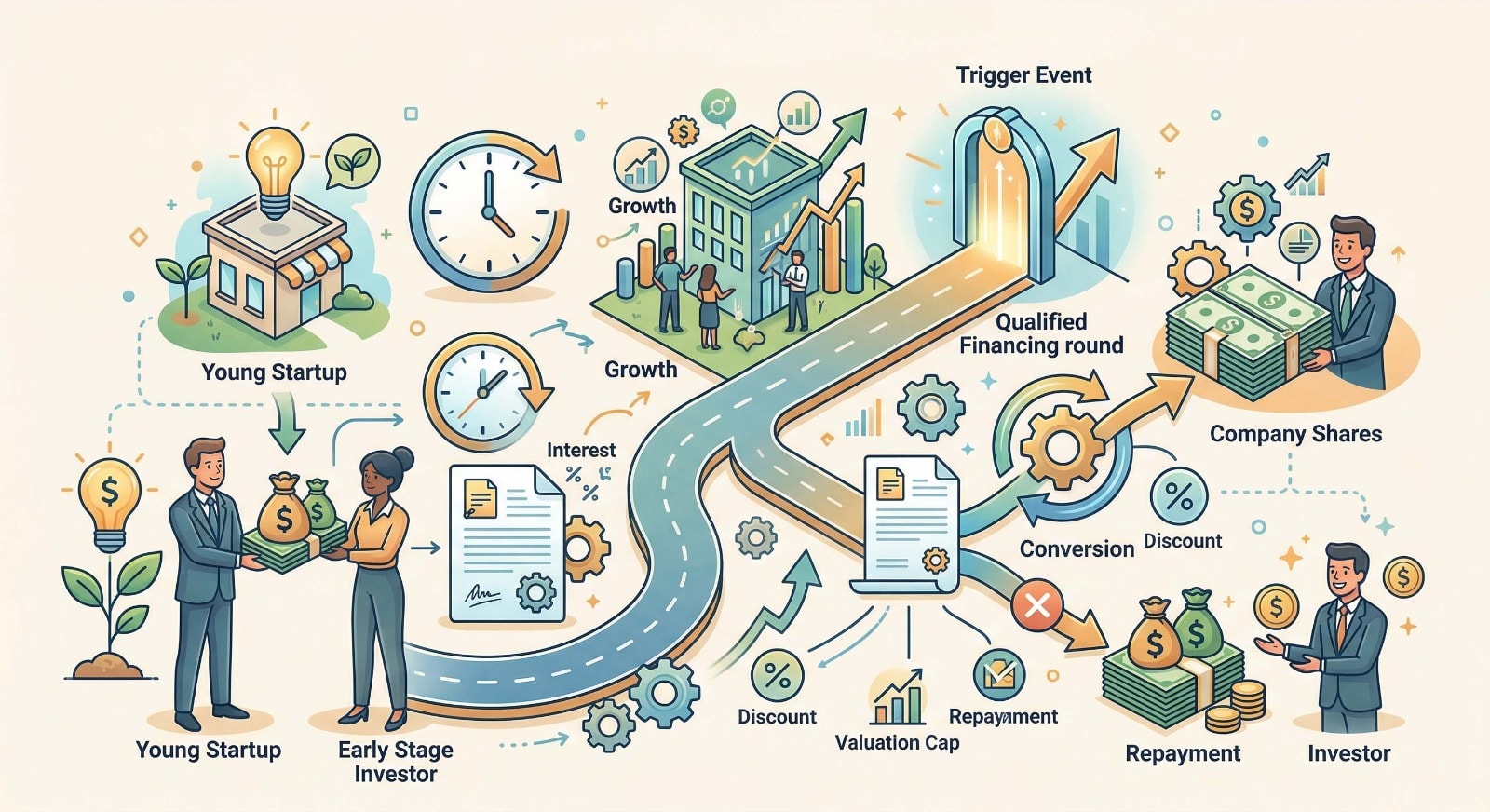 The convertible note is essentially a short-term debt note. Investors invest in a startup on the agreement that this investment would be converted into shares in a future round of funding, often at a discount or some favorable terms. Until the time of conversion, it serves like any loan but with the long-term intention of converting this loan into equity. This process is particularly useful for early-stage startups that do not have any specific valuation yet.
For example, if an investor invests ₹50 lakh into a startup through a convertible note, then it is like lending in the beginning. Once the startup completes the next round of funding, the note is
converted into equity at some discount price such that the investor receives more shares for the same amount of money than new investors.
How Does a Convertible Note Work?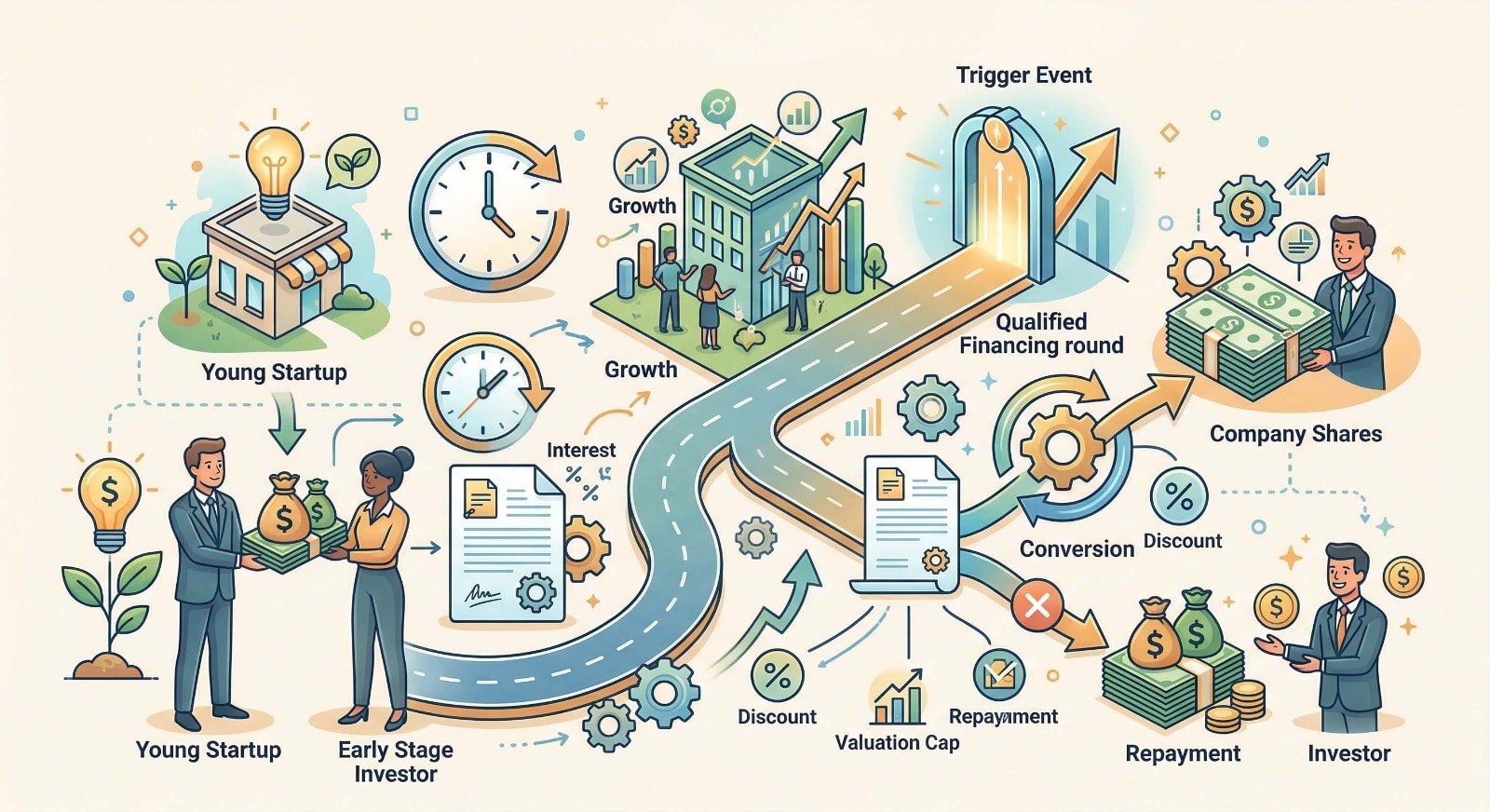 The process can be broken down into simple steps:
1. Investment: They invest their money in the startup in exchange for a convertible note.
2. Agreement Terms: The terms include discount rate, interest rate, valuation cap, and term of maturity.
3. Debt Phase: The note remains a debt on the startup until there's a qualifying funding round.
4. Conversion: At the next round of equity, the note converts into shares, typically at a discounted rate compared to new investors.
5. Benefit to Investors: Early investors are compensated for the risk in the form of discounts or valuation caps.
Advantages of Convertible Notes
· Faster Fundraising: Startups can raise capital quickly without lengthy valuation discussions, allowing them to get funds when timing is crucial.
· Suitable for Early-Stage Startups: Suitable for startups that do not presently have a clear-cut or justifiable valuation, allowing them to delay this process until they gain more traction.
· Lower Legal and Administrative Costs: Convertible note documents are simpler than equity rounds, saving time and money.
· Investor Incentives: Investors receive benefits such as discounts or valuation caps to persuade them to invest at the earliest.
· Flexibility for Founders: The founders can be focused on developing and growing the business without having to negotiate complex equity terms at the beginning.
· Bridge to Future Funding: Convertible notes can act as a bridge between funding rounds, helping startups maintain momentum until the next major investment.
Disadvantages/Challenges of Convertible Notes
· Debt Burden: the note represents a debt on the company's balance sheet until the conversion date, which can create financial pressure if the next funding round takes longer than expected.
· Risk of Over-Dilution: If the valuation cap is set too low, then the founders are at risk of issuing more equity than desired when the notes convert into shares.
· Uncertain Future Funding: If the startup fails to raise a future funding round, it might need to repay the note in cash, which can be stressful on early-stage capital.
· Regulatory Compliance: It can be problematic navigating documentation, filing, and compliance with RBI or MCA regulation, especially for those startups with no experience in the law.
Important Terms to Know
Term | Description |
Discount Rate | The discount on share price is offered to investors when the note is exchanged as an incentive for early investment. |
Valuation Cap | The maximum company valuation at which the note will convert, providing investors a good price. |
Interest Rate | The interest rate is received on the note while it’s debt, usually converting into equity with the principal. |
Maturity Date | The date when the note converts to equity or must be repaid, normally within 1–3 years. |
Conversion Trigger | The event, usually a future funding round, that triggers the note’s conversion to equity. |
Tranche | A portion of the total investment is released at specific stages or milestones, often in larger funding deals. |
Qualified Financing | The minimum funding amount required to make an automatic conversion of the note into shares. |
Use Cases in India
Convertible notes have become a preferred funding option for many Indian startups seeking quick capital before larger rounds.
For example, Kapiva, an Ayurvedic food company, used convertible notes to expand its product range and distribution. Similarly, Petpooja, a restaurant management SaaS firm, raised capital in the form of convertible notes to expand its technology and reach more clients.
Other startups like HealthifyMe and Pocket Aces have also used this method to bridge early funding gaps before major equity rounds. These cases show how convertible notes help startups raise funds efficiently while building traction and securing better valuations later.
Major Players and Trends
There are several noted companies and investors who actively engage in convertible note transactions in India. Venture capital companies like Sequoia Capital India, Accel, Blume Ventures, and Matrix Partners actively use this source of capital for early-stage startups.
Law firms like Cyril Amarchand Mangaldas, Khaitan & Co., and Trilegal enable structuring these deals and compliance.
Founders from companies like Zerodha, Razorpay, and Lenskart have also used or supported convertible notes in their fundraising history. The trend is slowly growing, with more startups using convertible notes and SAFEs for rapid and flexible raising.
Advantages for Startups
1. Faster fundraising – Startups can raise funds quickly as valuation negotiations are postponed.
2. Best for early-stage businesses – Suitable when it is difficult to determine a fair valuation at initial stages of growth.
3. Flexibility – Enables founders to concentrate on growing the business rather than negotiating hard equity terms.
4. Lower costs – Legal and documentation costs are typically less expensive than equity rounds.
5. Investor-friendly – Discounts and valuation protections make investors to be more willing to join.
Future Outlook & Predictions
The use of convertible notes in India is expected to grow as early-stage startups seek faster and more flexible fundraising options. With sectors like SaaS, fintech, healthtech, and consumer brands expanding rapidly, investors are increasingly comfortable with convertible instruments that balance risk and reward.
Hybrid instruments blending convertible notes and SAFEs will also grow more common, simplifying paperwork and accelerating rounds of funding. Improved regulation can also make cross-border investments easier, encouraging more foreign participation.
In total, convertible notes will remain a key tool in India's startup universe, allowing founders to raise early-stage capital easily while keeping space for maneuver in the future to scale and fight over valuations.
Conclusion
Convertible notes are a simple and effective way for Indian startups to raise early-stage funding. They enable entrepreneurs to focus on business growth without worrying about early-stage valuation negotiations and provide investors with incentives in the form of discounts and valuation caps. Startups must take care of potential risks such as debt burdens, dilution, and regulatory issues. With proper planning and expert legal advice, convertible notes can prove to be a handy tool to form and grow a successful startup with expert startup guidance.
FAQs
Q- Is a convertible note issuable by all startups in India?
No, only private limited companies that are considered startups by DPIIT are allowed to issue convertible notes.
Q- What is the minimum size of investment?
The minimum amount of investment is ₹25 lakhs per tranche.
Q- Do convertible notes compulsorily convert into equity?
Usually yes, but repayment can be called upon if a future funding round does not materialize.
Q- How are convertible notes taxed in India?
Tax treatment is based on whether the note is treated as debt or equity at conversion. A tax professional should be consulted.
Q- Why do investors like convertible notes?
Investors receive early entry, discounted stock, and protection in the form of valuation caps, a low-risk means of funding early-stage startups.