How Much Equity Should You Give Investors in a Seed Round? A Founder's Guide
By Rohini Rajpoot · 24 August 2026
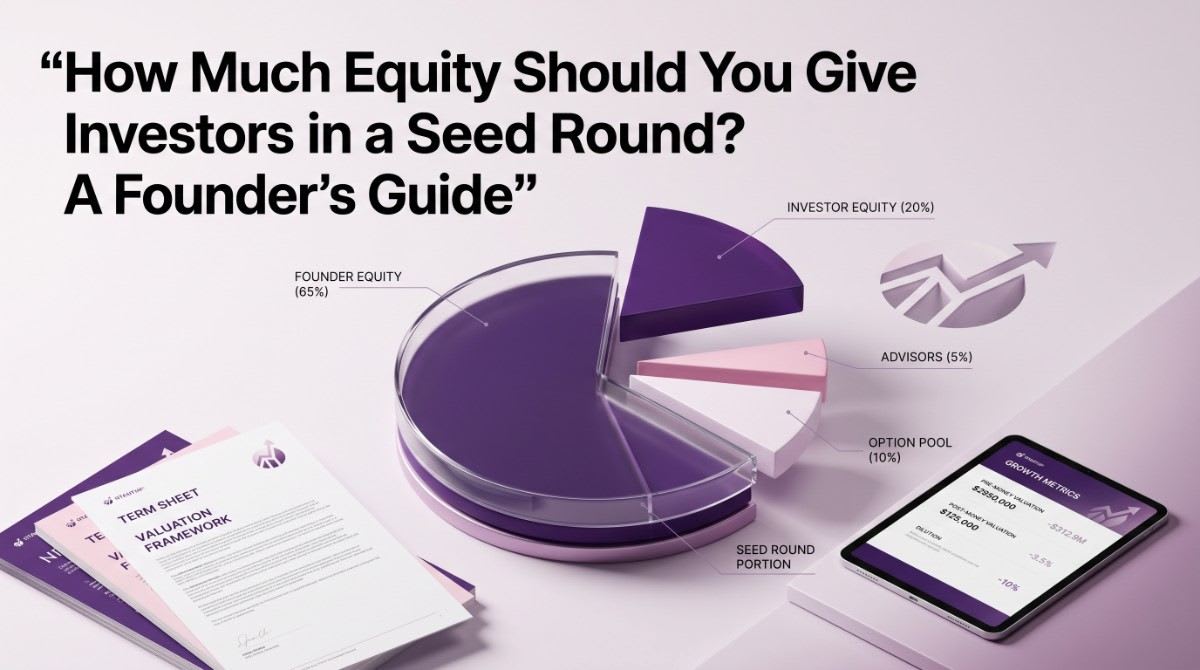
Learn how much equity to give investors in a seed round, understand founder dilution, valuation, option pools, and startup cap table management.
If you're about to raise a seed round, someone has probably already told you "give away 20% and move on." It's not bad advice, but it's incomplete. The right number depends on your valuation, how much capital you actually need, your traction, and how well you negotiate. Founders who treat 20% as a rule instead of a starting point often end up giving away more than they needed to, or scaring off investors by holding on to too much too early.
This blogswalks through how seed equity actually works: the typical ranges, how to calculate your own dilution, what investors look at, and the mistakes that quietly cost founders the most equity over time.
How much equity should you give investors in a seed round?
Most seed rounds land somewhere between 10% and 25%, with the bulk of deals clustering around 15% to 20%. That range isn't a rule, it's just where the market tends to settle because of how investors think about returns. A seed investor writing a check needs the math to work out to a meaningful return if your company succeeds, and 15-20% is usually the sweet spot where both sides can live with the deal. The actual number for you depends on:
How much you're raising
What valuation you and your investors agree on
Your traction so far (users, revenue, waitlist, whatever proof you have)
How competitive your round is
How much runway you need to hit your next milestone
How much you plan to raise in future rounds, and how much room you want to leave for that
The goal isn't to give away the smallest possible slice. It's to raise enough money, at a fair price, to get to your next milestone without running out of cash or handing over more ownership than the round justified. Think of it as controlled dilution rather than dilution avoidance. You're going to give something up. The question is whether you're getting enough in return.
What is seed round equity dilution?
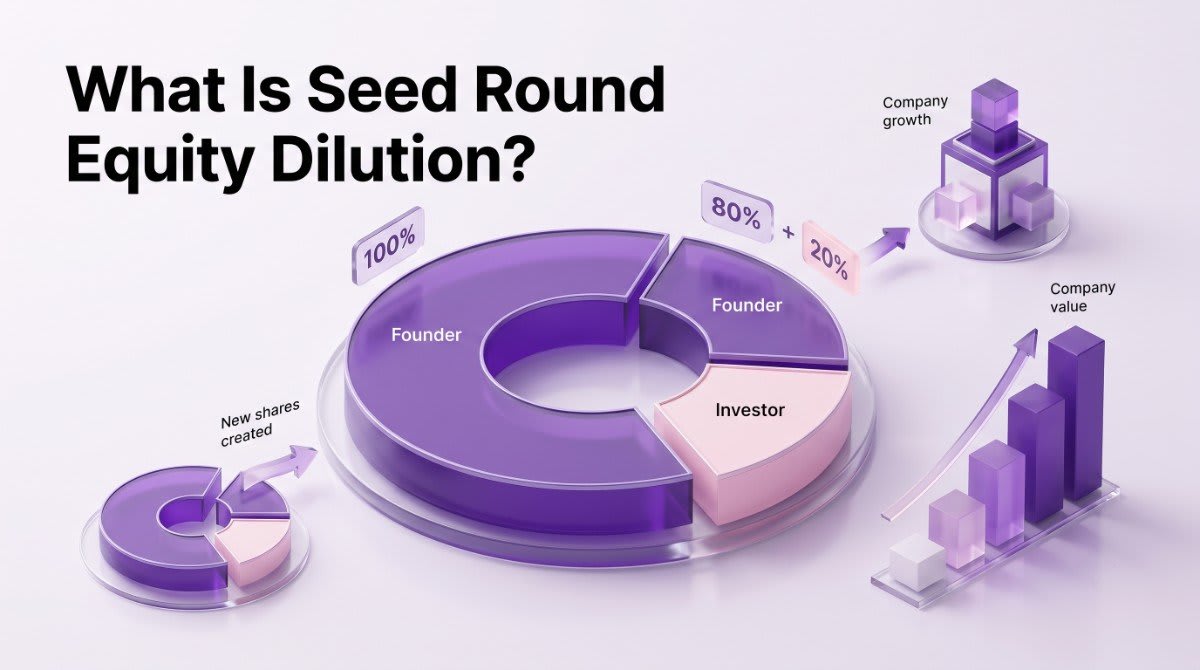 Dilution is simply what happens to your ownership percentage when new shares get issued. Say you own 100% of your company today. The moment you sell 20% to an investor, your slice of the pie shrinks to 80%, even though you haven't sold a single share you already held. New shares were created and sold, and everyone's percentage adjusted to make room.
This confuses a lot of first-time founders because it feels like losing something. In one sense it is. But dilution isn't inherently bad, it's the mechanism that lets you trade a smaller piece of a company that's about to grow much larger for the cash you need to actually make it grow. Owning 80% of a company worth 10 crore is worth a lot more than owning 100% of a company that never gets past the idea stage because it ran out of money.
The distinction worth holding onto: giving away equity for nothing is bad. Giving away equity in exchange for capital that meaningfully increases your company's value is how the whole system is supposed to work.
How much equity do investors typically take in a seed round?
Here's a rough sense of how dilution tends to break down by stage. These are market patterns, not fixed rules, and your actual deal can land outside them for good reasons.
Stage | Typical dilution |
Pre-seed / angel round | 10% to 20% |
Seed | 15% to 25% |
Series A | 15% to 25% |
Series B and later | 10% to 15% |
A few patterns worth understanding:
Earlier-stage rounds tend to involve more dilution relative to the capital raised, because the risk to the investor is higher and there's less proof the company will work. As you gain traction, your valuation goes up, and the same dollar amount buys the investor a smaller percentage.
If a single investor in your seed round is asking for something well above 20%, treat that as a signal to slow down and ask why. It might be justified by an unusually large check or unusually early stage, but it's also the kind of term that can leave you without enough ownership to stay motivated, or without enough equity left to offer future investors and early employees.
Valuation matters more than the percentage itself. Two rounds that both give away 20% can look completely different depending on whether that 20% came from a 5 crore or a 20 crore valuation. Don't anchor on the percentage in isolation.
How to calculate founder dilution
The math is simpler than it looks. Here's the basic formula:
Post-money valuation = Pre-money valuation + Amount raised
Investor ownership = Amount raised ÷ Post-money valuation
Example:
A startup raises ₹2 crore at an ₹8 crore pre-money valuation.
Post-money valuation: ₹8 crore + ₹2 crore = ₹10 crore
Investor ownership: ₹2 crore ÷ ₹10 crore = 20%
Founder ownership after the round: 80%
If there were two founders who each owned 50% before the round, they'd each own 40% after (50% × 0.8), and the investor would hold the remaining 20%. Every existing shareholder gets diluted proportionally unless the deal specifically structures it otherwise.
This is the calculation most founders already know. The part that catches people off guard is what happens when you add an option pool into the mix, which we'll get to shortly.
Pre-money vs Post-money valuation
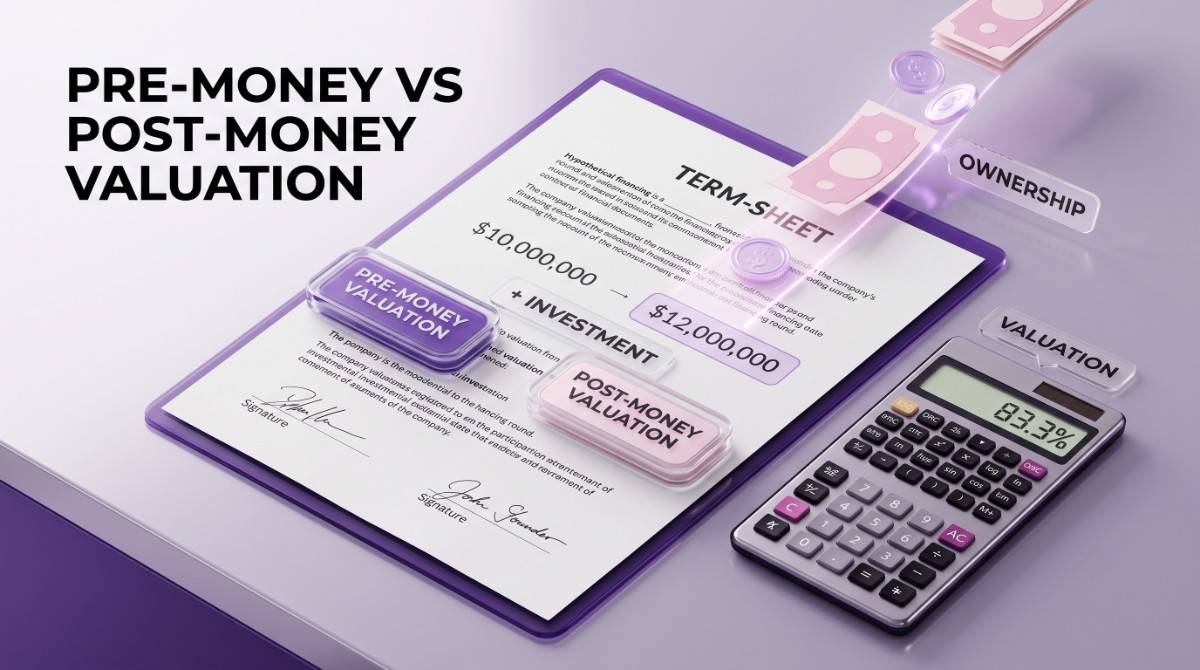 These two terms get mixed up constantly, and mixing them up can change your actual dilution by several percentage points without anyone noticing until the paperwork is signed.
Pre-money valuation is what your company is worth right before the new investment comes in.
Post-money valuation is what your company is worth immediately after, which is just pre-money plus the new cash raised.
Pre-money | Post-money | |
What it measures | Value before the round | Value after the round |
Includes new capital? | No | Yes |
Used to calculate | Founder's existing stake | Investor's new ownership % |
The confusion usually shows up when a term sheet says "we're investing at a 10 crore valuation" without specifying which one. If that 10 crore is pre-money, you're diluting less than if it's post-money, because in the post-money case your original company is only worth 10 crore minus whatever they're putting in. Always ask which one is being quoted before you do any mental math on your ownership.
SAFEs, Convertible Notes, and Priced Rounds
Not every seed check comes in the form of a straightforward equity sale. A lot of seed rounds today use instruments that delay the valuation conversation instead of setting it immediately.
SAFE (Simple Agreement for Future Equity) isn't equity or debt. It's a promise that the investor's money converts into shares later, usually at your next priced round, often at a discount or capped at a specific valuation. Founders like SAFEs because they're fast and cheap to execute. The catch is that if you raise multiple SAFEs across several months at different terms, they can stack up in ways that dilute you more than you expected once they all convert at once.
Convertible notes work similarly but are structured as debt that converts into equity, usually with an interest rate and a maturity date attached.
In India specifically, seed rounds are often structured through equity shares, compulsorily convertible preference shares (CCPS), or instruments like iSAFE notes, which are the Indian adaptation of the standard SAFE. CCPS is common because it gives investors some downside protection while still counting as equity rather than debt for regulatory purposes.
If you're taking multiple small checks before your priced round, it's worth modeling out what happens when all of them convert at the same time. The individual checks might each feel small, but the combined dilution at conversion is often larger than founders expect.
What determines your seed round equity?
A handful of factors shape where you land within the typical range:
Traction: Even a small amount of proof, users, revenue, a working prototype with real signups, shifts the negotiation in your favor. Investors are pricing risk, and traction lowers it.
Revenue and growth: If you have any revenue at all, its growth rate matters more than its absolute size at this stage.
Market opportunity: A large, clearly growing market gives investors more reason to accept a higher valuation, because the upside justifies it.
How much you're raising: Raising more money at the same valuation means giving up a larger percentage. This is often the easiest lever to control, since it's tempting to raise "just in case" when you should be raising for a specific milestone.
Business model: Recurring revenue businesses tend to get priced differently than one-time transaction businesses, even at similar revenue levels.
Founder strength: This isn't just about resumes. Investors look for relevant domain experience, complementary skills between co-founders (commonly one technical, one commercial), and evidence that the team can actually execute, not just ideate.
Your existing cap table: If you've already given away a large chunk to advisors, early hires, or a previous round, that shapes how much room is left and how attractive the deal looks to a new investor.
Future funding needs: A savvy founder thinks two rounds ahead, not just about this one. Giving up too much now can box you in later.
The option pool shuffle (why your real dilution is higher than it looks)
This is the part of seed dilution that catches the most founders off guard, and it rarely gets explained clearly.
Most seed investors require you to set aside an option pool, typically 10% to 20% of the company, reserved for future employee equity grants. The catch is where that pool gets carved out from. If it's created before the investment closes (a "pre-money" pool), the dilution from that pool comes entirely out of the founders' side, not the investor's.
Here's a simplified example. Say you're raising at a 10 crore post-money valuation, with an investor putting in 2.3 crore for 23%. If the deal requires a 20% pre-money option pool, that pool is carved out of the company before the investor's money is added. The founders end up absorbing both the investor's stake and most of the pool's cost, which can push actual founder dilution well past what the headline percentage suggested.
Compare that to a 10% pool instead of 20%, using otherwise identical terms. The smaller pool means less pre-money dilution, and founders can end up owning roughly 10 percentage points more of the company under the same deal terms, just because the pool size changed.
The lesson: don't just negotiate the investment percentage. Negotiate the option pool size too, and understand whether it's coming out of your ownership or the post-money cap table as a whole. This single point of negotiation is often worth more than shaving a point or two off the headline equity number.
How much founder equity should you keep?
It's tempting to fixate on "how much do I own right after this round," but that's the wrong frame. What matters more is whether you're still meaningfully incentivized and in control several rounds from now. Rough reference points, not rules:
After pre-seed: founders often still hold 80% to 90%
After seed: founders commonly land around 60% to 80%
Through Series A: many investors and advisors consider it important for founders to stay above 50%, both for motivation and for maintaining effective control
These numbers move around a lot depending on how many rounds you raise and how large your option pool grows. The practical takeaway is to model your ownership two or three rounds out before you agree to seed terms, not just the round in front of you. A deal that looks fine in isolation can look very different once you see where it leaves you heading into Series A and B.
Startup equity split between founders and investors
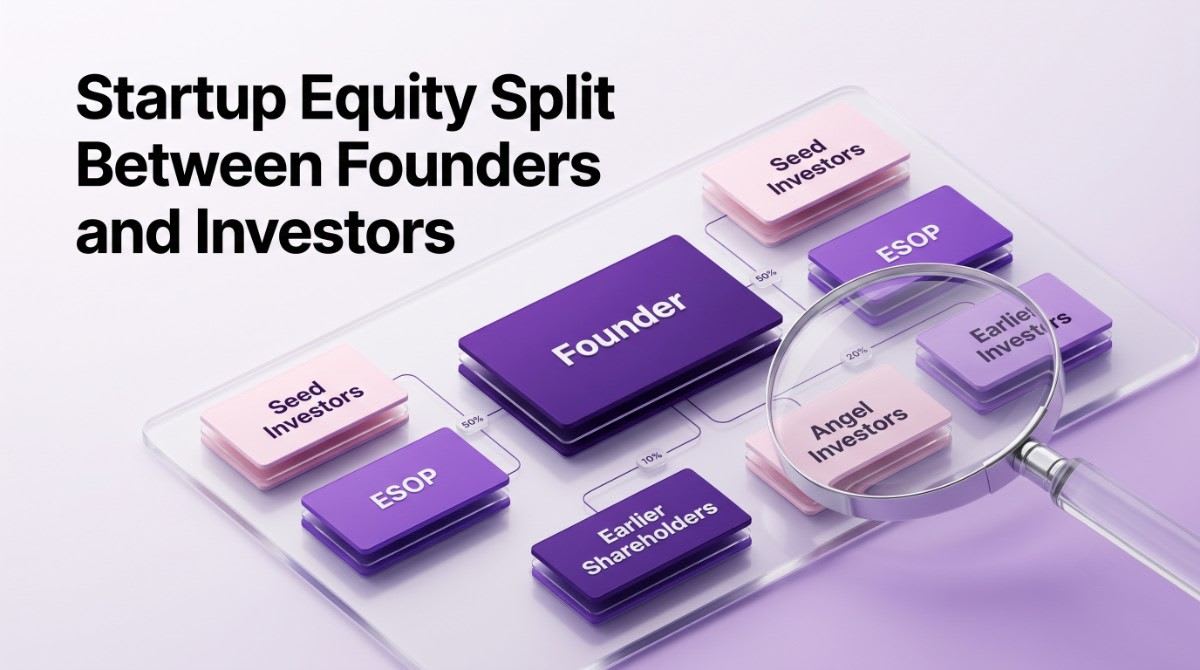 By the time your seed round closes, your cap table usually includes more than just you and the investor. A typical post-seed cap table might include:
Founders
Seed investors
Any angel investors from earlier rounds
The ESOP (employee stock option) pool
Any earlier shareholders, like early advisors or friends-and-family investors
Your cap table is the single source of truth for who owns what, and it's worth keeping clean from day one. Founders who let their cap table get messy, informal handshake equity to early collaborators, unclear vesting, undocumented advisor grants, often find it creates real friction the first time an institutional investor asks to see it.
How angel investors evaluate their equity stake
Angel investors are thinking about a few things when they decide what stake to ask for:
How much they're putting in
What valuation they believe is fair given your stage
How risky the investment is (early-stage is inherently riskier)
What kind of return they'd need to make the risk worth it, angels often think in terms of needing a handful of their investments to return 10x or more to make the portfolio work
How much leverage they have in the negotiation, which depends partly on how many other investors are interested
Angels tend to look closely at the team and the market opportunity more than revenue at this stage, since there usually isn't much revenue yet to evaluate.
How seed funding affects your cap table
A simple before-and-after makes this concrete.
Before funding: Founder A: 60% Founder B: 40%
After a seed round where the investor takes 20%: Founder A: 48% Founder B: 32% Investor: 20%
Both founders' percentages shrink proportionally, but if the round increases the company's overall value, the actual worth of each founder's stake can still go up even though the percentage went down. This is the core trade-off of raising capital: a smaller slice of something bigger is often worth more than a larger slice of something small.
Dilution Across Multiple Rounds
Seed dilution rarely happens in isolation. It's worth looking at how ownership compounds across a realistic fundraising path.
Round | Dilution this round | Founder ownership after |
Starting point | — | 100% |
Pre-seed | 15% | 85% |
Seed | 20% | 68% |
Series A | 20% | 54.4% |
Series B | 15% | 46.2% |
By Series B, a founder who gave up what looked like reasonable amounts at each individual round can already be below majority ownership. None of these individual numbers were unusual, but stacked together they add up fast. This is why it's worth modeling two or three rounds ahead rather than optimizing only for the round directly in front of you.
What Are Anti-Dilution Provisions?
Anti-dilution provisions protect investors if you raise a future round at a lower valuation than the one they invested at, sometimes called a down round. Without protection, a down round would dilute everyone, including the earlier investor, at the new lower price.
Anti-dilution clauses adjust the earlier investor's conversion price so they're partially or fully shielded from that dilution, which means the extra dilution gets absorbed disproportionately by the founders and other shareholders instead.
You don't need to become a lawyer to understand the basic idea, but you should understand roughly how aggressive the clause is (full ratchet protections are much harsher on founders than the more common weighted-average versions) before you sign anything. If the terms feel complicated, that's the moment to get an actual lawyer to walk you through the specific mechanics rather than guessing.
India-Specific Seed Funding Numbers
If you're raising in India, a few local benchmarks are worth knowing:
Indian seed rounds typically range from around ₹1 crore to ₹10 crore
Angel investors in India commonly write checks between ₹10 lakh and ₹2 crore, often through syndicates or angel networks rather than solo checks
Median seed-stage dilution in India has hovered around 19%, broadly in line with global norms
Instruments like CCPS and iSAFE notes are common structures for Indian seed deals, alongside straightforward equity shares
The underlying math doesn't change based on geography, dilution is still investment divided by post-money valuation, but the typical check sizes, the common legal instruments, and investor expectations do vary. It's worth having these local numbers in mind when a term sheet lands so you can tell quickly whether it's in a normal range for the Indian market.
Non-Dilutive Alternatives Worth Knowing About
Equity funding isn't the only option, and it's worth at least being aware of the alternatives before defaulting to giving away another slice of the company.
Venture debt lets you borrow against your existing traction or committed equity funding, usually alongside a round rather than instead of one.
Revenue-based financing ties repayment to a percentage of monthly revenue, which can work well for companies with predictable recurring income.
Grants and government schemes exist in many markets for specific sectors (deep tech, climate, and similar categories) and cost you nothing in equity.
None of these replace equity funding entirely for most early-stage startups, but they're worth understanding as tools that can reduce how much you need to raise through dilutive rounds, especially once you have some traction to borrow against.
Common Equity Mistakes Founders Should Avoid
Giving away too much too early, often out of fear that the deal will fall through if they push back
Focusing only on valuation and ignoring option pool size, board seats, and other terms that affect real ownership and control
Not modeling future dilution, agreeing to seed terms without checking what they mean for Series A and B
Forgetting the ESOP pool's real cost, especially when it's carved out pre-money
Not understanding investor rights, like liquidation preferences or anti-dilution clauses, before signing
Letting the cap table get messy, informal equity promises and undocumented grants that create problems later
Believing the first offer is the market rate, when in reality terms vary widely and there's usually room to negotiate
A related myth worth naming directly: many first-time founders assume that if an investor is willing to fund them at all, they should accept whatever percentage is asked for rather than risk losing the deal. In practice, most experienced investors expect some negotiation, and founders who never push back on any term tend to be the ones who end up furthest outside the normal range.
Conclusion
The goal of a seed round isn't to give investors the smallest possible percentage. It's to raise enough capital at a fair valuation while keeping enough ownership and control to build the company through the rounds that follow. Understand the mechanics, the option pool shuffle especially, model your dilution a few rounds ahead, and negotiate the terms that actually matter rather than fixating on the headline percentage alone. A healthy deal works for both the founder and the investor, and getting there starts with actually understanding the math instead of guessing at it. Need help navigating your startup funding journey? Connect with Startup Coach for expert guidance on fundraising, valuation, equity, and building a stronger path for your startup. Contact us today to get started.
FAQs
1. How much equity should I give investors in a seed round?
Most seed rounds involve giving up 15% to 20%, though anywhere from 10% to 25% is within normal range depending on valuation, capital needed, and negotiating leverage.
2. How much equity do investors typically take in seed funding?
Seed investors typically take 15% to 25% collectively across all investors in the round, with most individual deals landing closer to 20%.
3. What is seed round equity dilution?
It's the reduction in your ownership percentage that happens when new shares are issued to investors in exchange for capital.
4. How is founder equity percentage calculated after seed funding?
Divide the amount raised by the post-money valuation (pre-money valuation plus amount raised) to get the investor's new ownership percentage. Subtract that from 100% to get the founders' combined remaining ownership.
5. What is the difference between pre-money and post-money valuation?
Pre-money is what the company is worth before new investment comes in. Post-money is pre-money plus the new capital raised.
6. How much equity should founders keep after a seed round?
Most founders land somewhere between 60% and 80% after seed, though this depends heavily on option pool size and how much was raised.
7. How much equity should founders have left after seed, Series A, and Series B?
As a rough guide: 60-80% after seed, roughly 45-55% after Series A, and often somewhere in the 35-50% range after Series B, though this varies a lot based on how each round was negotiated.
Meta description: Learn how much equity to give investors in a seed round, understand founder dilution, pre-money and post-money valuation, and build a healthy startup cap table.