How To Get Funding Challenges for a Biotech Startup in India
By Toishaa Soni · 17 November 2025
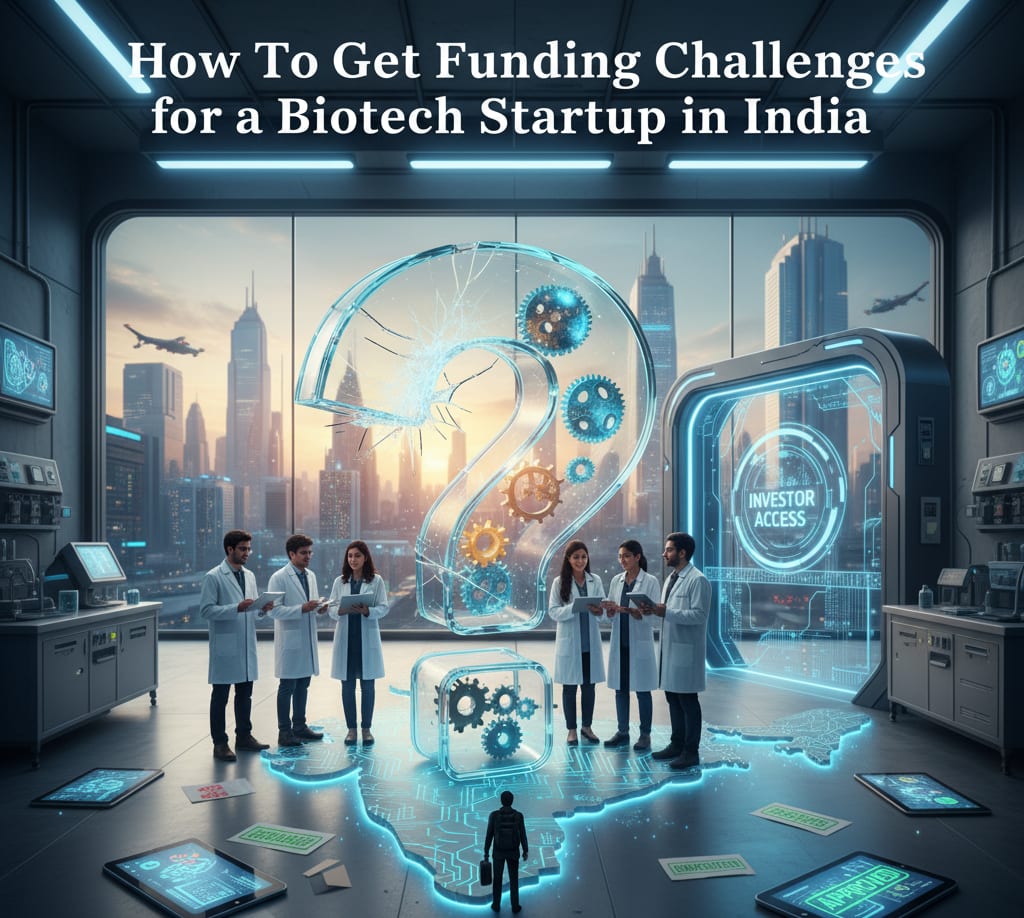
Learn more about funding, challenges, government schemes, private investments, and incubators for biotech startups in India in a simple way.
Biotechnology is one of the fastest-growing sectors in India. It offers important solutions in many areas, like healthcare, agriculture, environment, and biomanufacturing. Despite this, raising initial funding remains the biggest challenge for early-stage biotech startups.
Digital or software-based startups multiply, but biotech companies have to go through a long research process, expensive lab equipment, expert scientists, and strict regulations. Therefore, initial funding is not only important but essential for business growth.
This guide provides comprehensive information for biotech founders, including funding challenges, government support, private investment options, and practical strategies for obtaining funding with a strong business model.
Why Do Biotech Startups Need More Funding?
Biotech startups need strong financial support from the start. Research and development require expensive lab equipment, chemicals, testing machines, and work materials. The product development process is slow because experiments, safety testing, and validation take time.
Regulatory approvals also require time and money. Biotech startups employ highly specialized scientists and technical experts who are both more experienced and cost-effective. Additionally, they require infrastructure such as specialized labs, biological material storage, and testing facilities. This is why initial funding acts as a lifeline.
Key Funding Challenges in India
Biotech product development is time-consuming and does not generate revenue in the early stages.
Initial costs such as lab setup, equipment, and testing are high.
The regulatory approval process is complex and time-consuming.
Many investors do not fully understand the scientific and technical nature of the biotech sector.
Banks and traditional lenders are hesitant to lend to early-stage biotech startups.
The cost of patents, certifications, and compliance places an additional burden on initial funding.
Government Funding Schemes
India has built a strong support system for biotech innovation, led by the Biotechnology Industry Research Assistance Council (BIRAC). Key schemes include BIG for early-stage research, SBIRI for commercialization, and PACE for late-stage scale-up, along with BioNEST incubators offering labs and mentorship.
Additional support comes from the Startup India Seed Fund Scheme, Nidhi Prayas, Nidhi EIR, and the Atal Innovation Mission, which help with prototyping, funding, and incubation.
Several states like Karnataka, Telangana, Maharashtra, Gujarat, and Kerala also provide grants, infrastructure, and ecosystem support for biotech startups.
Private and Institutional Funding Options
Biotech startups become attractive to private investors after receiving the initial validation. A number of venture capital firms in India are keen on healthcare, medtech, diagnostics, genomics, and biotechnology.
Funding and technical support can be provided by partnerships with pharmaceutical companies, hospitals, and research organizations. Angel investors who come from a scientific and healthcare background also believe in early-stage startups.
International organizations like the World Health Organization, the Bill & Melinda Gates Foundation, USAID, and the Wellcome Trust are interested in public health and biotech innovations. Scientific credibility, a clear intellectual property plan, early trial results, and a strong business model are crucial to attracting private investment.
Effective Strategies for Obtaining Funding
Biotech founders can increase their funding prospects by focusing on the following strategies: Early validation shows investors that the idea is viable. Partnerships with universities, labs, and hospitals add credibility. Intellectual property protection strengthens investor confidence.
It is essential to develop a clear development roadmap so that investors understand where and how funds will be used. Joining the right incubator reduces initial costs and provides guidance. The presentation should effectively communicate the problem, solution, scientific basis, market potential, and plan necessary for an investor to make an informed decision.
The Role of Incubators
Incubators have become a critical component in the development of biotech startups, as they deliver advanced labs, equipment, scientific and business guidance, and regulatory support, connecting them with investors. The major biotech incubators in India are C-Camp Bengaluru, IKP Knowledge Park Hyderabad, BITS Biocity Goa, Venture Centre Pune, TEEDs IIT Roorkee, and BioNest centers across the country.
The Future of Biotech Funding in India
The rapid growth of the Indian biotech industry encompasses rapid advances in the following areas: genomics, agricultural biotechnology, vaccines, diagnostic devices, bioenergy, synthetic biology, and environmental biotech. With increasing interest by investors, government support, and a strong research infrastructure, funding opportunities will continue to increase for biotech startups.
Conclusion
Fundraising for a biotech startup in India is not easy, but it's completely achievable with proper guidance and preparedness. Long development processes, complicated regulations, and high costs surely make things tough, but today, more help is available in India than ever.
The integration of government grants, incubators, private investors, scientific evidence, and a clear business strategy will help startups move smoothly from an idea to innovation and finally to market.
If you are building a biotech startup and need the right support for funding and strategy, connect with our experts to get the right guidance.
FAQs
Q- Why do biotech startups find funding difficult?
Biotech startups hardly raise funding because they have to undergo a long development process, invest in a laboratory setup, and also take a longer time for revenue generation.
Q- What is the best government scheme for an early biotech startup?
The Biotechnology Ignition Grant is considered the best scheme for early research and proof-of-concept.
Q- Can biotech startups apply to the Startup India Seed Fund Scheme?
Yes, they can apply through a recognized incubator if they meet the criteria.
Q- Do biotech startups need patents?
While not required at first, patents instill confidence in investors.
Q- What are India's major biotech hubs?
The major biotech hubs in India are Bengaluru, Hyderabad, Pune, Mumbai, and Delhi NCR.