What Are the Different Types of Startup Funding? Complete Guide for Beginners
By Toishaa Soni · 23 February 2026
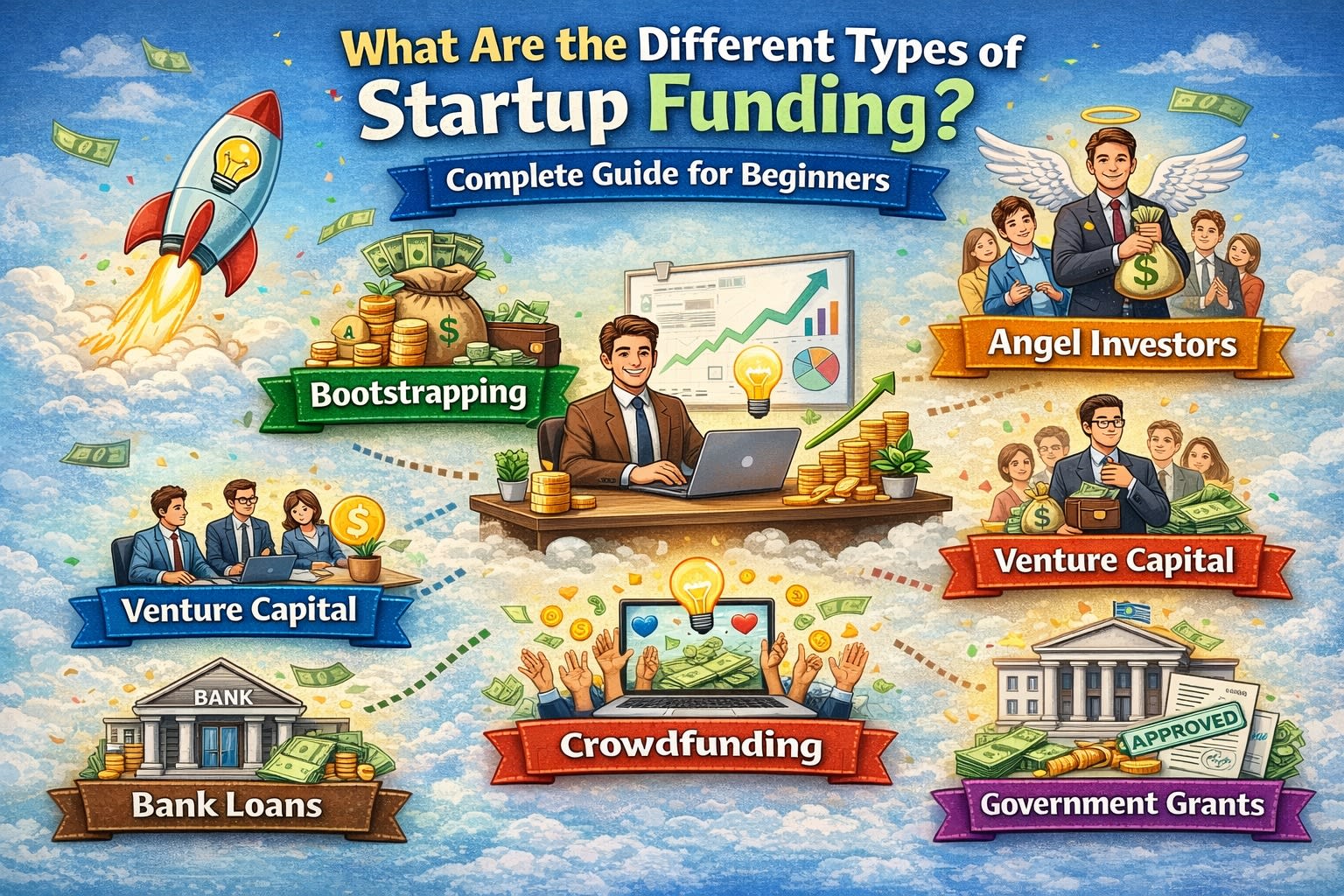
A beginner-friendly guide to startup funding types, from bootstrapping and angel investors to VC, debt, grants, and crowdfunding.
Every startup begins with an idea, but transforming that idea into a viable business requires capital at different stages. One of the biggest challenges founders face is understanding what type of funding to raise and when.
Startup funding is not about raising the maximum amount of money. It is about choosing the right funding structure that aligns with your startup’s stage, business model, and long-term vision. This guide explains the different types of startup funding in simple terms, helping beginners make informed decisions.
Bootstrapping: Self-Funding Your Startup Bootstrapping means building your startup using personal savings or early business revenues. Founders retain full ownership and complete control over decisions.
This approach encourages financial discipline and early focus on profitability. However, growth is usually slower due to limited resources, and founders bear higher personal financial risk. Bootstrapping works well for service-based businesses, SaaS startups with low capital requirements, and founders who prioritize independence.
Angel Investors: Early-Stage Capital and Mentorship
Angel investors are individuals who invest their personal capital in early-stage startups, typically at the pre-seed or seed stage.
Apart from funding, angels often offer mentorship, industry knowledge, and network access. In return, founders give up a portion of equity. Angel funding is ideal when a startup needs capital to build its product, hire an initial team, or validate market demand.
Convertible Notes and SAFE Agreements
Convertible notes and SAFE agreements are flexible funding instruments commonly used in early stages.
They allow startups to raise capital without immediately fixing a valuation. The investment converts into equity during a future funding round. This approach reduces negotiation complexity and speeds up fundraising when valuation is uncertain.
Venture Capital: Scaling High-Growth Startups  Venture capital funding comes from institutional investors focused on high-growth startups.
VC funding typically follows stages. Seed funding validates product-market fit. Series A, B, and C rounds support scaling, market expansion, and operational optimization.
VCs bring large capital, strategic guidance, and credibility. However, founders must give up significant equity and meet aggressive growth expectations. This funding suits startups aiming to build large, scalable businesses.
Debt Financing: Growth Without Equity Dilution
Debt financing includes business loans, working capital facilities, and venture debt.
Unlike equity funding, debt does not dilute ownership. However, it requires regular repayments with interest, making cash flow stability essential. Debt is best suited for startups with predictable revenues and a clear repayment plan.
Crowdfunding: Community-Driven Funding
Crowdfunding allows startups to raise small amounts from a large group of people through online platforms.
It is particularly effective for consumer-facing products and can also serve as a marketing and validation tool. Crowdfunding can be equity-based, reward-based, or donation-based, depending on the platform.
Government Grants and Startup Schemes
Government grants and schemes provide non-dilutive funding to startups, meaning no equity is given up and repayment is not required.
These schemes often support innovation, research, and early-stage development. While competitive, they are valuable for reducing early financial pressure and extending runway.
How to Choose the Right Funding Type  The right funding depends on your startup’s stage, revenue, capital needs, and growth speed.
Early-stage startups often start with bootstrapping or angel funding. As traction increases, venture capital may support scaling. Debt and grants can complement equity at various stages. The key is strategic alignment, not urgency.
Startup Coach Perspective
Funding should support execution, not replace it. Raising money too early or from the wrong source often creates misalignment and pressure.
At Startup Coach, we help founders design funding strategies based on readiness, unit economics, and long-term goals. The smartest funding decisions are intentional and timed correctly.
Conclusion
There are multiple types of startup funding, each suited for different stages and business models. From bootstrapping and angel investment to venture capital, debt, crowdfunding, and government grants, founders today have more options than ever.
Understanding these options early helps startups raise the right capital at the right time and build sustainable, resilient businesses.
FAQs
Q: What is the best funding option for first-time founders?
Bootstrapping or angel funding is often best for first-time founders to validate ideas with minimal dilution.
Q: When should a startup raise venture capital?
Venture capital is suitable when a startup has strong traction and needs capital to scale rapidly.
Q: Is debt financing risky for startups?
Debt can be risky if revenues are unstable, but it works well for startups with predictable cash flows.
Q: Are government grants free money?
Yes, grants are non-dilutive and do not require repayment, but they are competitive and purpose-specific.
Q: Can a startup combine different funding types?
Yes, many startups use a mix of bootstrapping, equity, debt, and grants at different stages.