How Much Does It Cost to Build an MVP in India? 2026 Cost Guide
By Rohini Rajpoot · 26 August 2026
Learn the cost of building an MVP in India in 2026, including pricing by MVP type, development team, features, platform, timeline, and hidden costs.
Type "MVP development cost India" into Google and you'll get five different answers from five different websites, none of them wrong exactly, just answering for five different products. One founder builds a working app for 3 lakh. Another spends 40 lakh and still runs out of runway before launch. The difference almost never comes down to which developer you hired, it comes down to what you actually asked them to build.
So instead of throwing one number at you, here's the actual breakdown, by MVP type, by team, and by the stuff nobody quotes you upfront until you're already halfway through the project.
What is an MVP, actually?
 MVP stands for Minimum Viable Product. Strip away the jargon and it just means the smallest working version of your idea that still solves a real problem for a real person.
Founders build MVPs for one reason. They want to know if anyone actually cares about what they're building before they burn six months and a few lakh finding out the hard way. That said, an MVP isn't a stripped-down demo, and it definitely isn't a rough sketch you show your cofounder over coffee. It works. End to end. It just does less than the final product eventually will. Here's the part people miss: the difference between an MVP and a "real" product is scope, not quality. A finished product tries to handle every scenario a user might throw at it. An MVP is built to prove exactly one thing. Get that one distinction right and your budget stays sane. Miss it, and you'll find yourself six months in with a half-built everything and zero users to show for it.
How much Does It Cost to Build an MVP in India?
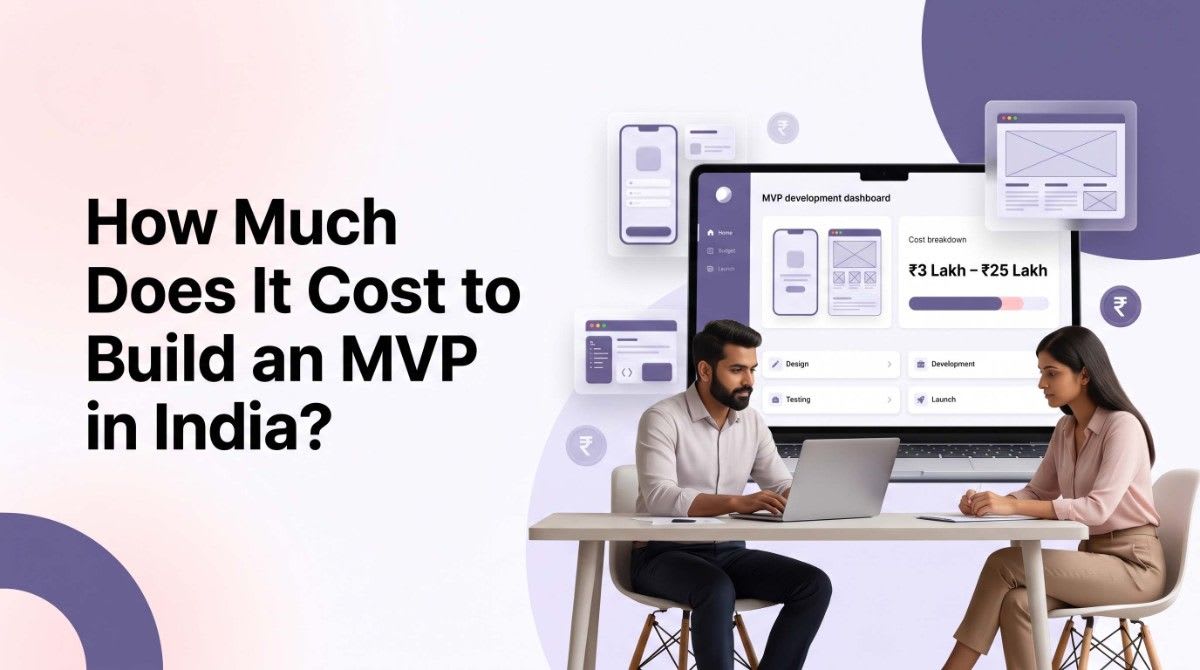
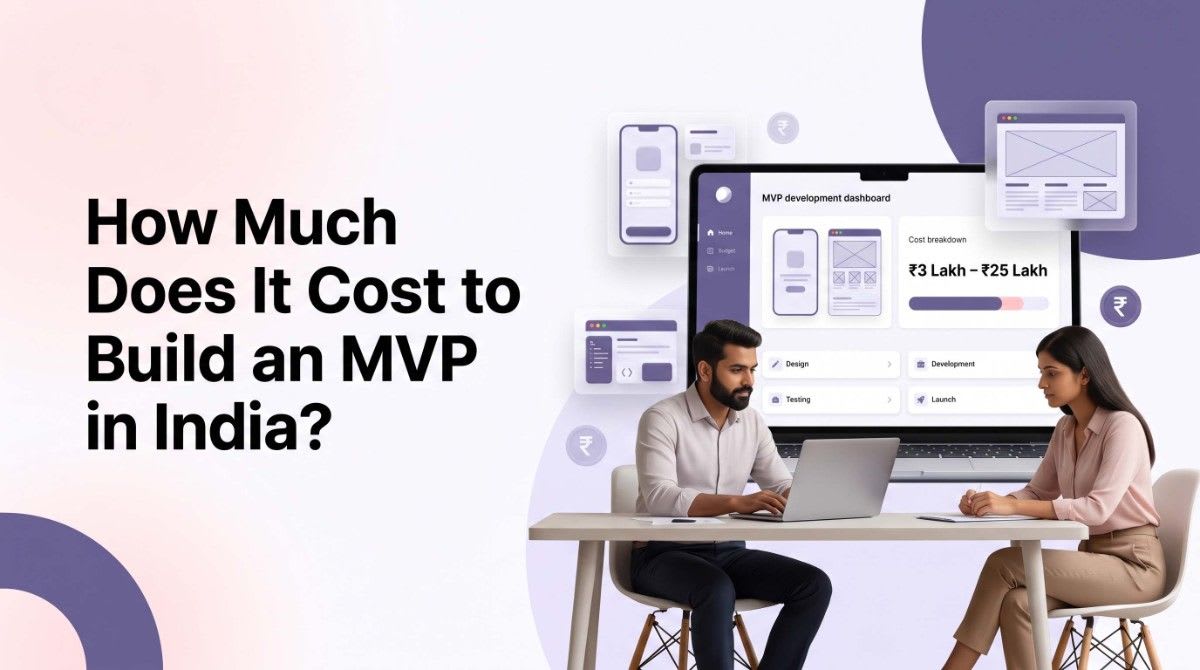 Here's the honest number: startup MVP development in India usually lands somewhere between 3 lakh and 25 lakh, or roughly 15,000 to 45,000 USD for a mid-range build with an experienced Indian team. A bare-bones no-code MVP can slip in under a lakh. On the other end, AI-heavy or compliance-heavy products can blow past 40 to 50 lakh without much trouble.
Why such a wide gap? Because MVP pricing in 2026 comes down to scope far more than which company you hire. When two agencies quote wildly different numbers for what sounds like "the same" MVP, nine times out of ten they're not scoping the same product. One heard "app" and priced a full platform. The other priced exactly what you said and nothing more.
A rough band that most Indian teams price within:
Simple MVP (single platform, basic login, one core workflow): 2 lakh to 6 lakh
Medium-complexity MVP (web and mobile, payment integration, admin panel, multiple user roles): 6 lakh to 18 lakh
Complex MVP (AI features, real-time functionality, marketplace or fintech logic, compliance needs): 18 lakh to 50 lakh and up
What actually pushes a quote up or down inside these bands comes down to a handful of things: how many features you're asking for, whether you need web, Android, iOS, or all three, how custom the design has to look, how heavy the backend is, how many third-party tools you're bolting on, how much real testing gets done, and whether the quote covers maintenance after launch or just stops the day you get the handover email. A number that looks cheap on the surface but skips maintenance, hosting, and post-launch bug fixes isn't actually cheaper. You're just paying for it later, usually at a worse time.
What Determines MVP Development Cost?
1. Number of Features
The single biggest lever, by far. Every screen, every user role, every "oh and can we also add" adds design hours, dev hours, and testing hours you didn't budget for. Experienced founders keep coming back to the same rule: your MVP should do one thing well. Not five things okay-ish.
2. Platform
Web only is the fastest and cheapest way to get something in front of real users. Android or iOS alone adds native development time you can't skip around. Go cross-platform with something like React Native or Flutter and you cover both mobile platforms from a single codebase, usually cheaper than building two native apps separately. Want web and mobile together? That's the priciest combination on this list, and it's only worth it if your users genuinely need it from day one, not because it "feels more complete."
3. Design and User Experience
A clean, functional interface costs a fraction of what a fully custom, animated, brand-heavy design will run you. For a product that still needs to prove people want it, usable beats polished almost every time. Save the beautiful design system for after you've got users.
4. Backend and Database
This is the invisible part of the invoice. Real-time data, complicated business logic, multiple user roles, large datasets, none of it shows up when you're clicking through a demo, but it's exactly what eats engineering hours behind the scenes.
5. Third-Party Integrations
Payment gateways like Razorpay, Stripe, or PayU. Maps and location. SMS, email, or push notifications. Login through Google, Apple, or OTP. Each one looks small on its own. Stack three or four together and you're often looking at 15 to 25 percent added to the total build.
6. Development Team
A freelancer gets you the cheapest hourly rate, but you're taking on more risk around consistency and whether they're even available when you need them. An agency costs more per hour but brings a structured process and project management baked in, which usually means less coordination headache on your end. An in-house team costs the most upfront, and makes the most sense only if you're planning to keep building well past the MVP stage.
MVP Development Cost by Type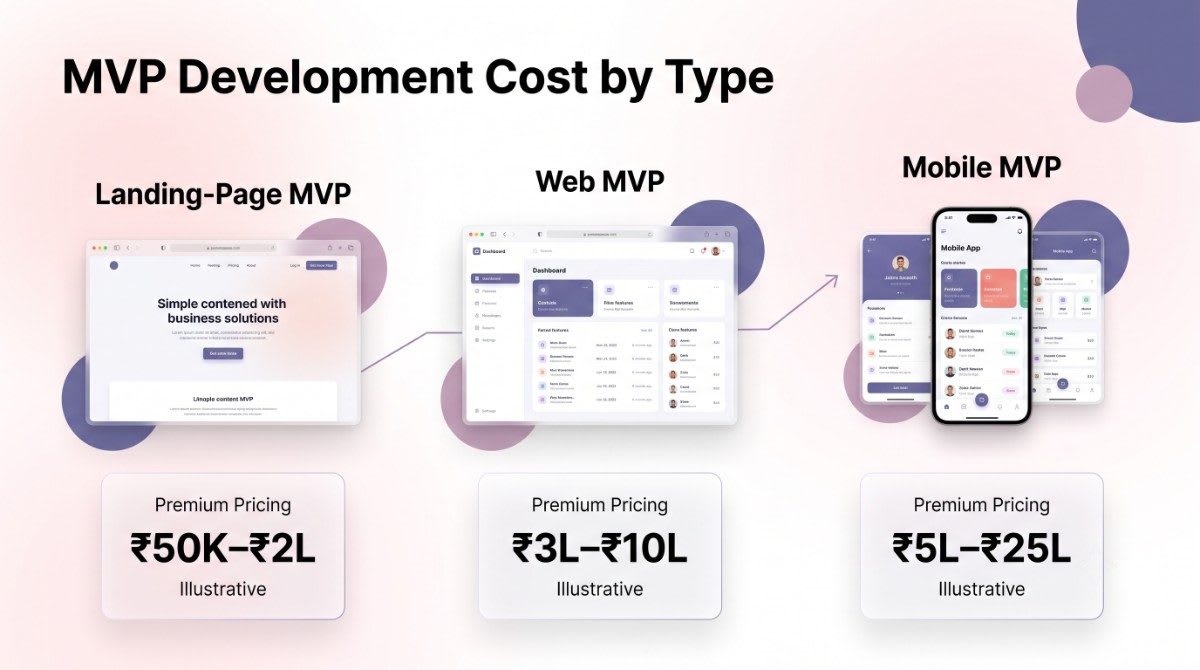
MVP Type | Complexity | Typical Cost (India) | Typical Cost Factors |
Landing-page MVP | Low | Rs 30,000 to Rs 1.5 lakh | Design and hosting only |
No-code MVP | Low to Medium | Rs 50,000 to Rs 4 lakh | Platform subscription plus setup |
Web MVP | Medium | Rs 3 lakh to Rs 10 lakh | Frontend plus backend build |
Mobile MVP | Medium to High | Rs 6 lakh to Rs 20 lakh | App development plus backend plus API work |
AI or complex MVP | High | Rs 15 lakh to Rs 50 lakh+ | Model integration, advanced architecture, compliance |
AI MVPs deserve their own note here since they are the fastest-growing category in 2026. A chatbot or AI-assisted workflow built on an existing LLM API can start around Rs 2 lakh for a narrow use case. A more involved build with retrieval-augmented generation, custom data pipelines, and vector databases can run Rs 10 lakh to Rs 30 lakh depending on how much custom infrastructure it needs.
MVP Cost by Team Type: Freelancer vs Agency vs In-House
Most cost guides skip this part entirely, and it's usually where founders get caught off guard later. The hourly rate on the quote matters a lot less than who's actually sitting behind it doing the work.
Role | Typical Indian Hourly Rate | Notes |
Junior developer | Rs 800 to Rs 1,800 | Best for well-defined, low-risk tasks |
Mid-level developer | Rs 1,800 to Rs 3,500 | Handles most standard MVP feature work |
Senior developer or architect | Rs 3,500 to Rs 6,000 | Needed for system design and tricky integrations |
Freelancer (mixed experience) | Rs 700 to Rs 15,000 | Wide range, vet carefully |
Full agency team (dev, PM, QA, design blended) | Rs 2,500 to Rs 4,500 | Includes coordination overhead |
For a bit of global context, the same mid-range MVP that runs 35,000 to 55,000 USD with a solid Indian team typically costs 100,000 to 150,000 USD or more with a US-based team, and somewhere around 45,000 to 100,000 USD with a Western European team. That gap is basically the whole reason India has become the go-to choice for founders outside the country. Not because the work is worse. Because the same skill costs less here.
Don't just chase the lowest hourly rate though. A freelancer charging Rs 700 an hour who takes three times as long to ship a feature isn't actually cheaper than a mid-level developer at Rs 2,500 who gets it right the first time.
No-code vs custom MVP development
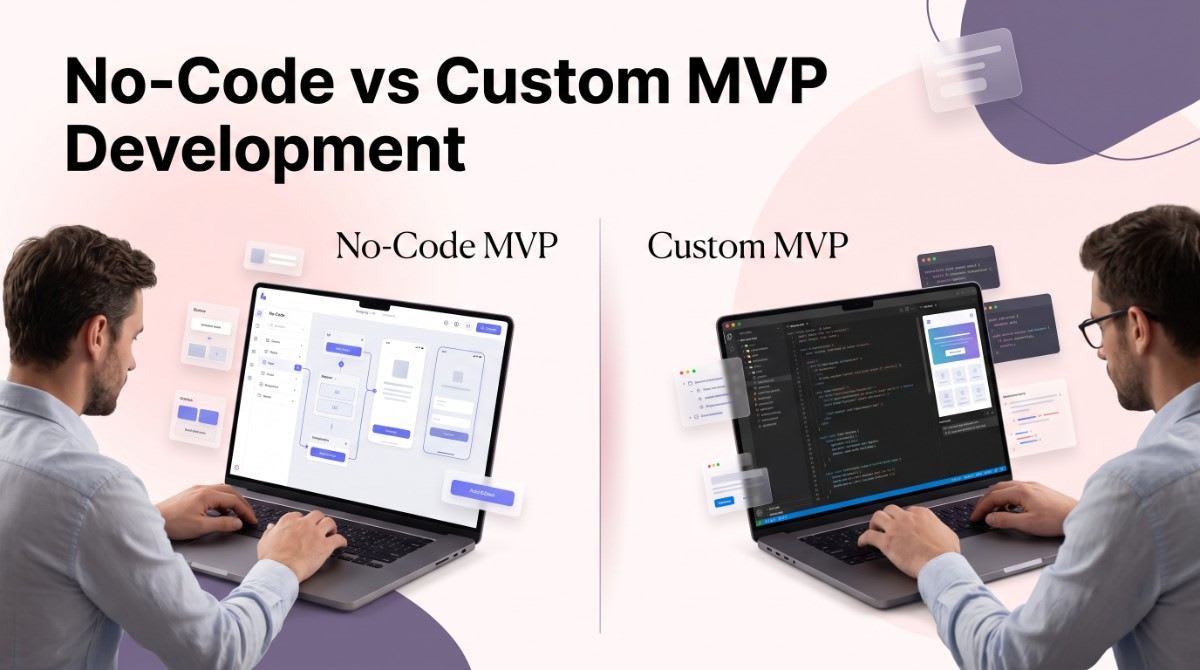 No-Code MVP
Faster to launch, often four to six weeks
Lower upfront cost, typically Rs 50,000 to Rs 4 lakh using tools like Bubble, Webflow, or Glide
Good for testing a simple idea with a small user base
Limited customization and scaling gets harder past a certain point
Custom MVP
More flexibility to build exactly what the product needs
Better long-term scalability and easier to hand over to an in-house team later
Higher development cost and longer timeline
Full control over the technology stack, which matters if you plan to raise funding on the strength of your tech
Neither is the universally right answer. Go no-code first if you're genuinely still not sure people want this. Go custom once you already have some signal and need something investors and users will actually trust at scale.
Prototype vs MVP: What's the difference?
People mix these up constantly, and it's one of the more expensive mistakes a first-time founder makes.
A prototype tests the concept and the design. Think clickable mockups in Figma, no real backend, no real data, nobody actually using it. Its whole job is answering questions like: does this flow make sense, does it look right, would a stranger figure out how to use it without help.
An MVP tests the product with real users. Working code. A real backend. Actual people trying to solve an actual problem with it. Its job is answering a harder question: will people use this, and more importantly, will they come back next week.
If you're still not sure the idea is right, or you need something to show early investors, start with a prototype. Once you believe in the direction and need proof that real usage backs it up, that's when you move to an MVP.
MVP Development Process
Start by defining the problem, in one sentence, and be specific about who has it. Vague problem statements lead to vague products.
Then get specific about your user. "Small business owners" tells you nothing. "Salon owners in tier-2 Indian cities managing appointments over WhatsApp" you can actually design for.
Next, take everything on your feature wishlist and cut it down brutally to what's actually needed to test the core assumption. Most of that list can wait.
Build a rough prototype to get the flow right before anyone writes production code. Then develop the MVP in short cycles, agile style, so you can course-correct without throwing away weeks of work.
Test it properly. Skipping QA because "it's just an MVP" is how founders end up launching something that crashes on the first real user. Then launch, even to a tiny group of people. And once it's out there, collect feedback. Honestly, this last step is the entire point of doing any of this in the first place.
Hidden and Post-Launch Costs Founders Forget
Most MVP quotes cover the build and stop there. Almost none of them mention what comes after, and that's exactly where budgets quietly go off the rails.
Hosting and infrastructure: Rs 3,000 to Rs 25,000 per month depending on traffic and whether you use cloud services like AWS or GCP
Third-party API costs: payment gateways, SMS providers, and AI model APIs often bill per use, and this adds up faster than expected once real users show up
Maintenance and bug fixes: budget roughly 15 to 20 percent of the original build cost per year for ongoing support
App store costs: Apple Developer Program is about 99 USD a year, Google Play is a one-time 25 USD fee
Domain, SSL, and monitoring tools: small individually, easy to forget when scoping the initial budget
A good rule of thumb when asking for a quote: set aside 10 to 15 percent of your total budget specifically for these costs, and ask any agency directly whether their number includes post-launch support or ends at handover.
How to Reduce MVP Development Costs
Start with only the features required to test your core assumption, nothing added "just in case"
Use no-code tools for simple, low-risk parts of the product where custom code adds no real value
Build for one platform first, usually web, and expand once you have validation
Use existing APIs instead of building infrastructure from scratch
Avoid custom design work until you know the product direction is right
Run a small paid discovery phase before committing to full development, it usually cuts 30 to 40 percent of unnecessary features before they get built
Treat product validation as step one, not an afterthought
How Long Does It Take to Build an MVP?
Simple or no-code MVP: four to eight weeks
Standard web or mobile MVP: eight to fourteen weeks
Complex MVP (AI, marketplace, fintech, multiple integrations): three to six months
If your MVP timeline is stretching well past these ranges, that is usually a sign the scope has quietly grown beyond what an MVP should be. Agile development helps here because it forces the team to ship, test, and adjust in short cycles instead of disappearing for months and returning with something the market may not want anymore.
How to Choose the Right MVP Development Partner
This is where a lot of founders get burned, often more than on the actual pricing. A few checks before signing with any Indian development team or agency:
Ask for an itemized estimate broken down by feature and phase, not a single lump-sum number. A one-line quote is a guess, not an estimate.
Ask to see two or three shipped products, not just design mockups or a portfolio page.
Talk to a past client directly if possible. A serious agency will not hesitate to connect you.
Be cautious of anyone quoting an hourly rate with no accompanying time or scope estimate. That is a blank check, not a budget.
Check whether the quote includes QA and testing, or just development. Testing is often the first thing cut to lower a number.
Confirm who owns the code and IP after handover, and get it in writing before work starts.
Choosing the cheapest developer without checking any of the above is one of the most expensive mistakes a founder can make, because the real cost shows up later in rework, not in the invoice.
Why Product Validation Matters Before Development
This is the part founders skip most often, and it is the one that matters most.
Do not spend Rs 10 lakh building something you could have tested for Rs 10,000. Before writing a line of code, talk to the people you think will use this. Ask if the problem is real for them. Test whether they would actually pay for a solution, even with something as simple as a landing page and a waitlist.
Build a rough prototype if needed. Collect honest feedback, not polite feedback from friends. Only once there is real signal should the development budget get committed.
This is the core idea behind the lean startup methodology: build, measure, learn, and only then invest at scale. Skipping straight to a full custom build without this step is how founders end up with a well-built product that nobody asked for.
Common MVP Development Mistakes
Building too many features instead of testing one core assumption
Skipping customer research and assuming the problem is obvious
Confusing a prototype with an MVP and treating clickable mockups as proof of demand
Choosing a technology stack before fully understanding the problem
Prioritizing polished design over basic usability
Scaling infrastructure and marketing before demand is validated
Choosing the cheapest developer without checking quality, process, or past work
FAQs
How much does it cost to build an MVP in India?
Most startup MVPs in India cost between Rs 3 lakh and Rs 25 lakh, depending on complexity, features, and whether the build includes mobile apps or AI functionality.
What is the average MVP development cost in India?
For a mid-complexity MVP with web and mobile components, expect somewhere between Rs 6 lakh and Rs 18 lakh with an experienced Indian team.
How much does an MVP app cost in India?
A mobile MVP typically costs Rs 6 lakh to Rs 20 lakh, depending on whether you build native apps for both platforms or a single cross-platform codebase.
What affects MVP pricing in India?
Feature count, platform choice, design complexity, backend architecture, third-party integrations, and whether you hire a freelancer, agency, or in-house team.
Is a no-code MVP cheaper?
Yes, upfront. No-code MVPs typically cost Rs 50,000 to Rs 4 lakh, but they come with scaling limitations that custom-coded MVPs do not have.
How long does it take to build an MVP?
Most MVPs take four to fourteen weeks depending on complexity, with complex AI or compliance-heavy products taking three to six months.
What is the difference between a prototype and an MVP?
A prototype tests the design and concept with no real backend. An MVP is a working product tested with real users solving a real problem.
Should a startup build an MVP before raising funding?
In most cases, yes. Investors respond far better to a working product with even a small amount of real user traction than to an idea on a slide.
Can I build an MVP without coding? Yes, for simple use cases. No-code platforms like Bubble, Webflow, and Glide can get a basic MVP live without a development team, though they hit limits as the product grows.
Conclusion
The cheapest MVP is not always the best MVP, and the most expensive one is not automatically the safest bet either. The real goal is spending just enough to properly test your core assumption, learn something real from actual users, and use that to decide what gets built next.
India remains one of the most practical places to build that first version, with strong engineering talent at a fraction of what the same team would cost in the US or Western Europe. But the savings only hold up if the scope is right and the team is properly vetted. Get those two things right, and a well-planned MVP can validate demand long before you commit to the much larger investment of building the full product.
SEO Title: How Much Does It Cost to Build an MVP in India? 2026 Cost Guide
Meta Description: Find out how much it costs to build an MVP in India in 2026. Explore MVP pricing, development options, cost factors, no-code tools, and product validation.