Startup Growth and Metrics Terms Every Founder and Investor Must Know
By Toishaa Soni · 11 June 2026
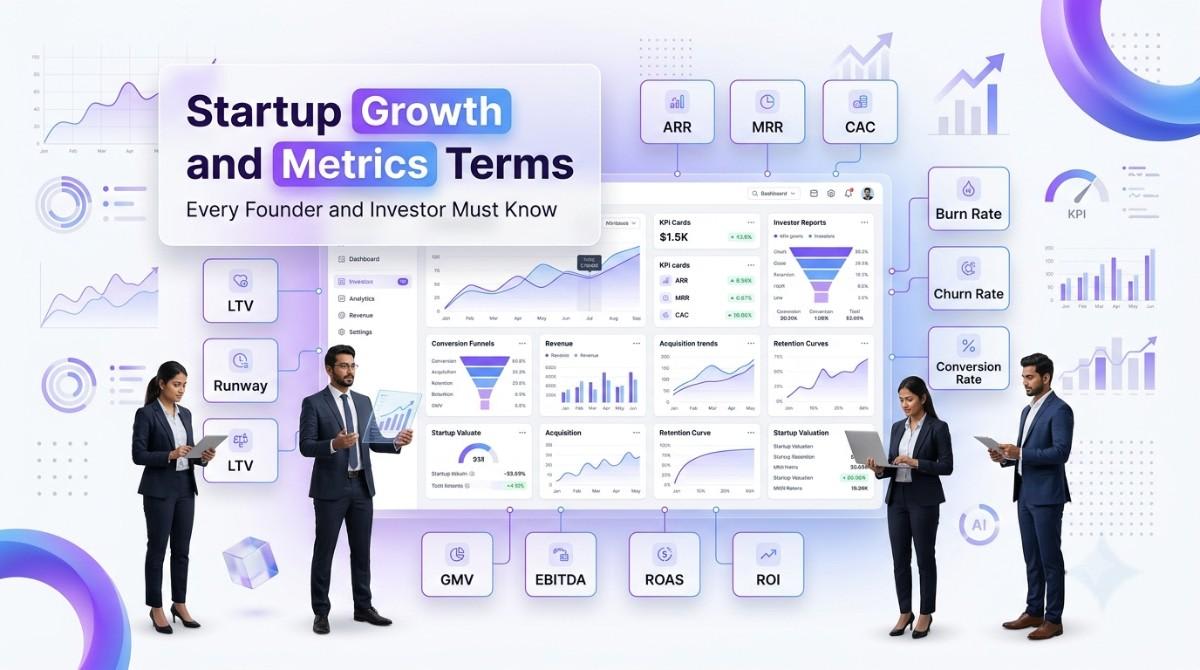
Learn essential startup metrics like ARR, churn, LTV, runway, retention, traction, and scaling to make smarter business decisions.
Numbers tell the story of a startup better than any pitch deck. When investors ask how the business is doing, they are not looking for enthusiasm or vision statements. They want metrics. They want to know whether customers are staying, whether revenue is growing predictably, and whether the unit economics make sense at scale. The problem is that founders without a financial background often hear terms like ARR, churn, LTV, and runway and nod along without knowing what they mean or how to use them.
This guide explains key startup growth and metrics terms in simple language, helping founders understand numbers like ARR, churn, LTV, and runway with confidence. For deeper insights into growth, fundraising, and business fundamentals, working with a startup coach can help turn complex metrics into actionable decisions.
Understanding Revenue
 Revenue
Revenue is the total money a business earns from its core activities before any expenses are deducted. For a SaaS company it is subscription payments. For an e-commerce business it is product sales. Revenue is not profit. A company can have strong revenue and still be losing money if costs exceed what it brings in. Investors treat revenue as the starting point for understanding a business, but they always want to understand what sits beneath it.
Annual Recurring Revenue (ARR)
ARR is the predictable, repeating revenue a subscription business can expect over a full year. If a company has five hundred customers each paying twenty thousand rupees per month, the ARR is one hundred and twenty crore. ARR strips out one-time payments and shows only the revenue the business can count on returning each year without re-selling it. Investors use ARR to measure stability and growth trajectory, and it is often the primary basis for valuation in software businesses.
As subscription revenue grows, founders often use a Startup Valuation Calculator to estimate how recurring revenue may influence company valuation.
Run Rate
Run rate is a forward projection of annual revenue based on current performance. If a company earns fifty lakh in a single month, the run rate is six crore for the year. It assumes current performance continues unchanged, which makes it useful for early-stage companies without a full year of data but potentially misleading if growth is uneven or seasonal. Investors treat it as a rough indicator rather than a firm forecast.
EBITDA
EBITDA stands for Earnings Before Interest, Taxes, Depreciation, and Amortization. It measures core operational profitability by stripping out financial and accounting variables. A company with strong EBITDA is generating real profit from its operations. It comes up more often in growth-stage and mature companies than in very early indian startups. When acquirers or late-stage investors use EBITDA multiples to value a business, knowing what goes into this number matters.
Return on Investment (ROI)
ROI measures the return generated from an investment relative to its cost. Subtract the investment cost from the gain, divide by the cost, and express as a percentage. Spend ten lakh on a campaign that generates thirty lakh in revenue and the ROI is two hundred percent. Startups apply ROI thinking to marketing spend, hiring, product development, and almost any resource allocation decision. Financial planning becomes easier when founders regularly track margins using a Gross Margin Calculator.
Monetize
To monetize a product means to turn it into a source of revenue. Many startups build an audience or product first and figure out the business model later. Monetization is that second step. It can happen through subscriptions, advertising, transaction fees, premium features, or data licensing. How a startup plans to monetize, and whether that plan makes financial sense at scale, is one of the first questions any serious investor will raise.
Customer Health Metrics
 Churn Rate
Churn rate is the percentage of customers who cancel within a given period. Start the month with one thousand subscribers, lose one hundred, and your monthly churn is ten percent. Churn is one of the most critical metrics for any subscription business because it directly affects growth. High churn means the business loses customers as fast as it acquires them, making growth expensive and unsustainable. Investors study churn closely because it reveals whether customers genuinely find value in the product.
Retention
Retention is the opposite of churn. It measures the percentage of customers who continue using a product over a given period. Strong retention is the foundation of any sustainable subscription business. It also serves as the clearest signal of product-market fit. Customers who stay are telling you the product solves a real problem. Customers who leave are telling you something is not working, and no amount of new customer acquisition can paper over a retention problem indefinitely.
LTV (Lifetime Value)
LTV is the total revenue expected from a single customer over the entire length of their relationship with the business. A customer paying five thousand rupees a month who stays for two years has an LTV of one lakh twenty thousand. LTV is most useful when compared against the cost of acquiring that customer. Where LTV significantly exceeds acquisition cost, the business has healthy unit economics. Where the two are nearly equal, growth alone will not make the business profitable.
Business Health and Efficiency
 Metrics
Metrics are the specific, measurable numbers a business tracks to understand its performance and direction. Revenue, churn, conversion rate, and acquisition cost are all metrics. The important discipline is choosing the right ones for your stage and model. Tracking too many creates noise. Tracking the wrong ones means making decisions based on data that does not reflect what actually matters for your business.
KPIs
KPIs, or Key Performance Indicators, are the specific metrics a business designates as most critical to its goals. Every company could track dozens of numbers, but KPIs are the handful that leadership monitors closely and holds itself accountable to. For a SaaS startup, KPIs might be MRR growth, churn, and customer acquisition cost. Good KPIs are specific, measurable, and directly tied to the outcomes the business is working toward.
Runway
Runway is how long a startup can continue operating at its current burn rate before running out of cash. Two crore in the bank with a twenty-lakh monthly burn equals ten months of runway. It defines the window available to reach the next milestone, whether that is profitability, a product launch, or the next funding round. Most experienced founders aim to maintain at least twelve to eighteen months of runway at all times. Understanding cash flow, burn rate, and fundraising timelines is essential for maintaining healthy runway, which is why many founders seek professional startup advisory services during growth stages.
Market Penetration
Market penetration measures how much of a target market a company has captured. One million potential customers and ten thousand current ones means one percent penetration. Low penetration in a large market signals significant growth opportunity, provided the company can execute. High penetration signals that the company is already a dominant player and future growth may be harder to find.
Growth and Scaling Traction
Traction is real evidence that a startup is gaining momentum in the market. It shows up as paying customers, growing active users, rising revenue, or strong retention. What matters is that the numbers reflect genuine market demand rather than manufactured activity. Investors at every stage want to see traction before committing capital because it replaces assumption with proof and reduces their risk significantly. Building traction often requires a well-defined go-to-market strategy and consistent Marketing Support.
Validation
Validation is confirmation from the market that a problem is real and the solution works. It comes through customer interviews, pre-sales, pilots, or early paying customers. It does not mean a few friends approved the idea. It means real people have confirmed that the problem exists and that they value the solution enough to pay for it or change their behaviour because of it. Investors use validation to assess whether the core assumptions behind a business have been tested rather than merely theorised.
Scaling
Scaling means growing revenue significantly without a proportional increase in costs. A business that doubles customers without doubling headcount or infrastructure is scaling well. This phase typically follows product-market fit and requires repeatable processes, operational systems, and a product built to handle growth. It is also one of the hardest phases to navigate because what works at a small scale often breaks down when the business gets larger.
Scalable
"Scalable" describes a model or process that can grow revenue without costs rising at the same rate. Software is scalable because the cost of serving one more customer is near zero once the product exists. A service business requiring a new hire for each new client is much less so. Investors specifically look for scalable businesses because they offer the potential for large returns. A business where costs grow in lockstep with revenue will always struggle to generate meaningful profit regardless of size.
Hockey Stick
The hockey stick is the growth curve every investor wants to see: a long flat period followed by a sudden, sharp upward turn. It gets its name from the shape the curve makes on a graph. Most startups spend longer than expected in the flat section before the curve bends. The challenge is that it is very difficult to predict when or whether the inflection point will come, and many companies run out of resources waiting for growth that never arrives.
Conclusion
These terms form the measurement layer of every serious startup. Revenue and ARR show how much the business generates and how reliably. Run rate and runway show where things are heading and how much time remains. Churn and retention reveal whether customers value the product enough to stay. LTV and ROI test whether the economics make sense. Metrics and KPIs define what to track and why. Market penetration, traction, and validation show how much real ground has been covered. "Scaling" and "scalable" describe whether growth can be sustained efficiently. And the hockey stick is the shape every investor is hoping to see on the revenue chart.
Understanding these numbers and speaking to them with confidence is not just a fundraising skill. It is how founders actually run their businesses well, making decisions from data rather than instinct. Build the habit of tracking the right metrics early, and they will tell you exactly where to focus.
For personalized assistance with your startup's growth and fundraising goals, feel free to connect with our team for expert guidance.
Frequently Asked Questions
1. What is the difference between ARR and run rate?
ARR is the actual recurring revenue locked in through subscriptions or contracts. Run rate is a projection that annualises current performance. ARR reflects real commitments. Run rate is an estimate that assumes the present continues unchanged.
2. What is a good churn rate for a startup?
For SaaS companies, monthly churn below 2 percent is generally healthy. Annual churn below ten percent is a reasonable target. The lower the churn, the more valuable each customer becomes over their lifetime.
3. How is LTV different from revenue?
Revenue is what a customer pays in a given period. LTV is the total you expect to earn from that customer over the entire time they remain with you. LTV helps determine how much you can afford to spend acquiring each customer while staying profitable.
4. What is the difference between scaling and growth?
Growth means the business is getting bigger. Scaling means it is getting bigger without costs rising at the same rate. A business can grow by spending heavily to acquire customers, but scaling means the unit economics improve as the company expands.
5. How much runway should a startup maintain?
Most experienced founders and investors recommend at least twelve to eighteen months at all times. This provides enough buffer for setbacks, a proper fundraising process, and reaching meaningful milestones without constant cash pressure.
6. What counts as traction for an early-stage startup?
Traction is any real evidence the market wants what you are building. Paying customers, strong user growth, high retention, signed partnerships, or revenue milestones all qualify. The key is that it reflects genuine demand, not manufactured activity.
7. What is the difference between validation and traction?
Validation is early confirmation that a problem and solution are real, often before the product is fully built. Traction is evidence that the live product is gaining momentum in the market. Validation typically comes first, and traction follows.
8. Why do investors care so much about metrics?
Metrics remove opinion from the conversation. They show whether a business is performing, whether customers find value in the product, and whether the economics hold up. A strong story is useful, but metrics are the evidence that backs it.