Top Government Schemes for Seed Funding in India (2026): Grants, Loans and Startup Support
By Rohini Rajpoot · 31 July 2026
Explore the top government funding schemes for startups in India, including SISFS, SIDBI Fund of Funds, CGSS, MUDRA, and Stand-Up India. Learn eligibility, funding, and how to appl
Founders often assume that government funding means one scheme, one form, and one shot. In reality, India runs several distinct programs that work in very different ways, some hand out grants that never need to be repaid, others guarantee your bank loan so a lender takes you seriously, and a few work quietly in the background by funding the venture capital funds that eventually invest in you. Picking the wrong one, or applying to the right one at the wrong stage, wastes months founders usually don't have.
This guide walks through the major central schemes active in 2026, how they actually work, and how to figure out which one fits your startup right now. Scheme details, funding caps, and application windows do get revised fairly often, so treat the specifics here as a solid starting point and confirm the latest numbers on the official portal before you apply. This overview works well alongside a broader look too.
Why Government Funding Matters for Startups
Early-stage founders in India face a familiar problem. Banks want collateral you probably don't have yet. Angel investors and VCs usually wait for some proof that your idea works before writing a check. That leaves a gap right at the point where you need money the most, just to build a working prototype or make your first sales.
Government schemes exist to bridge exactly that gap, though they do it in different ways. Some are pure grants meant for prototype development, with no repayment and no equity given up. Others are loans, which need to be repaid but usually come without the collateral requirement that shuts most founders out of traditional bank credit. A few work through guarantees, reducing the risk for a bank or NBFC so they're willing to lend to you in the first place. And some, like the Fund of Funds structure, work indirectly, backing venture capital funds so that more institutional money eventually flows into startups like yours.
Beyond individual founders, this kind of support matters at a larger scale too. It's part of why India now has one of the largest recognized startup ecosystems in the world, and continued government investment is aimed at keeping that innovation and job creation engine running, particularly in areas like deep tech and advanced manufacturing where private capital tends to move more cautiously.
Types of Government Startup Funding in India
Funding Type | Best For | Repayment | Equity |
Grants | Prototype and R&D work | No | No |
Seed Funding (SISFS) | Early-stage startups | Depends on tranche | No |
Government-backed Loans | Business expansion | Yes | No |
Credit Guarantee | Loan support, not direct funding | Yes (loan itself) | No |
Venture Fund Support (Fund of Funds) | High-growth, capital-intensive startups | Equity-based | Yes |
Quick Comparison of Government Funding Schemes (2026)
Scheme | Funding Type | Best For | Maximum Support |
Startup India Seed Fund Scheme (SISFS) | Grant plus debt/convertible instruments | Early-stage startups building a prototype or entering the market | Up to ₹20 lakh grant, up to ₹50 lakh for commercialization, routed through approved incubators |
Fund of Funds for Startups (SIDBI) | Indirect equity funding via AIFs | High-growth and deep-tech startups | Capital deployed through SEBI-registered AIFs, no fixed per-startup cap |
Credit Guarantee Scheme for Startups (CGSS) | Credit guarantee, not a direct loan | Startups seeking debt financing without collateral | Guarantee cover up to ₹20 crore per eligible borrower |
PM MUDRA Yojana | Business loan | Small businesses and micro-enterprises, including very early startups | Up to ₹20 lakh under the newer Tarun Plus category, with lower tiers at ₹50,000, ₹5 lakh, and ₹10 lakh |
Stand-Up India | Bank loan | Women and SC/ST entrepreneurs starting a new venture | ₹10 lakh to ₹1 crore, with a revamp reportedly expanding this range under discussion |
Startup India Seed Fund Scheme (SISFS)
Overview
SISFS is run by DPIIT and is probably the most well-known government seed funding option for Indian startups. Instead of the government funding startups directly, money flows through a network of approved incubators, who evaluate applications and disburse funds against milestones.
Objectives
The scheme is built specifically to support proof of concept work, prototype development, product trials, and early market entry, the stage where founders usually have nothing concrete enough yet to interest a bank or a serious investor.
Key Benefits
A grant component that doesn't need to be repaid or exchanged for equity
Structured mentorship through your chosen incubator
Milestone-based disbursement that keeps you accountable to real progress
Added credibility with future investors, since selection by an approved incubator is itself a form of validation
Eligibility
To qualify, your startup generally needs to be DPIIT-recognized, incorporated within the last two years at the time of application, working on a genuinely innovative and technology-driven idea, and not have received more than ₹10 lakh in prior monetary support from another government scheme.
Funding Support
Up to ₹20 lakh as a grant for proof of concept and prototype work, and up to ₹50 lakh through debt or convertible instruments once you're ready for market entry and commercialization.
Application Process
You get DPIIT recognition first, create a profile on the Startup India portal, shortlist up to three approved incubators, submit your application with the required documents, and pitch to the incubator's evaluation committee if shortlisted.
Best For
Very early-stage startups that need capital before they have anything close to a track record.
Important Tips Before Applying
Have a working MVP if at all possible, keep your documentation complete and organized before you start, and pick an incubator that actually understands your sector rather than the most convenient or well-known one on the list.
Fund of Funds for Startups (SIDBI)
What Is the Fund of Funds?
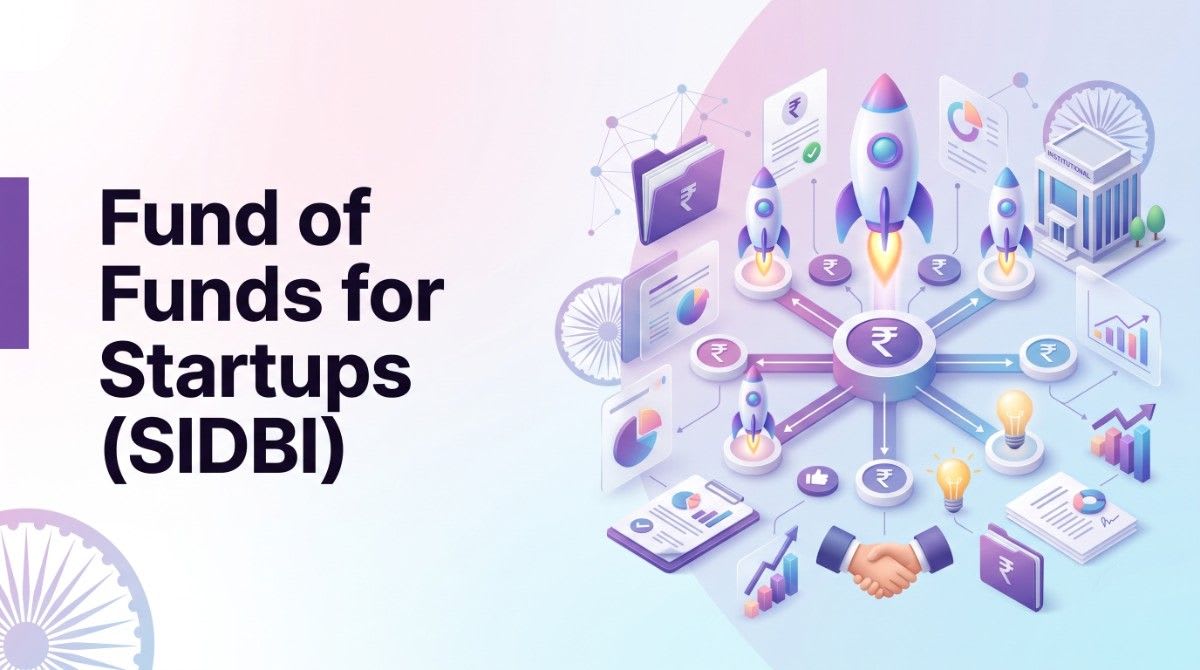
Unlike SISFS, the Fund of Funds for Startups doesn't give money to startups directly at all. It's a government-backed corpus, managed by SIDBI, that invests in SEBI-registered Alternative Investment Funds. Those AIFs then invest their own capital, along with the government's contribution, into individual startups.
How It Works
Think of it as the government seeding the venture capital ecosystem itself rather than picking individual startup winners. The original Fund of Funds, launched in 2016, backed well over a hundred AIFs, which in turn deployed tens of thousands of crores into more than a thousand startups over the years.
Recent Expansion: FFS 2.0
A newer phase, commonly referred to as FoF 2.0, was notified in 2026 with a fresh corpus of ₹10,000 crore. This version takes a more segmented approach, with dedicated allocations for deep tech startups working on things like quantum computing and robotics, tech-driven advanced manufacturing aligned with the Make in India push, and a broader early-growth segment meant to help founders survive the stretch where private capital is often hardest to find. There's also a deliberate push to get more of this capital flowing into startups outside the usual Bengaluru, Mumbai, and Delhi hubs.
Who Can Benefit
Founders don't apply to this scheme directly. Instead, you benefit by raising capital from an AIF that itself received backing from the Fund of Funds. If you're raising a proper VC round, it's worth asking a fund you're talking to whether they're an FFS-backed AIF, since it can be a useful signal of their scale and staying power.
Eligibility
Your startup needs to be DPIIT-recognized to receive investment from an AIF operating under this scheme.
Advantages
The Fund of Funds structure indirectly increases the overall pool of domestic venture capital available to Indian startups, which matters for founders raising equity rounds even if they never interact with SIDBI or the government directly.
Credit Guarantee Scheme for Startups (CGSS)
Purpose
CGSS exists to solve a specific problem: banks and NBFCs are hesitant to lend to startups without collateral, since young companies are inherently riskier borrowers. CGSS steps in as a guarantor, absorbing part of the risk so lenders are more willing to extend credit.
How Credit Guarantees Reduce Lender Risk
The scheme works through the National Credit Guarantee Trustee Company, which provides guarantee cover to eligible lending institutions rather than to startups directly. If a startup defaults, the guarantee covers a significant portion of the loss for the lender, which makes them far more comfortable extending credit in the first place.
Eligible Startups
To qualify, a startup needs to be DPIIT-recognized, should have reached a stage of stable revenue that can support debt repayment, must not currently be in default with any lender, and shouldn't be classified as a non-performing asset.
Participating Financial Institutions
Scheduled commercial banks, RBI-registered NBFCs, and SEBI-registered Alternative Investment Funds structured as Venture Debt Funds can all extend credit under this scheme.
Benefits
The guarantee cover was expanded from ₹10 crore to a maximum of ₹20 crore per eligible borrower, with coverage levels of up to 85 percent on smaller loan amounts and 75 percent on larger ones. This makes collateral-free debt financing genuinely accessible for startups that have moved past the earliest, riskiest stage.
Loan Eligibility
CGSS covers a range of instruments, including working capital, term loans, venture debt, and subordinated debt, giving startups some flexibility in how they structure their borrowing.
Pradhan Mantri MUDRA Yojana
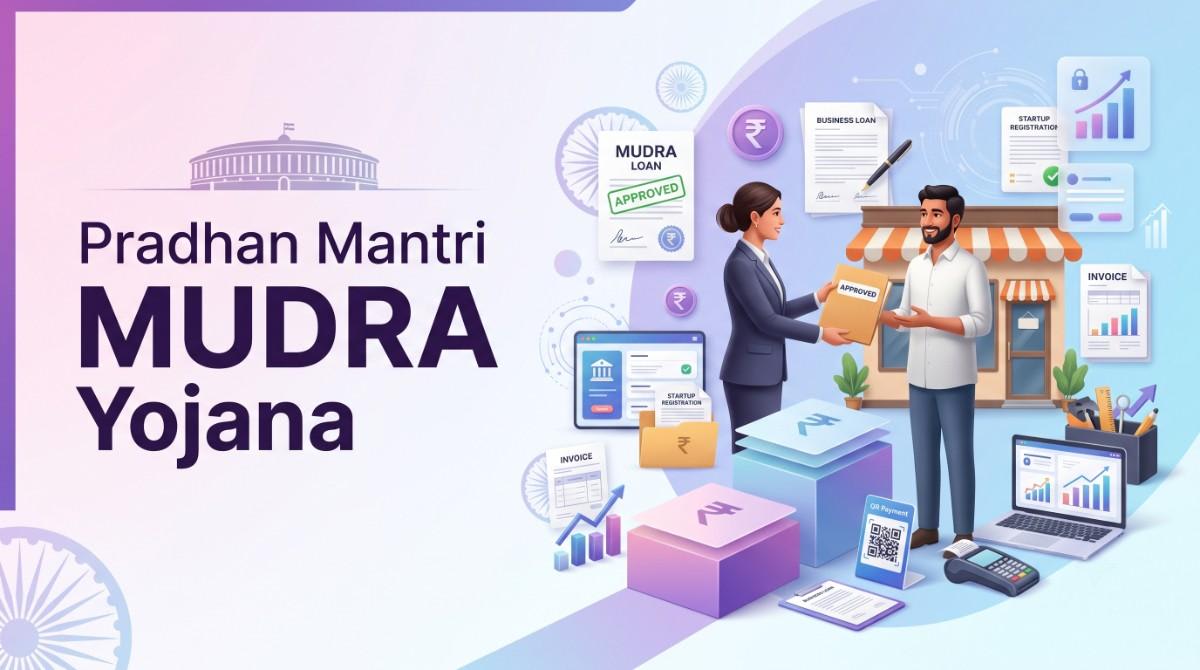
MUDRA loans are broader in scope than the startup-specific schemes above and are aimed at small businesses and micro-enterprises generally, but plenty of very early-stage founders use them, particularly for small, non-tech ventures.
Loan Categories
Shishu: loans up to ₹50,000, meant for brand-new businesses just getting off the ground
Kishor: loans between ₹50,000 and ₹5 lakh, for businesses with some operating history looking for moderate expansion capital
Tarun: loans between ₹5 lakh and ₹10 lakh, for more established small businesses
Tarun Plus: a newer category offering ₹10 lakh to ₹20 lakh, introduced for repeat borrowers who've successfully repaid an earlier Tarun loan
Who Can Apply
Non-corporate, non-farm small and micro-enterprises, including sole proprietorships and small partnerships, can apply through participating banks, NBFCs, and microfinance institutions.
Loan Limits
The scheme now goes up to ₹20 lakh under Tarun Plus, a meaningful jump from the original ₹10 lakh ceiling, though most first-time applicants will start in the Shishu or Kishor categories.
When Startups Should Consider MUDRA Instead of Equity Funding
MUDRA makes sense for founders who want to retain full ownership and don't need a large amount of capital right away, particularly for small, revenue-generating businesses that don't fit the high-growth, venture-backable mold that most equity investors look for.
Stand-Up India Scheme
Objective
Stand-Up India is designed specifically to get more women and SC/ST entrepreneurs into business ownership by mandating that every scheduled commercial bank branch support at least one loan to each group for a new venture.
Eligibility
Applicants need to be SC, ST, or women entrepreneurs aged 18 or above, starting a greenfield venture, meaning a genuinely new business rather than an expansion of an existing one. For non-individual enterprises like partnerships, the eligible category needs to hold at least 51 percent of the controlling stake.
Loan Amount
The established range has been ₹10 lakh to ₹1 crore since the scheme launched in 2016. There have been reports through 2025 and into 2026 of a planned revamp that would raise this ceiling, with some sources citing figures as high as ₹2 crore, but the details of an expanded scheme have not been consistently confirmed across sources at the time of writing, so it's worth checking the official Stand-Up India portal for the current status before you plan around a higher limit.
Women Entrepreneurs
Women founders starting new manufacturing, services, trading, or agriculture-allied businesses are directly eligible, and the bank-branch mandate specifically ensures they aren't sidelined in favor of other borrowers.
SC/ST Entrepreneurs
The same structure applies to SC and ST entrepreneurs, with the goal of expanding access to formal, collateral-light credit for communities that have historically had a harder time securing bank loans.
Supported Businesses
Manufacturing, services, trading, and agriculture-allied activities are all covered, as long as the venture is a new, greenfield project.
Benefits
Composite loans covering both term loan and working capital needs in a single facility, a relatively long repayment tenure with a moratorium period built in, and handholding support through dedicated Stand-Up Connect Centres and SIDBI.
State Government Startup Policies and Grants
Beyond the central schemes, many state governments run their own startup support programs, often stacking on top of what's available at the national level. These vary widely in scope and generosity, so it's genuinely worth checking what your specific state offers rather than assuming central schemes are your only option.
Karnataka Startup Policy, one of the more mature state programs, with seed grants and strong ties to the Bengaluru startup ecosystem
Kerala Startup Mission, offering incubation support and grants with a particular focus on technology and innovation-driven ventures
Telangana, home to the T-Hub ecosystem, one of India's most active state-backed incubation networks
Tamil Nadu Startup and Innovation initiatives, supporting founders through grants and incubation infrastructure across the state
Gujarat Startup Policy, which has historically offered strong incentives around patent filing costs and market access support
Maharashtra Startup initiatives, with programs aimed at both Mumbai's established ecosystem and emerging tier-two cities in the state
Delhi Startup and Incubation Policy, with the Delhi cabinet having cleared a policy backed by a meaningful allocation aimed at building out the city's innovation ecosystem
Typical state-level support includes seed grants, subsidized or free incubation space, reimbursement of patent filing costs, rent subsidies for office space, help with market access, and sector-specific innovation grants. Because these programs change fairly often and vary a lot by state, your best move is to check your state's official startup policy portal directly rather than relying on older summaries.
Which Government Scheme Is Right for Your Startup?
If You Need... | Best Scheme |
Prototype or proof-of-concept funding | SISFS |
Access to venture capital indirectly | Fund of Funds for Startups (via AIFs) |
A straightforward business loan | MUDRA |
Collateral-free credit support for an established startup | CGSS |
A loan as a woman or SC/ST first-time entrepreneur | Stand-Up India |
Additional grants or incentives on top of central schemes | Your state's startup policy |
How to Improve Your Chances of Approval
Get DPIIT recognition early, since it's a prerequisite for several of these schemes
Put together a clear, realistic business plan rather than an overly ambitious one
Validate your MVP with actual users before applying wherever possible
Build financial projections grounded in comparable numbers, not best-case guesses
Keep every document organized and complete before you start any application
Choose the right incubator or lending institution for your specific sector and stage
Be ready to demonstrate genuine market potential, not just a good idea on paper
Common Mistakes Founders Make While Applying
Applying to a scheme that doesn't actually match their stage or funding need
Missing basic eligibility criteria, like DPIIT recognition or the incorporation timeline
Submitting a weak or generic business plan
Presenting financial projections that don't hold up to scrutiny
Leaving documentation incomplete or inconsistent
Applying before there's any real product validation to show
Overlooking state-level opportunities that could be stacked with central schemes
Conclusion
Government funding can genuinely accelerate a startup's early journey, but only if you pick the scheme that actually matches your stage and funding need. A prototype-stage founder chasing a bank loan, or an established, revenue-generating business applying for a proof-of-concept grant, is going to waste time on a mismatch. Take the time to map your current stage against what each scheme is actually built for, check both central and state-level options, and get your documentation and business plan in solid shape before you apply. Scheme details do shift fairly often, so a quick check of the official portal before you submit anything is always worth the few extra minutes.
Frequently Asked Questions
1. Which is the best government seed funding scheme in India?
There's no single best option since each scheme serves a different purpose. SISFS is generally the strongest fit for very early-stage prototype funding, while CGSS and MUDRA suit startups that are ready to take on debt, and the Fund of Funds matters more once you're raising an actual VC round.
2. Is the Startup India Seed Fund Scheme a grant or a loan?
It's a mix. The first tranche, up to ₹20 lakh, is a grant that doesn't need to be repaid. The second tranche, up to ₹50 lakh, is structured as debt or convertible instruments.
3. Who is eligible for government startup funding?
Eligibility varies by scheme, but most require DPIIT recognition, and several have additional criteria around incorporation timeline, sector, revenue stage, or founder background, such as the SC/ST and women-focused criteria under Stand-Up India.
4. Can pre-revenue startups apply?
Yes for grant-based and equity-linked schemes like SISFS and the Fund of Funds, since these are specifically designed for early-stage companies. Debt-based schemes like CGSS generally expect some revenue stability before extending a loan guarantee.
5. Does a startup need DPIIT recognition?
For most of these schemes, yes. It's essentially the entry ticket for SISFS, CGSS, and Fund of Funds-backed AIF investment.
6. What is the difference between SISFS and SIDBI's Fund of Funds?
SISFS gives capital, largely as a grant, directly to individual startups through approved incubators. The Fund of Funds doesn't invest in startups directly at all, it invests in venture capital funds, which then make their own decisions about which startups to back.
7. Can startups apply for multiple government schemes?
Generally yes, as long as each scheme's individual eligibility conditions are met, though some schemes cap how much prior government funding you can have received, so it's worth checking for overlap before assuming you can freely combine everything.
8. Are there state-specific startup grants available?
Yes, and they're often underused. Most major states run their own startup policies with grants, incubation support, or subsidies that can be combined with central schemes