The Ultimate Startup Glossary: Essential Terms Every Founder Should Know
By Toishaa Soni · 22 May 2026
Learn essential startup terms covering funding, growth, legal, product, branding, and startup culture in one complete glossary.
If you have ever sat in a funding meeting nodding along while someone talked about SAFEs or burn rate and had no idea what any of it meant, this guide is for you. The startup world runs on its own language, and knowing it is the difference between confidence and confusion. This glossary covers every major term across funding, legal structure, growth, product, operations, people, lifecycle, finance, branding, and culture.
1. Startup Funding and Investment
 The journey starts with pre-seed funding from personal savings or a friends and family round, sometimes called "friends, family, and fools". From there, startups raise seed funding, then Series A, Series B, and Series C rounds. Angel investors write early checks through angel groups, micro-VCs focus on small bets, and venture capital firms have a general partner deciding and limited partners supplying capital. Corporate venture capital comes from large companies. A family office manages a single wealthy family's wealth.
A SAFE note and convertible note both convert to equity later. A discounted convertible note rewards early risk with a lower conversion price. A priced round sets pre-money and post-money valuations. A 409a valuation is a legally required appraisal before issuing options. Other paths include crowdfunding, crowdinvesting, revenue-based financing, debt financing, peer-to-peer lending, and grants. REG D, REG A, and REG CF govern legal fundraising. An ICO is a crypto-native method.
Investors track burn rate, MRR, CAC, and runway. A cap table records ownership. Dilution reduces existing holders including diluted founders, when new shares are issued. Pro-rata rights preserve ownership in future rounds. A lead investor sets terms, a scout sources deals, and smart money brings expertise beyond capital. A deal memo documents the thesis, deal flow is the opportunity pipeline, and follow-on funding is continued backing. A flat round holds valuation steady, a down round raises below the previous one, a bridge is emergency capital, and a party round has many investors without a clear lead.
Liquidation preference sets payout order. Warrants give the right to buy shares later. A success fee rewards advisors who close deals. Secondary market sales let early holders exit before an IPO. Post-IPO equity, post-IPO debt, and post-IPO secondary offerings raise capital after going public. A unicorn is valued over one billion dollars, a decacorn over ten billion, and a hectocorn over one hundred billion. A zebra is profitable and sustainable. A zombie unicorn has stalled after a high valuation. A vulture capitalist exploits desperate founders. Exits happen through an IPO, acquisition, or liquidity event. A SPAC is a shell company shortcut to going public. Private equity targets mature companies.
2. Legal, Compliance and Corporate Structure

Startups file articles of incorporation and a shareholders' agreement. Authorize shares are the total equity allowed and issued shares are those distributed. Founders hold common stock while investors hold preferred stock or convertible preferred stock. Options come from an option pool and earn through a vesting schedule. An 83(b) election filed within 30 days of restricted stock lowers tax exposure. Sweat equity is ownership earned through work.
A term sheet outlines deal terms before closing. Due diligence is the investor's investigation. The Board of Directors governs major decisions. Drag-along rights let majority holders compel minority holders to approve a sale. A right of first refusal gives existing investors first chance at shares. Representations and warranties are legal promises about the company's condition. A lockup prevents post-IPO insider sales. The SEC regulates public markets. A corporate round comes from a large corporation. A waterfall defines the payout order during an exit.
3. Startup Growth and Metrics
 ARR and MRR measure subscription revenue. Revenue is total income and EBITDA shows operational profitability. ROI measures return on investment and LTV estimates a customer's total value. Churn rate tracks cancellations against retention. Run rate projects current performance annually. Runway shows months of cash remaining. Traction is early market evidence and validation confirms real demand. KPIs are the metrics teams track. A scalable business grows revenue faster than costs. Market penetration measures share captured. To monetize is to turn users into revenue.
4. Product Development and Technology
 An MVP is the simplest product built to test a core assumption. Before it comes a proof-of-concept and prototype. Alpha testing happens internally, beta testing with limited real users, then launch and commercialization follow. Agile and Scrum organize work into short sprints for fast iteration. LEAN eliminates waste. A customer development model prioritizes customer conversations before building. Dogfooding means using your own product internally. Product-market fit is when demand pulls the product forward. A pivot is a deliberate strategy shift. Stealth mode is operating privately before announcing.
SaaS delivers software by subscription. PaaS provides cloud infrastructure. The stack is the technology behind a product. Amazon Web Services powers much of the internet. Disruption displaces existing markets through disruptive technology. Growth hacking experiments cheaply to acquire users. Gamify adds game mechanics for engagement. Hackathons produce ideas in intense short sprints. R&D covers long-term innovation. UI is what users see and touch while UX is how the experience feels. Freemium offers a free tier with paid upgrades.
5. Startup Operations and Business Strategy
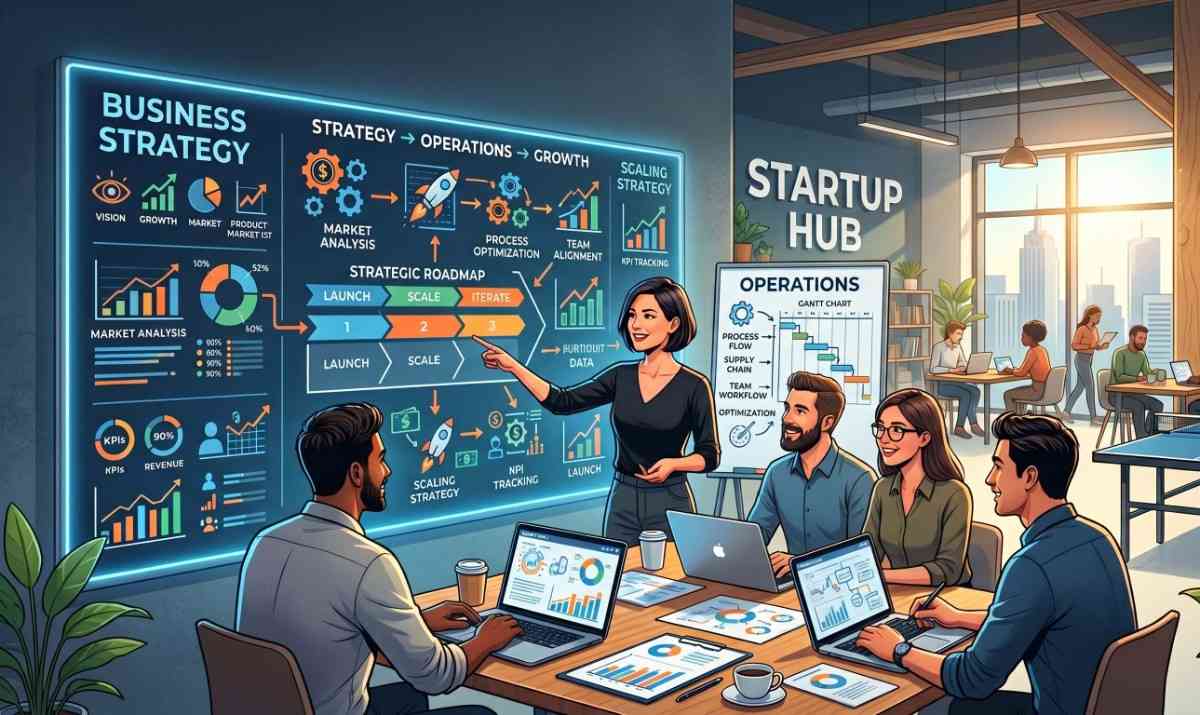
B2B sells to businesses, B2C sells to consumers, and B2B2C sells through a business to reach the consumer. Bootstrapping means growing without outside investment. BAU covers routine daily operations. A BHAG is a long-range ambitious goal. OKRs translate big goals into measurable targets. A USP and value proposition explain why customers should choose you. A target market defines who you build for. First mover advantage goes to whoever enters a market first. Ramen profitable means earning just enough to survive. Loss leader pricing grabs share by pricing below cost. Pay to play requires investors to join future rounds or lose rights. A soft landing is a gentle acquisition for a struggling company. An exit strategy is the long-term plan to realize returns.
An elevator pitch is a 60-second company summary. A pitch deck is the investor slide presentation. A demo day is the public event where startups present. Pitch competitions offer prize money. Incubators support early companies and accelerators like YC add capital and structure. In-kind support is non-cash help and non-equity assistance comes without an ownership stake. The ecosystem is the broader startup community. Social proof builds credibility through external evidence. Thought leaders shape industry conversation. Evangelists promote with genuine passion. Problem-founder fit is the match between who you are and what you solve. The X of Y is a positioning shortcut like "the Airbnb of boats."
6. Startup People and Founder Roles
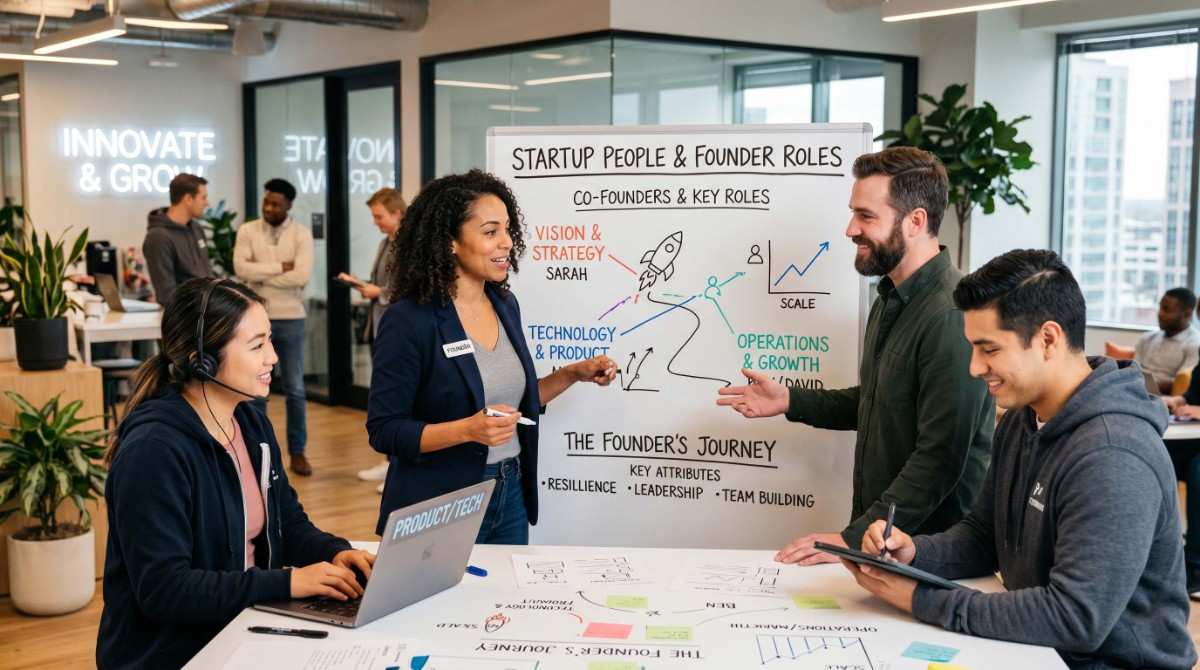 A technical founder builds the product while a non-technical founder handles business and operations. A serial entrepreneur has launched multiple companies. A solopreneur builds alone. An EIR is a seasoned founder embedded at a VC firm. An advisor provides guidance for equity. An intrapreneur drives innovation inside a large organization. A visionary sets long-range direction. An acquihire is a company purchased mainly to bring in its team.
7. Startup Lifecycle and Exit Events
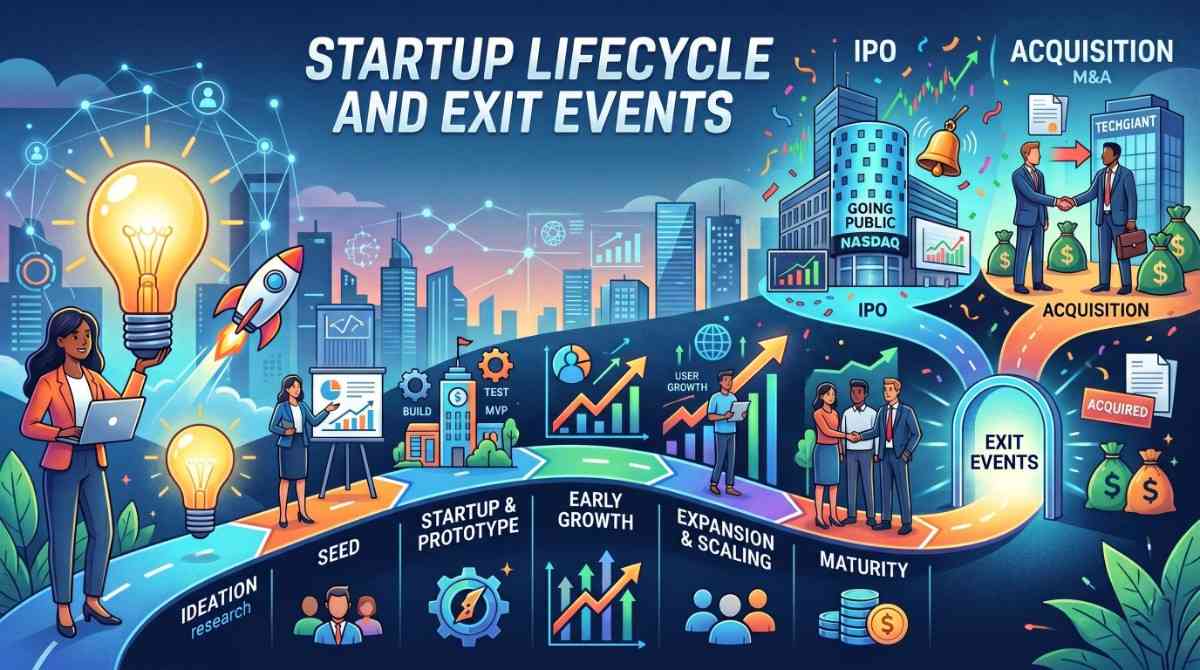
Most startups begin in an incubator or accelerator, with YC being the most prestigious globally. As valuations grow, companies become a pony at $100 million, a centaur at $100 million ARR, a unicorn at $1 billion, a decacorn at $10 billion, and a dragon when they return a full fund. Social ventures balance profit with mission. Exits happen through an IPO, acquisition, merger, or buyout. A zombie company operates with no realistic growth or exit path.
8. Finance and Accounting
 The balance sheet shows what a company owns and owes. The cash flow statement tracks money moving in and out. Burn rate is monthly spend. Run rate projects annual revenue from current numbers. Runway measures months of survival. EBITDA isolates operational profitability. ROI quantifies return on investment. Revenue is total income before expenses.
9. Community, Branding and Marketing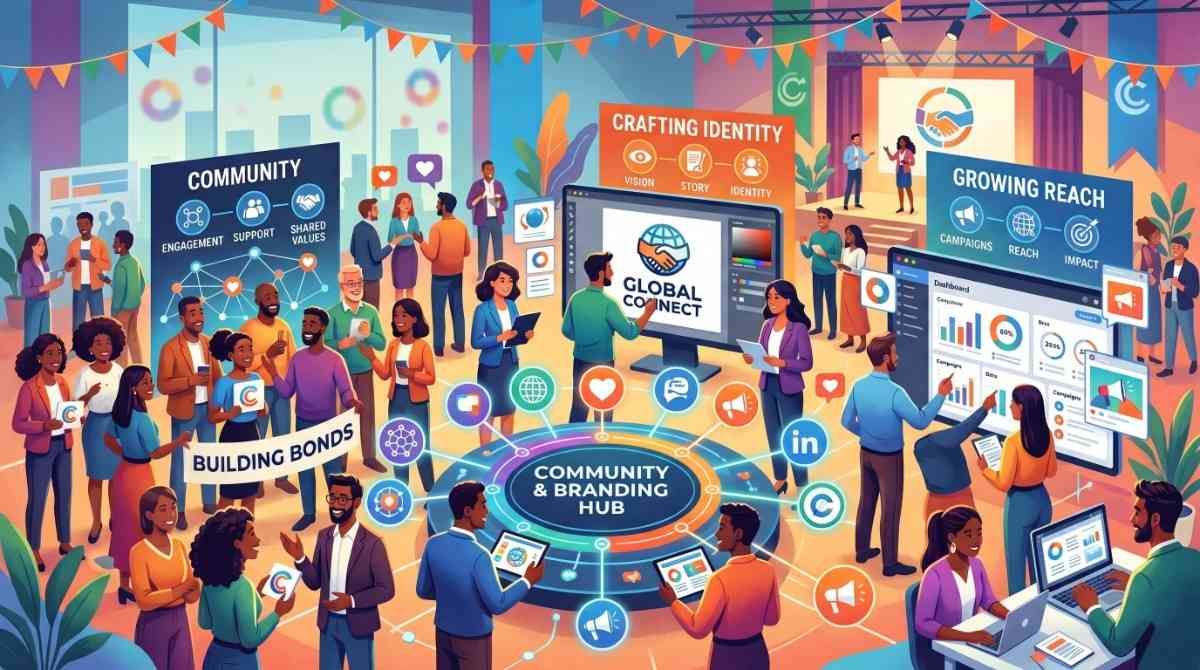
Growth hacking drives user acquisition through rapid low-cost experiments. Crowdsourcing taps public input for ideas or content. Gamify adds game mechanics to increase engagement. Social proof uses testimonials and press to build trust. A strong USP and value proposition tell customers why to choose you. Thought leaders and evangelists build credibility through authentic influence.
10. Famous Startup Slang and Culture Terms
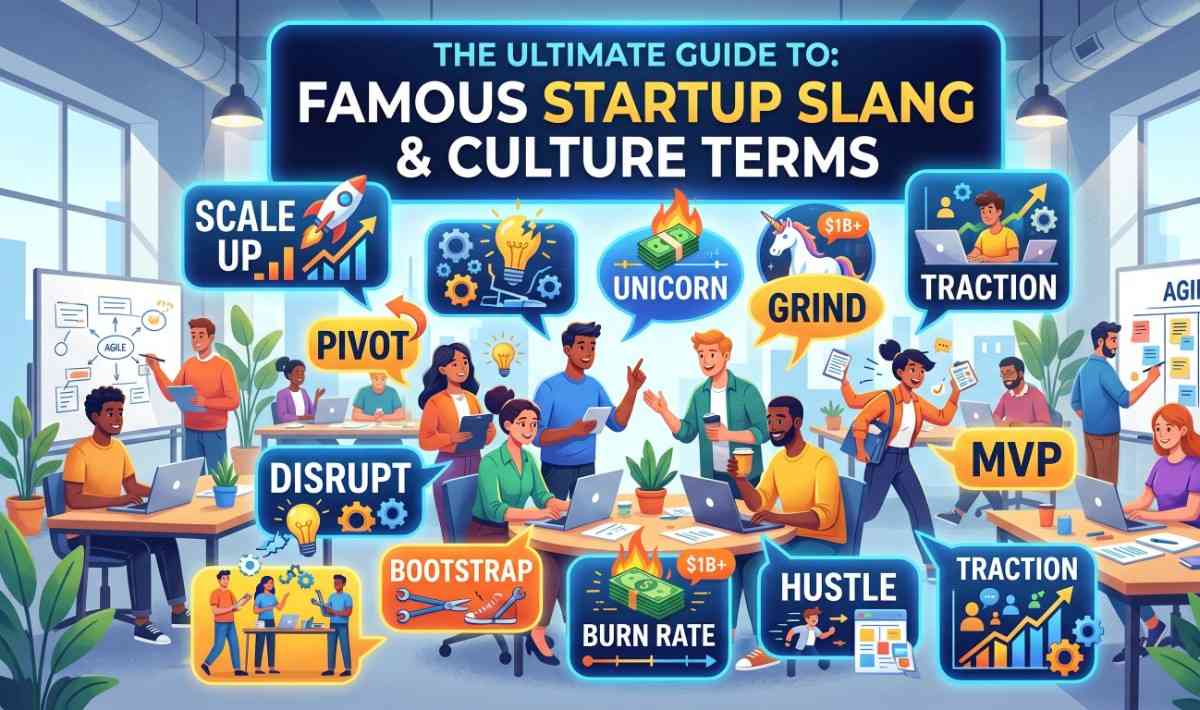 Hockey stick growth is the flat-then-vertical curve every investor wants. A moonshot is an ambition so big it seems impossible. Buying the logo means signing a prestigious client mainly for brand credibility. Eating their lunch means taking a competitor's customers aggressively. Friends, family, and fools are the earliest believers. The valley of death is when money is nearly gone but revenue has not arrived. The trough of sorrow is the emotional low after initial excitement fades. The chasm is the gap between early adopters and the mainstream market where many startups fail. 'Ramen profitable' means earning just enough to keep founders fed. The two-pizza rule says a team should be small enough to feed with two pizzas. A zombie unicorn once held a billion-dollar valuation and now has nothing but the title.
Conclusion
Knowing startup vocabulary alone will not build a successful company, but it will help you think more strategically, communicate with greater confidence, and make informed decisions throughout your entrepreneurial journey. Whether you are raising your first round of funding, refining your business model, scaling operations, or preparing for an exit, understanding the language of startups can give you a significant advantage. If you are looking for expert guidance to navigate the startup ecosystem, connect with the team at Startup Coaching and take the next step toward building and growing your venture with confidence.
FAQs
1. What is the difference between pre-seed and seed funding?
Pre-seed uses personal capital to test an idea. Seed funding comes once there is a product to show, used to hire and acquire early customers.
2. Why does runway matter so much?
It tells you exactly how long you have before cash runs out and forces disciplined spending toward the next milestone.
3. What does product-market fit feel like?
Retention improves without extra effort, customers refer others unprompted, and the team struggles to keep up with demand.
4. What does a VC do beyond writing a check?
The best VCs open doors to customers, future investors, and key hires, and provide guidance through difficult decisions.
5. Is becoming a unicorn still a worthy goal?
It remains a recognized benchmark, but many founders now prefer the zebra model, building profitable sustainable companies that do not depend on endless fundraising.