What is the Margin Percentage in the Startup India loan?
By Toishaa Soni · 18 November 2025
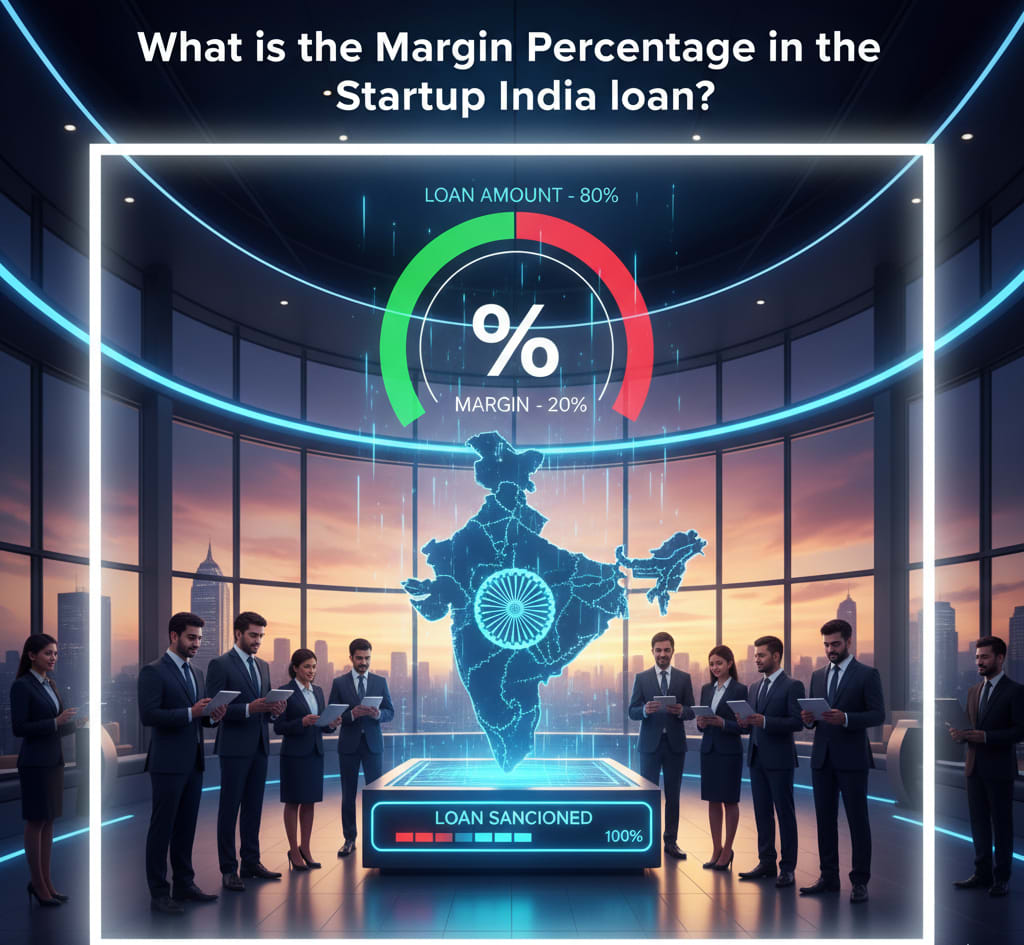
Full information on the margin percentage for a Startup India Loan, how much personal investment is required, and how margins are determined for various schemes.
Starting a new business in India is both exciting and challenging. The biggest question in the initial stages is where and how to get funding. While personal savings, family support, or angel investors are helpful, the Startup India schemes launched by the government have become an important support for new entrepreneurs today.
Many people ask what the margin percentage is for a Startup India loan. Margin is the portion of the investment that the entrepreneur must make in their project, with the remaining amount provided by the bank or financial institution. Understanding this is essential for both business planning and achieving business growth.
What is Margin Money in a Loan?
It is the amount of money an entrepreneur has to invest in a project from their own resources. Suppose a project cost is ₹10 lakh and the bank asks for a 15 percent margin. In this case, the entrepreneur has to invest ₹1.5 lakh himself, and the bank provides a loan of ₹8.5 lakh.
Banks require margin to assure the borrower of their commitment, reduce the risk of default, and build trust. This percentage depends on the loan, project, terms, and applicant profile.
Overview of the Startup India Loan
The Startup India Loan is not a single scheme but a conglomerate of several government financial programs. Launched in 2016, the campaign aims to promote innovation, support new enterprises, reduce dependence on informal credit, and increase employment opportunities.
The major schemes under this initiative include Mudra Loans, Stand Up India, SIDBI Startup Loans, and CGTMSE. Each scheme has different loan limits, interest rates, and margin rules.
Margin Percentage in Startup India Loans
The unique feature of these schemes is that in many cases the margin is very low and may even be zero in some categories. Let’s understand it category wise:
1. Mudra Loan
Shishu (up to Rs. 50,000): No margin
Kishor (50,000 to 5 lakh): Usually zero or sometimes 5 to 10 percent
Tarun (5 to 10 lakh): Around 10 to 15 percent
Stand Up India offers loans ranging from ₹10 lakh to ₹1 crore. This is for women and SC or ST entrepreneurs. Margins are approximately 10 to 25 percent, and the bank finances at least 75 percent of the project cost.
2. SIDBI Startup Loan
In most cases, the margin is 10 to 15 percent. If the startup is innovation-based or backed by investors, SIDBI may reduce this amount.
3. CGTMSE-Based Loans
These are unsecured loans for MSMEs. Margins typically range from 10 to 25 percent.
Why Margin Percentage Matters
Margin determines how much personal capital an entrepreneur must invest. Lower margins make it easier to start a business, while higher margins require greater personal capital.
Additionally, personal investment reassures the bank that the entrepreneur is serious about the project.
Key Features of Low Margins
Low margin requirements are extremely beneficial for new entrepreneurs. This provides an additional boost to women and minority entrepreneurs. Many schemes do not require collateral, offer flexible EMIs, and even help those in rural and semi-urban areas grow their businesses.
Eligibility Criteria
Businesses eligible for a Startup India loan must be new or recently started. They must fall under the MSME category, have Startup India accreditation, and be between 18 and 65 years of age. The business idea must be viable and profitable.
Factors Affecting Margin Percentage
The margin percentage depends on the type of business, loan amount, credit score, and the bank's risk assessment process. Manufacturing projects often have higher margins, while those in the service sector may have lower margins.
How to Reduce Margin Percentages
Entrepreneurs can reduce their margins by taking steps such as choosing unsecured schemes, creating a strong business plan, maintaining a good credit score, utilizing state or central government subsidies, and taking advantage of incubators or grants.
Real-life example
An entrepreneur wants to start a food processing unit with an investment of ₹20 lakh. He applied under the Stand Up India scheme. The bank finances 75 percent, or ₹1.5 million, and bears a 25 percent margin, or ₹5 million. The entrepreneur invests ₹2 million from his savings and receives a ₹3 million subsidy from the state government. This way, his entire margin requirement is met. This example illustrates how subsidies can reduce the marginal burden.
Conclusion
The margin percentage for Startup India loans typically ranges from zero to 25 percent. This varies based on the plan, loan amount, and applicant profile. Small businesses benefit most from Mudra schemes because they often don't require a margin. Larger loans, such as Stand Up India or SIDBI, may have higher margins, but subsidy and guarantee schemes reduce this burden. By choosing the right scheme, preparing a strong business plan, developing good financial habits, and utilizing available subsidies, entrepreneurs can easily obtain funding and give their business the right direction.
If you are planning to start your business and need the right support for funding and planning, connect with our experts.
FAQs
Q- Is a margin always required for Startup India loans?
No, margins are zero in categories like Mudra Shishu.
Q- What can the minimum margin be?
In some schemes, it can be absolutely zero.
Q- Can banks reduce the margin percentage?
Yes, banks can reduce the margin if you have a good credit score and a strong plan.
Q- Can the margin percentage change if you change banks?
Yes, banks can decide this according to their risk policy.
Q- Can subsidies be used as margin?
Yes, many state and central government subsidies can be adjusted as margins.