Why Deeptech, Robotics & Semiconductors Are the Next Big Startup Opportunity
By Rohini Rajpoot · 18 September 2026
Explore deeptech startup opportunities in India, from robotics and semiconductors to AI hardware, spacetech, and emerging technologies.
For a long time, "Indian startup" basically meant a consumer app, a marketplace, or a fintech product chasing the next few hundred million users. That's still a huge part of the story. But something else has been building quietly underneath it, and in 2026 it's not quiet anymore.
Deeptech, robotics, AI hardware, and semiconductors are pulling in serious attention from founders, investors, and the government all at once. Indian deeptech companies have raised close to 11.4 billion dollars cumulatively since 2015, and 2025 alone was the strongest year the sector has ever had. That's not a niche trend anymore. It's starting to look like the next real chapter for Indian founders.
So what makes this different from the software-first startups that came before it? Basically everything, from how long it takes to build the product to how much capital it takes to get there. Let's get into it.
What Is Deeptech, and Why Does It Matter?
Deeptech is a broad label, but the core idea is simple. It covers startups built on real scientific or engineering breakthroughs, not just clever software wrapped around an existing idea. Think advanced robotics, chip design, satellite systems, new materials, or AI infrastructure that's actually being built from the ground up rather than stitched together from existing tools.
The difference from a typical software startup comes down to what's actually happening inside the company. A software-first startup can often launch with a small team and a laptop. A deeptech company usually needs serious R&D, specialized engineering talent, and intellectual property that took years, not weeks, to develop.
Examples of what falls under this umbrella today include AI-native chips, satellite and launch technology, quantum computing research, robotics for manufacturing and healthcare, and advanced battery or materials science. It's a wide net, but the common thread is depth. These companies are solving problems that require real technical groundwork before there's even a product to sell.
Why Deeptech Startup Opportunities Are Growing in India
A few things are lining up at once, and none of them happened by accident.
India has a genuinely massive engineering talent pool, one of the largest in the world, and a growing chunk of that talent is now choosing to build hard technology companies instead of just joining global tech firms. R&D capabilities across the country have also matured, with universities, corporate labs, and startups increasingly working on problems that would have been unthinkable to tackle locally a decade ago.
Government support has played a real role too. The Semicon India Programme alone came with an outlay of 76,000 crore rupees, covering chip manufacturing, design, packaging, testing, and talent development. On top of that, the Research, Development and Innovation Fund has a corpus of one lakh crore rupees aimed specifically at strengthening innovation capacity.
There's also a demand story here. India wants more locally developed technology, especially in strategically sensitive areas like defense, telecom, and semiconductors, rather than depending entirely on imports. And the broader global supply chain shift, companies looking to diversify away from a small handful of manufacturing hubs, has opened a door that India is actively trying to walk through.
Robotics: From Automation to a Startup Opportunity
Robotics used to be something big industrial companies handled in-house. That's changing fast, and it's opening real space for startups to step in.
Manufacturing is the obvious starting point. Factories are automating processes that used to require large manual labor forces, and there's growing demand for Indian-built robotics rather than imported systems. Warehousing and logistics are close behind, especially as quick commerce and e-commerce companies push for faster, cheaper fulfillment.
Healthcare is a quieter but genuinely interesting frontier. Surgical robotics and assistive medical devices are still early in India, which means there's real room for new entrants rather than just competing against entrenched players. Defense and space applications are another growing area, often backed directly by government interest and funding. And even agriculture, an industry that doesn't always come up in startup conversations, is starting to see robotics applied to things like precision farming and crop monitoring.
Semiconductors: Why India Wants a Bigger Role
Semiconductors sit underneath almost everything in the modern economy. Phones, EVs, AI infrastructure, appliances, none of it works without chips, and for years India has watched that entire value chain play out almost entirely overseas.
That's the gap India is trying to close, and it's not limited to just manufacturing. Chip design, packaging, testing, and the broader ecosystem around semiconductors all represent opportunities, not just the fabrication plants that get most of the headlines. Demand is also rising fast from electronics, EVs, AI hardware, and consumer devices, all of which need a steady, reliable chip supply.
There's already real momentum here. The Design Linked Incentive scheme under the India Semiconductor Mission has supported 23 startups so far, according to the Ministry of Electronics and IT. A one billion dollar India Deep Tech Alliance was also announced to help back this kind of work. Semiconductor startups are increasingly seen as strategically important, not just commercially interesting, and that distinction tends to bring a different level of long-term government backing.
Where Are the Biggest Deeptech Opportunities?
Deeptech isn't one category. It's really a cluster of overlapping fields, each with its own opportunity set:
AI hardware, including chips and infrastructure built specifically for AI workloads
Robotics, spanning manufacturing, logistics, healthcare, and agriculture
Semiconductors, across design, manufacturing, and testing
Space technology, from launch systems to satellites and Earth observation
Defense technology, an area drawing increasing government and private interest
Drones, for both commercial and strategic use cases
Advanced manufacturing, including materials science and industrial automation
Climate and energy technology, particularly battery and clean energy innovation
Biotechnology, an area still early relative to its long-term potential
Some of these are further along than others. Spacetech and semiconductors, in particular, have been flagged as the fastest growing segments within deeptech recently. But there's real activity across almost every category on this list.
Why Investors Are Paying Attention to Deeptech
For years, deeptech was seen as a hard sell to Indian VCs. Long timelines and heavy capital needs don't exactly scream "quick returns." That's shifted, and there's a real reason why.
Deeptech companies tend to build technology that's genuinely hard to copy. That's a big deal for investors, because software products can often be replicated by a competitor in a matter of months. A proprietary chip design or a validated robotics platform is a different story entirely. Strong intellectual property, high barriers to entry, and the potential to compete in global markets, not just the Indian one, all make these businesses look more defensible over the long run.
There's also a strategic angle that pure software rarely has. Certain technologies, semiconductors and defense tech especially, matter to national interests in a way that gives them staying power even when broader funding tightens up elsewhere. That combination, strong moats plus strategic relevance, is a big part of why deeptech has started pulling serious capital even as the rest of the funding market has gotten more selective.
The Challenges Deeptech Founders Need to Understand
None of this comes easy, and it's worth being upfront about that instead of painting a picture that's too rosy.
R&D costs in deeptech are genuinely high, often far beyond what a typical software startup would spend before shipping a first product. Product development cycles stretch longer too, sometimes years rather than months, before there's anything close to a commercial release. Hardware brings its own headaches: manufacturing constraints, supply chain dependencies, and physical prototyping that software founders never have to think about.
Specialized talent is another real bottleneck. Finding engineers with the right depth in chip design or advanced robotics isn't as simple as posting a job listing. Regulatory requirements can add further delays, particularly in sectors like defense, space, or biotech. And because so much of this requires capital before there's meaningful revenue, deeptech growth tends to be capital intensive in a way that can scare off investors looking for faster returns. Commercialization timelines, put simply, are just longer across the board.
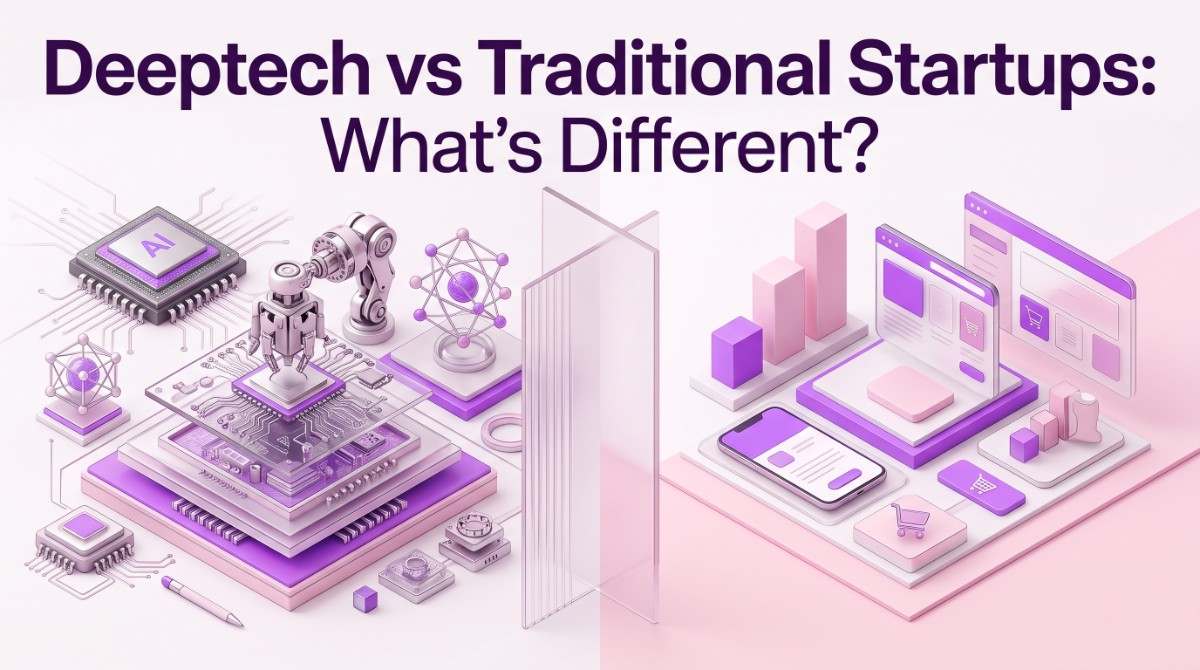
Deeptech vs Traditional Startups: What's Different?
Traditional Startup | Deeptech Startup |
Faster product iteration | Longer R&D cycles |
Lower initial capital | Often capital intensive |
Software-led | Science and engineering-led |
Easier to replicate | Stronger technology barriers |
Faster market entry | Longer commercialization |
Neither model is objectively better. They're built for different kinds of founders and different kinds of problems. A software startup rewards speed. A deeptech startup rewards depth and patience.
What Does It Take to Build a Successful Deeptech Startup?
A few ingredients show up again and again in the deeptech companies that actually make it.
It starts with a strong technical founding team, people who genuinely understand the science or engineering at the core of the business, not just the market opportunity around it. That team needs to be solving a real-world problem, not chasing a technology for its own sake. Proprietary technology and serious R&D capability matter enormously, and so does a clear IP strategy from early on, since that protection is often the entire moat.
Beyond the tech itself, founders need a realistic path to commercialization, industry partnerships that can validate the product in real conditions, and patient capital from investors who actually understand these timelines instead of pushing for growth metrics that don't apply. And underneath all of it, the business model still has to scale. Brilliant technology that can't eventually reach a large enough market isn't a startup. It's a research project.
India's Deeptech Startup Ecosystem: What's Changing?
The ecosystem around deeptech has genuinely matured over the past few years, not just the funding numbers.
There are now over 8,800 deeptech startups in India, with more than 1,800 of them funded and seven having reached unicorn status. Universities and research institutions are increasingly feeding founders and technology directly into startups, rather than keeping that work locked inside academic papers. Incubators and accelerators built specifically for hardware and deeptech have grown alongside this, giving founders support that a generic startup accelerator often can't provide.
Government initiatives have added real fuel here too, from the Semicon India Programme to dedicated deeptech funds and eligibility frameworks that now recognize how much longer these businesses take to develop. In 2026, the recognized age limit for deeptech startups was extended to 20 years and the turnover cap raised to 300 crore rupees, a direct acknowledgment that these companies simply can't be judged on the same timeline as a typical startup. Corporate partnerships are growing too, and investor interest keeps climbing as more funds build dedicated deeptech theses instead of treating it as a side bet.
Is Deeptech the Next Big Opportunity for Indian Founders?
Honestly, the evidence points that way, but it comes with real caveats.
The opportunity is significant because India finally has the talent, policy support, and market demand lining up at the same time, something that wasn't true even five years ago. Semiconductors and spacetech currently show the strongest momentum, though robotics and AI hardware aren't far behind. Timing matters here too. Being early in a maturing ecosystem tends to come with real advantages, from better access to talent to stronger relationships with the government programs backing this space.
But founders need to think beyond short-term funding cycles. Deeptech isn't a sector where you raise a seed round and expect a quick Series A bump on vanity metrics. It rewards founders who are building technology with genuine global potential, not just something that solves a narrow domestic problem. That's a harder, slower path. It's also, for the right founders, a much more defensible one.
Read More: Top Startup India Incubators List 2026
How Founders Can Prepare for a Deeptech Startup
If this sounds like the right direction, here's a practical way to approach it:
Identify a genuinely high-value problem, not just an interesting piece of technology
Validate the underlying technology before building a full business around it
Build an experienced technical team early, since this is where deeptech lives or dies
Protect your IP from the start, not as an afterthought once you've raised money
Test with real industry partners to get honest feedback outside your own team
Understand your funding requirements realistically, including how long it'll take before revenue shows up
Build a clear commercialization roadmap, not just a research plan
Start thinking about global markets early, since the strongest deeptech companies rarely stay India-only for long
Conclusion:
Deeptech, robotics, and semiconductors are opening up a kind of opportunity that looks very different from the consumer app and marketplace wave that defined Indian startups for the last decade. India has the talent, the demand, and now an increasingly supportive ecosystem behind it.
But none of this is a shortcut. These businesses require patience, deep technical expertise, real capital, and disciplined execution over years, not months. The opportunity here isn't simply to build another startup. It's to build technology that's genuinely difficult to replicate and valuable enough to compete globally, not just locally.
Thinking of building the next big deeptech venture? Startup Coach can help you turn the technology into a scalable business.
FAQs
1. What are deeptech startup opportunities in India?
They span AI hardware, robotics, semiconductors, spacetech, defense technology, drones, advanced manufacturing, climate tech, and biotechnology. Semiconductors and spacetech currently stand out as the fastest growing segments.
2. What are deeptech startups?
Deeptech startups are companies built around genuine scientific or engineering breakthroughs, rather than software applications layered on existing technology. They typically involve heavy R&D, specialized talent, and real intellectual property.
3. Why are robotics startups growing in India?
Rising demand across manufacturing, warehousing, healthcare, defense, and agriculture is driving this growth, alongside a push to reduce reliance on imported automation systems and build homegrown alternatives.
4. Is India becoming a semiconductor hub?
It's moving in that direction. Government programs like the Semicon India Programme and the Design Linked Incentive scheme are actively supporting chip design, manufacturing, and testing capabilities, though India is still building toward that role rather than having fully arrived.
5. Which deeptech sectors have the most potential in India?
Semiconductors and spacetech currently show the strongest momentum, with robotics, AI infrastructure, and defense technology close behind.
6. Why are investors interested in deeptech startups?
Deeptech companies tend to have stronger technology moats, harder-to-replicate intellectual property, and access to global markets, along with strategic importance that can insulate them somewhat from broader funding slowdowns.
7. What are the biggest challenges for deeptech startups?
High R&D costs, long product development cycles, hardware and manufacturing complexity, difficulty finding specialized talent, regulatory hurdles, and capital-intensive growth are the main obstacles founders face.
8. How can I start a deeptech startup in India?
Start with a real, high-value problem, build a technically strong founding team, validate the technology early, protect your IP from day one, and plan for a longer, more capital-intensive path to commercialization than a typical software startup.