Compliance Risk Management: Strategies to Reduce Risk & Stay Compliant
By Rohini Rajpoot · 7 May 2026
Learn compliance risk management strategies for startups. Reduce legal risks, stay compliant, and build a strong compliance framework.
Every startup founder knows the feeling of being heads-down building your product, closing customers, and managing a dozen priorities at once. Compliance feels like a bureaucratic afterthought. Until it isn't. A tax notice arrives. An investor's due diligence flags a missing filing. A disgruntled ex-employee raises a labor law dispute. Suddenly, compliance is the only thing on your agenda, and fixing it reactively costs ten times more than getting it right proactively.
Compliance risk management is the discipline that prevents that scenario. It is not about drowning in paperwork. It is about building smart systems that keep your startup legally protected while you focus on growth.
This blog understands you through what compliance risk management means for Indian startups, the step-by-step process, proven strategies, and how to build a framework that actually works at your stage.
What Is Compliance Risk Management?
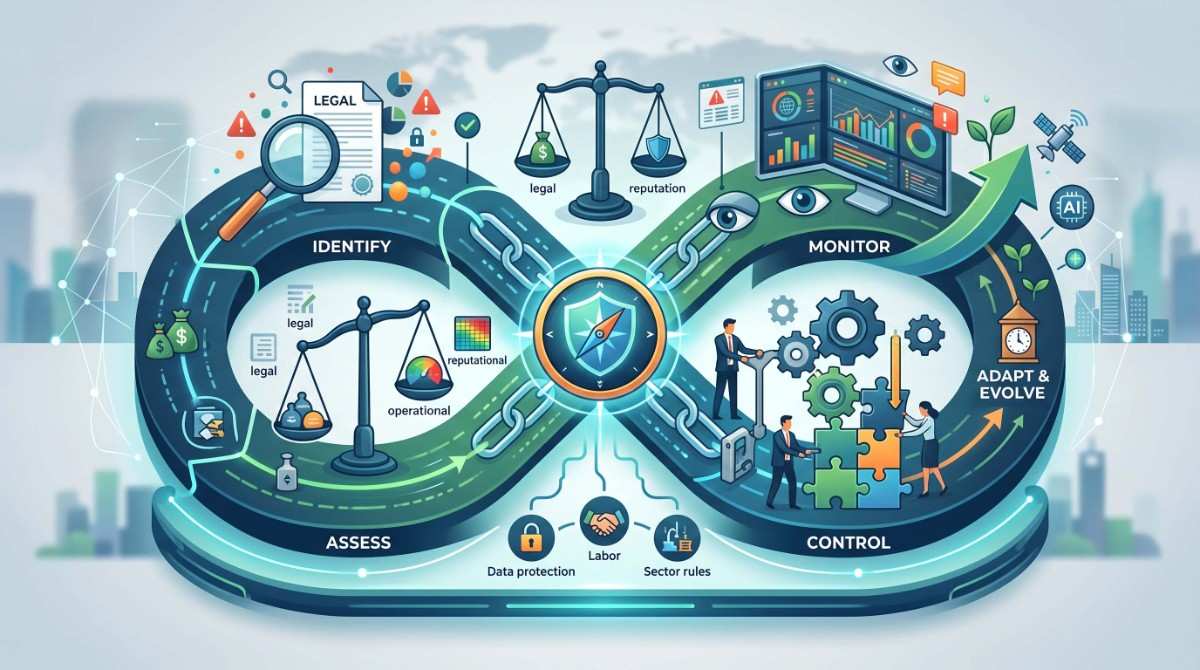 Compliance risk management is the ongoing practice of identifying, assessing, controlling, and monitoring the legal and regulatory risks that could expose your business to penalties, litigation, reputational damage, or operational disruption. Unlike a one-time compliance audit, compliance risk management is a living system. It evolves as your business grows, as regulations change, and as new risks emerge.
For startups, this means building processes that keep you compliant with tax laws, labor regulations, data protection requirements, sector-specific rules, and corporate governance obligations without it becoming a bottleneck to moving fast. The goal is simple: reduce the probability of a compliance failure, and reduce the damage if one does occur.
Why Compliance Risk Management Is a Startup Priority
Many founders delay building a compliance risk management process until they're raising a Series A or preparing for an audit. That's too late. Here's what's actually at stake:
1. Investor readiness
Every serious investor performs legal due diligence. Compliance gaps discovered at the term sheet stage can stall or kill a deal. Investors want to back clean, well-governed companies.
2. Operational continuity
A GST suspension, a bank account freeze, or a show-cause notice from the MCA can halt operations for weeks. These are not hypothetical; they happen to fast-growing startups that outpace their compliance infrastructure.
3. Talent trust
Employees expect their PF to be deposited, their ESOPs to be valid, and their workplace to be legally sound. Compliance failures erode internal trust faster than anything.
4. Cost efficiency
Penalties, legal fees, and remediation costs from compliance failures far exceed the cost of prevention. Building the right compliance risk framework early is simply good financial sense.
The Compliance Risk Management Process: Step by Step
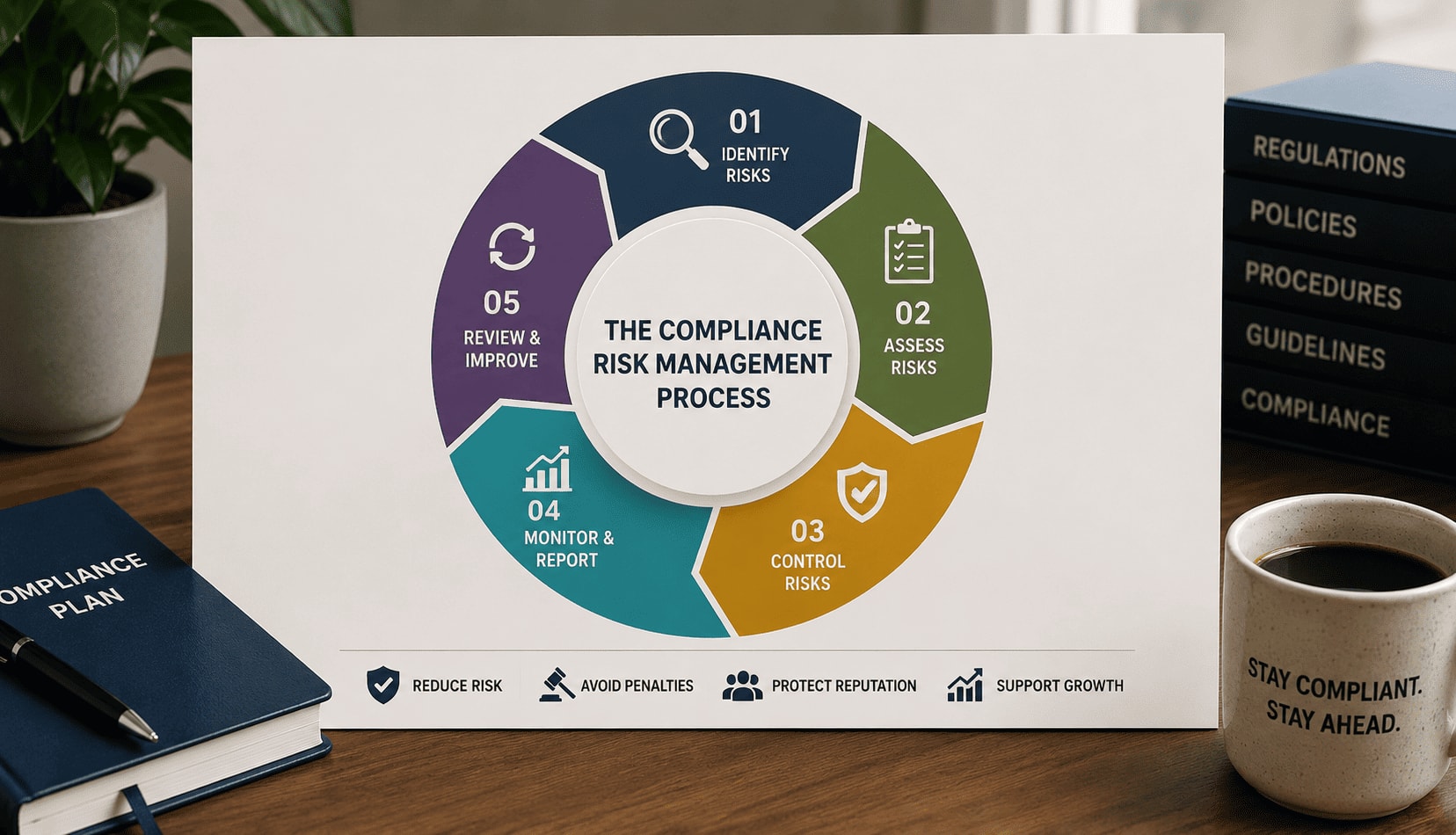 A structured compliance risk management process transforms a reactive scramble into a proactive system. Here are the five stages every startup should follow:
Stage 1: Risk Identification
You cannot manage what you haven't mapped. Begin by identifying every regulatory obligation that applies to your business, like tax, labor, corporate, data, sector-specific, and foreign investment laws.
This is your compliance universe. It will differ based on your industry (fintech, edtech, D2C, or SaaS), your revenue (above ₹20L triggers GST), your headcount (10+ employees triggers POSH), and your funding structure (foreign investment triggers FEMA).
Map it all out. Leave nothing assumed.
Stage 2: Risk Assessment
Once risks are identified, evaluate each for likelihood and impact. A missed advance tax payment is a moderate risk, and penalties are calculable. An FEMA violation involving foreign investment is a high-severity risk. The consequences can be severe and swift.
This prioritization is the backbone of how to manage compliance risk without becoming overwhelmed. You don't need to fix everything at once. You need to fix the right things first.
Stage 3: Risk Control and Mitigation
For each identified risk, define a control. Controls are the policies, processes, tools, or responsibilities you put in place to reduce the likelihood or impact of a compliance failure. Examples of practical controls for Indian startups:
Automated GST return reminders with a dedicated owner accountable for filing
Standardized employment contract templates reviewed by a lawyer, used for every hire
A data privacy policy that is reviewed and updated every six months
A compliance calendar with all regulatory deadlines plotted for the financial year
Quarterly cap table reviews to keep equity records accurate
Controls do not need to be complex. They need to be consistent.
Stage 4: Monitoring and Reporting
Controls only work if they are actually being followed. Build a simple monitoring rhythm: monthly check-ins on filings, quarterly compliance reviews across all domains, and immediate escalation protocols when a risk materializes.
If you have a leadership team, make compliance a standing agenda item in your quarterly reviews. Transparency is a strength, not a weakness.
Stage 5: Review and Continuous Improvement
Your compliance risk management process must evolve. As you grow from 5 to 50 employees, as you expand to new states, or as you launch new products or accept foreign investment, the regulatory landscape shifts. Schedule a full compliance review at least twice a year, and always immediately after a major business event like a funding round, an acquisition, or a market expansion.
Compliance Risk Strategies That Actually Work for Startups
Here are the most effective compliance risk strategy approaches that practical founders use:
1. Assign Ownership, Not Just Awareness
Compliance fails when it's everyone's responsibility and therefore no one's. Designate a compliance owner, even if it's a co-founder or a part-time CFO who is accountable for ensuring key obligations are met on time.
2. Build a Compliance Calendar
Plot every regulatory deadline for the year on a shared calendar. GST returns, TDS deposits, advance tax due dates, ROC filings, ESOP grant approvals, and annual audits—all of it in one place, with reminders set well in advance. This single habit prevents most deadline-related penalties.
3. Use Technology to Reduce Human Error
Leverage tools like ClearTax for GST and income tax, Razorpay Payroll for PF and ESI management, and Zoho or QuickBooks for financial compliance. Manual processes are where compliance mistakes breed. Automation reduces that surface area significantly.
4. Engage External Experts Strategically
You don't need a full-time legal team early on. But you do need reliable access to a CA, a labor law advisor, and a startup lawyer. Building these relationships before a crisis means you get faster, cheaper help when you need it most.
5. Standardize Your Contracts and Policies
Template-driven compliance is underrated. A well-drafted employment contract, NDA, vendor agreement, and data processing policy reviewed once by a lawyer and used consistently dramatically reduces contract-related compliance risk across hundreds of transactions.
6. Document Everything
In a compliance dispute, documentation is your defense. Board resolutions, ESOP grant letters, POSH training records, and data consent logs—maintain them systematically, not just when you're preparing for due diligence.
Building a Compliance Risk Framework for Your Startup
A compliance risk framework is the overarching structure that ties all of the above together. At its core, it answers four questions:
What are we required to follow? (Regulatory inventory)
Who is responsible for each compliance area? (Ownership map)
How are we ensuring compliance? (Controls and processes)
When do we review and update? (Review cadence)
For early-stage startups, this framework doesn't need to be a 50-page document. A well-maintained spreadsheet with your regulatory obligations, owners, deadlines, and status is a perfectly functional compliance risk framework. What matters is that it exists, is used, and is updated. As you scale, this evolves into more formal governance board-level compliance reporting, internal audits, and eventually a dedicated compliance function.
Common Compliance Risk Management Mistakes to Avoid
Even well-intentioned founders make these errors:
1. Treating compliance as a one-time exercise
Filing your first GST return and calling it done. Compliance is continuous, not episodic.
2. Conflating legal incorporation with ongoing compliance
Registering your Pvt. Ltd. is the beginning, not the end. Annual filings, board meetings, and statutory registers must be maintained every year.
3. Waiting for a problem to arise to hire expertise
Engaging a CA or startup lawyer reactively is always more expensive and stressful than having them on call proactively.
4. Assuming growth-stage rules don't apply yet
POSH, ESOP regulations, and FEMA obligations have specific thresholds and triggers. Many founders discover they crossed a threshold months ago.
Startup Coach’s Perspective
From a startup coach’s perspective, compliance risk management is not just about avoiding penalties, it is about building a startup that is investor-ready and scalable from day one. Founders who put basic compliance systems in place early usually spend less time dealing with legal surprises later. It also creates stronger trust with employees, investors, and partners. As the business grows, these small systems become a major operational advantage. Startups that manage compliance proactively are often able to scale faster and make decisions with far more confidence.
Conclusion
Risk management in compliance is not about being fearful; it is about being strategic. The founders who build strong compliance foundations early move faster later, raise capital more easily, and sleep better at night. You don't have to navigate this alone. At Startup Coach, we work with founders at every stage to build the legal, financial, and governance infrastructure that scales with their ambition—from incorporation to IPO readiness.
If you want to audit your current compliance posture and build a robust compliance risk management system tailored to your startup, connect with our team today! Let's protect what you're building.
FAQs
Q: What is compliance risk management for startups?
Compliance risk management is the process of identifying, managing, and monitoring legal and regulatory risks to avoid penalties and business disruptions.
Q: Why is compliance important for Indian startups?
Compliance helps startups avoid fines, legal issues, investor concerns, and operational interruptions.
Q: How can startups reduce compliance risks?
Startups can reduce risks by creating compliance calendars, using automation tools, maintaining proper documentation, and consulting experts when needed.
Q: What are common compliance risks startups face?
Common risks include GST non-compliance, missed ROC filings, labor law violations, FEMA issues, and data privacy gaps.
Q: When should a startup start building a compliance framework?
Startups should begin building a compliance framework from the early stages to avoid costly problems later.