Top 5 Early-Stage Venture Capital Funds That Back Startups in India
By Rohini Rajpoot · 23 October 2026

Explore 5 venture capital funds backing early-stage startups, their investment focus, funding stages, and tips to pitch your star
Most founders hit the same wall. You have an idea, maybe a rough prototype, and a handful of people who say they’d pay for it. Now you need money to find out if it’s real, and your savings only stretch so far.
This is where early-stage venture capital funds come in. A good one gives you a cheque, of course, but also advice from people who have watched hundreds of startups work or fail, and introductions that would take you years to get on your own. The catch is that “good” depends on you. A fund that suits a deeptech team with no revenue may be a poor match for a consumer brand already selling every day.
In this post we look at five of the top venture capital firms for startups in India: Peak XV Partners, Accel, Blume Ventures, Elevation Capital and Speciale Invest. We also cover how to choose between them, how to get funding from a VC firm, and what investors actually look for. We checked the details in October 2026, but fund sizes and programmes change often, so confirm everything on each fund’s own website before you pitch.
What Are Early-Stage Venture Capital Funds?
An early-stage venture capital fund pools money from investors (called limited partners) and puts it into young companies in exchange for equity. These companies are usually small, often pre-revenue, and risky. The fund accepts that most bets will fail, because one big winner can pay for the rest.
The stages blur at the edges, but roughly it goes like this. Pre-seed is the earliest money, used to build a first product or test an idea. Seed comes when you have something working and need to find out if people want it at scale. Series A is for startups with real traction that are ready to build a repeatable way of growing.
Good funds offer more than money. Many give you a sounding board for hiring and strategy, access to other founders, and help with the next round. That support has a price, though. You are selling a slice of your company, so you’ll own less of it afterwards, and the investor expects a very large outcome. Venture capital isn’t right for every business, and it’s worth being honest with yourself about that before you start.
Top 5 Venture Capital Funds That Support Early-Stage Startups

1. Peak XV Partners
Peak XV is the firm formerly known as Sequoia Capital India and Southeast Asia. Its early-stage engine is Surge, a seed programme launched in 2019, which has backed more than 180 startups. The firm announced its twelfth Surge cohort on 28 September 2026, with 18 companies across areas like AI, robotics, space, consumer, healthcare and fintech.
The notable change is the cheque size. Surge can now invest up to $5 million per company, up from $3 million before. That’s a big number for a seed round, so expect a high bar. It’s also worth knowing that not every Surge startup is Indian. The recent cohorts include companies from the US and Southeast Asia too. Founders with a sharp, ambitious idea and a strong technical or product story tend to do best here.
2. Accel
Accel’s route in for the youngest startups is Atoms, a pre-seed programme it started in 2021. It has since backed more than 40 companies, and it runs separate tracks: Atoms AI for founders building with or around artificial intelligence, and Atoms X for what the firm calls “LeapTech”, meaning products or technologies that change how people live in a big way. Both tracks have offered up to $1 million.
This year Accel also teamed up with Google’s AI Futures Fund, so selected AI startups can raise up to $2 million, with each side putting in up to $1 million. Atoms is open to Indian and Indian-origin founders, including those based abroad. If you’re still at the idea stage, with no product and no customers, this is one of the few doors that are genuinely open. Accel also raised a $650 million early-stage fund for India and Southeast Asia for investing beyond the programme.
3. Blume Ventures
Blume is a Mumbai-based firm that has been backing Indian founders for well over a decade. It started as a small pre-seed investor and has grown with each fund, now investing mainly at seed and Series A. It also runs a dedicated pre-seed vehicle, the Blume Founders’ Fund, for very early bets.
Its portfolio is broad, with consumer, fintech, enterprise software and deeptech all showing up, and the firm likes India-first teams that might one day sell globally. Reported cheque sizes vary a lot between sources, anywhere from a couple of hundred thousand dollars to a few million, which is normal for a firm that invests across stages. Reports from late 2025 mention a first close of a fifth fund. Blume says it prefers warm introductions, though you can also reach out through its website.
4. Elevation Capital
Elevation, once known as SAIF Partners, has invested in India since 2002 and counts Swiggy and Paytm among its earlier bets. In 2026 it closed a $500 million Fund IX that sticks to seed and Series A rounds, with a particular interest in application-layer AI and in healthcare, education and financial services.
There’s one thing to be careful about. Elevation describes seed and Series A as its core, so if you’re at the pre-seed stage with only an idea, you may be a bit early. Its previous fund typically started with tickets of $2 to $5 million, and that range gives you a sense of the size of company it likes to back. It’s a strong match for teams that already have an early product and some proof that customers care.
5. Speciale Invest
Speciale is a Chennai-based fund that invests only in deeptech and science-led startups, and it does so at pre-seed and seed. Its third fund closed in August 2025 at ₹600 crore, and it plans to back around 18 to 20 companies across areas like space, AI infrastructure, climate, quantum and advanced manufacturing.
What sets it apart is how early it will come in. The firm says it’s happy to meet teams of two or three people with a strong idea, and it often leads a company’s first institutional round. Initial cheques are reported at roughly ₹7 to 10 crore, though you should confirm that directly. If you’re building hardware or a hard technical product that needs patient money, this is a fund to read up on.
How to Choose the Right Venture Capital Fund for Your Startup
Start with fit. Read what a fund says it invests in, then look at what it actually invested in over the last two years. Those two things don’t always match. A fund that says it backs consumer startups but hasn’t written a consumer cheque since 2022 is telling you something.
Next, check the stage. Plenty of founders waste months pitching a Series A fund with a seed-stage company. Look at the portfolio too, and ask whether the fund already backs a direct competitor of yours. That can quietly kill a deal.
Then think about the person across the table. A fund is really a few individuals, and you’ll be working with one of them for years. Talk to founders in the portfolio, including ones whose companies struggled, and ask how the investor behaved when things got hard.
Finally, look at the terms and the long game. Consider how much of your company you’re giving up and whether the investor will back you in future rounds. The best-known name is not automatically the best choice. A smaller, focused fund that returns your calls can do more for you than a famous one that doesn’t.
Read More: Top Seed Funding Schemes in India (2026) | Startup Coach
How to Get Funding From a VC Firm
There’s no secret formula, but there is a sensible order to do things in.
1. Prove people want it: Talk to customers, run a pilot, collect signups or early sales. Evidence beats a nice story.
2. Build your pitch deck: Keep it short and clear: the problem, your solution, the market, how you make money, who’s on the team, and what you’ll do with the funds.
3. Work out your numbers: Make realistic financial projections and understand how your startup valuation is likely to be seen. Inflated numbers make investors lose trust fast.
4. Research seed stage investors: Make a list of funds that match your sector and stage, and read their criteria.
5. Get in through the right door: A warm introduction from a founder or advisor works best. If a fund has a public submission process, follow it exactly.
6. Get ready for due diligence: Investors will check your legal papers, cap table, finances and customer claims. Have it all organised.
7. Read the term sheet carefully: Compare offers on valuation, board seats, liquidation preferences and other terms, and get a lawyer to review it before you sign.
What Do VCs Look for in an Early-Stage Startup?
Investors differ, but a few things come up again and again. They want a real problem and a solution that makes people’s lives easier. They want a market large enough that a successful company could become very big, or at least a clear path to reach that size.
They also bet heavily on the founders. Can this team build the product, hire well and keep going when it gets hard? At the earliest stages, the team is often most of the pitch.
After that comes proof: customer interest, early revenue, pilots or a product that people actually use. A business model that can grow without costs rising at the same pace matters too, along with sensible financial assumptions and a clear plan for how the money will be spent.
Keep in mind that all this shifts by sector and stage. A deeptech fund will weigh the science and the team far more than monthly revenue. A consumer fund will want to see repeat customers.
Angel Investors vs Venture Capital Funds
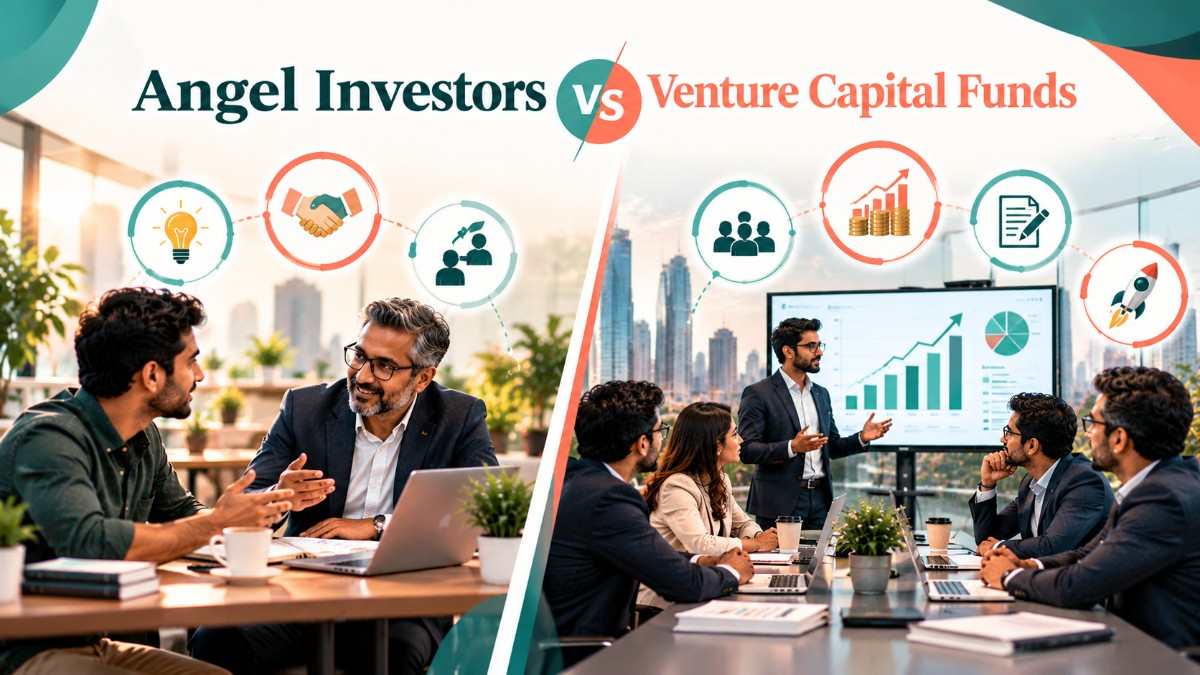
An angel investor is an individual who puts in their own money, often a successful founder or executive. A venture capital fund is a firm that invests other people’s money and answers to those backers.
Angels usually decide quickly, write smaller cheques and may help informally. VC funds take longer, have a more formal process, can write bigger cheques and often reserve money for follow-on rounds. Angels can be a good first step when you’re raising a small amount early, while a VC fund fits better when you’re aiming for fast growth and a larger round.
Amounts and process vary a lot in both cases, and many startups raise from angels first and then from a fund.
Conclusion
Choosing an investor matters as much as finding the money. The right fund brings experience and introductions, and the wrong one can drag you in directions you don’t want to go. So do your homework on each fund, polish your pitch and read every term before you agree. Aim for a partner who fits your startup, not just the biggest cheque.
Raising money is a lot easier when you walk in prepared. Startup Coach works with founders on the parts of fundraising that tend to trip people up, including pitch decks, financial planning, investor readiness and overall fundraising strategy.
Preparing to raise your next round? Explore Startup Coach’s fundraising services to learn how to strengthen your fundraising approach.
Frequently Asked Questions
1. Which venture funds invest in early-stage startups?
Many do, but not all at the same stage. Check each fund’s stage, sector, location and recent portfolio on its official website before you reach out.
2. How do I pitch my startup to a venture capital fund?
Lead with a clear deck, show whatever traction you have, back it with realistic projections, and approach funds that actually invest in your area, ideally through a warm introduction.
3. What do VCs look for in an early-stage startup?
A strong team, a big enough market, proof that customers want the product, a model that can scale, and sound business basics.
4. How much funding can an early-stage startup raise from a VC?
It depends on the stage, sector, traction, valuation and the fund’s own strategy. Programmes like Surge and Atoms publish ranges, but the actual amount is agreed deal by deal.
5. What is the difference between angel investors and venture capital funds?
Angels invest their personal money and move quickly. VC funds invest pooled money from outside investors, follow a more formal process and usually write larger cheques.