Startup Funding and Investment Terms Every Founder and Investor Must Know
By Rohini Rajpoot · 27 May 2026
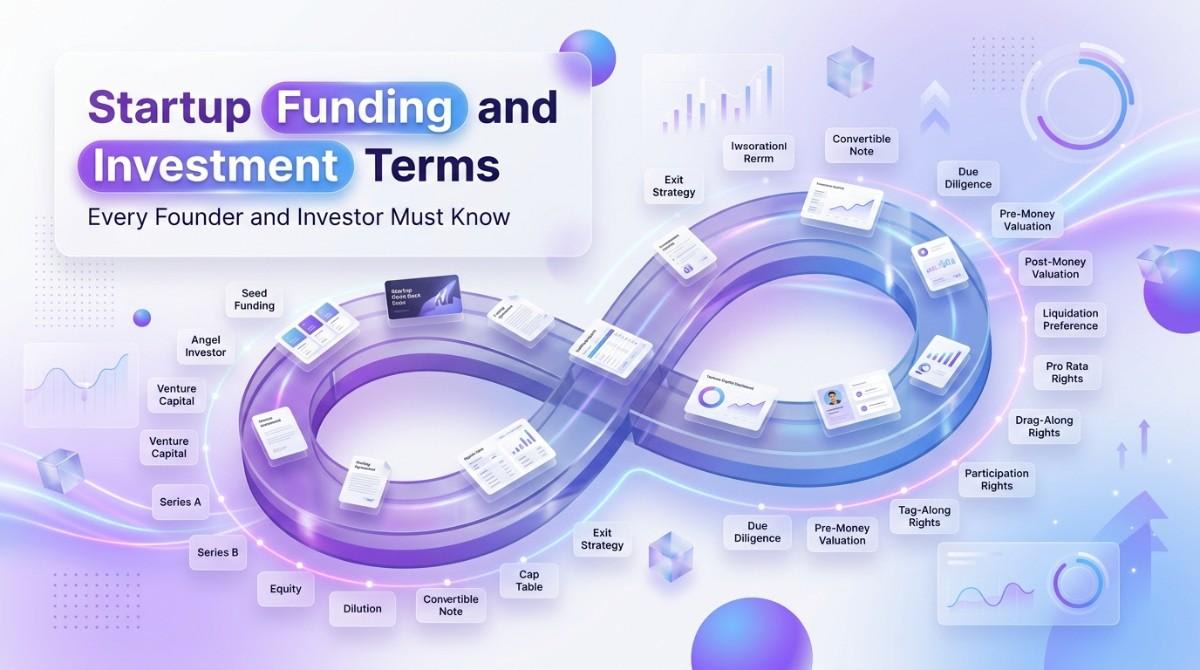
Learn essential startup funding and investment terms, including SAFE notes, cap tables, dilution, VC funding, and Series A basics.
If you have ever sat in a startup meeting and nodded along while someone talked about SAFE notes, cap tables, or Series A crunches without actually knowing what any of it meant, you are not alone. The startup world runs on its own language, and if you do not speak it, you are at a serious disadvantage whether you are raising money, investing it, or just trying to understand what is happening around you. This guide breaks down every major startup funding and investment term in plain language, no finance degree needed.
Where Does Startup Money Actually Come From?
Before getting into specific terms, it helps to understand the basic picture. Startups raise money in stages, and different types of investors show up at different stages depending on risk appetite, cheque size, and what the business looks like at that point.
Money can come from angel investors, venture capital firms, crowdfunding platforms, family offices, corporate venture capital arms, private equity firms, and sometimes government grants. Each of these comes with different expectations, different strings attached, and different levels of involvement in how the business is run.
Early Stage Funding Terms
 Pre-Seed Funding
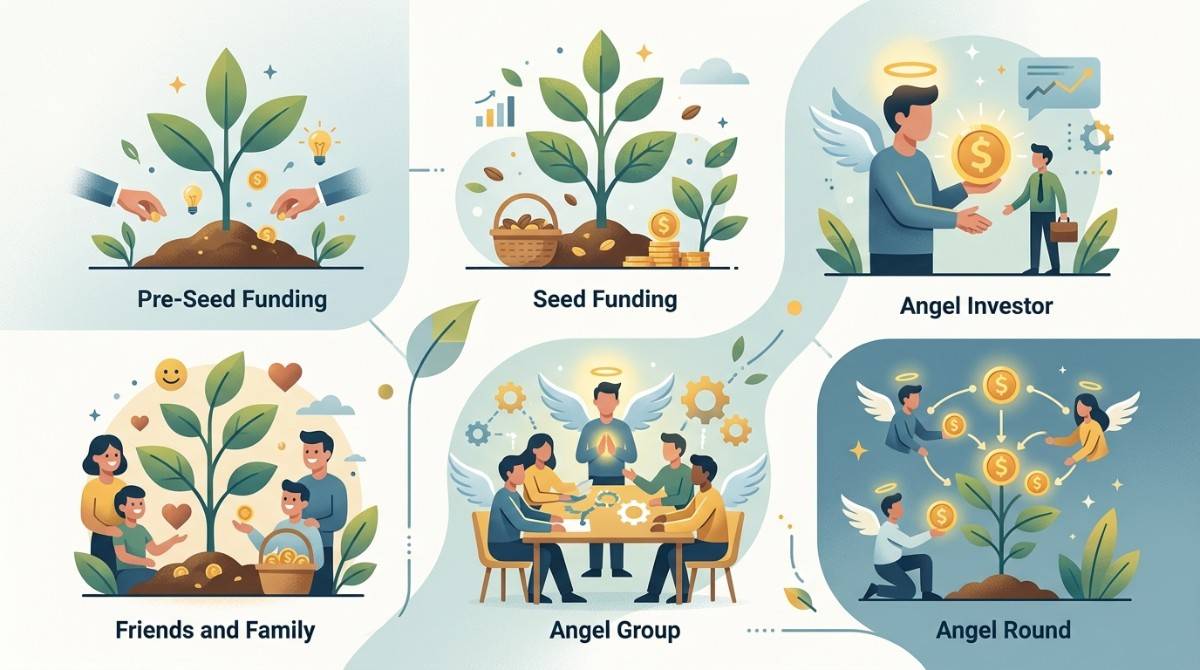
This is the very beginning. The founder usually has an idea, maybe a rough prototype or an MVP, and needs money to figure out if the thing is even viable. Pre-seed money typically comes from the founders themselves, friends and family, or small angel investors willing to take a punt on something that barely exists yet. The amounts are small, and the risk is high.
Seed Funding
Seed funding is the first proper investment round. The startup has moved past the pure idea stage and is building something real. Angel investors, angel groups, micro-VC firms, and crowdfunding platforms are common sources here. The goal is product development, early market research, and getting a team together.
Friends and Family Round
Exactly what it sounds like. Before any formal investor comes in, many founders raise a small amount from people who trust them personally. It is easier to close but needs to be handled carefully. Get the terms in writing and make sure everyone understands the risk, because mixing personal relationships and money can go wrong quickly.
Angel Investor
A wealthy individual who invests their own personal money into startups, usually at the early stages, in exchange for equity. Angel investors tend to make decisions faster than institutions, often bring useful contacts and mentorship alongside their cheque, and are generally more flexible about deal structure. Many of the best-known startup success stories were first backed by an angel.
Angel Group
A network of angel investors who pool resources and evaluate opportunities together. This allows individual investors to spread risk across more deals and gives startups access to larger amounts than a single angel might write.
Angel Round
The funding round where angel investors come in, typically after friends and family but before institutional venture capital, is called a "seed round".
Venture Capital and Growth Stage Terms
 Venture Capital (VC)
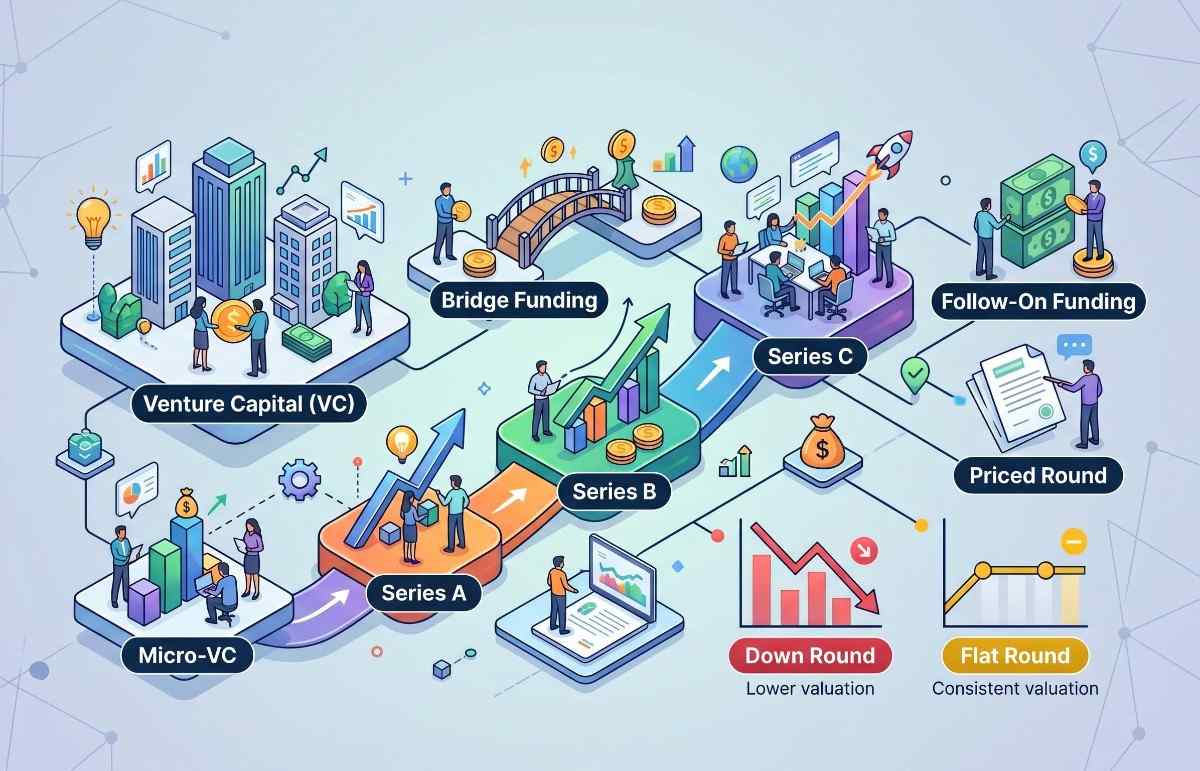
Venture capital is institutional investment into high-growth startups. VC firms raise money from limited partners, deploy it into startups in exchange for equity, and aim to generate significant returns within five to ten years, usually through an exit like an acquisition or IPO.
Micro-VC
Smaller venture capital funds that write smaller cheques, typically at the seed or pre-Series A stage. They fill the gap between angel investors and larger institutional VC firms.
Series A
The first major institutional funding round. A startup reaching Series A usually has real customers, growing revenue, and some evidence of product-market fit. Money goes toward team building, product improvement, and scaling what is already working.
Series B
By Series B, the business model is proven, and the focus shifts to scaling it aggressively. Hiring senior leadership, entering new markets, and building operational infrastructure are typical uses of this capital.
Series C
Usually raised by mature startups preparing for a big move, whether that is an IPO, a large acquisition, or global expansion. Investors at this stage expect stronger financial performance and lower risk compared to earlier rounds.
Bridge Funding
Temporary financing used to keep operations running between two funding rounds. If a startup is six months away from closing its next round but running low on cash, a bridge covers the gap.
Follow-On Funding
When existing investors put more money into a startup in a later round. It signals confidence in the business and often encourages new investors to come in alongside them.
Down Round
A funding round where the startup raises money at a valuation lower than its previous round. It is never a good sign and causes dilution for existing shareholders, but it can be better than running out of money entirely.
Flat Round
A round raised at the same valuation as the previous one. Not ideal, but less damaging than a down round.
Priced Round
A funding round where the company's valuation is set and agreed upon before investment is made. Series A, B, and C rounds are typically priced rounds.
Key Financial Metrics
 Burn Rate
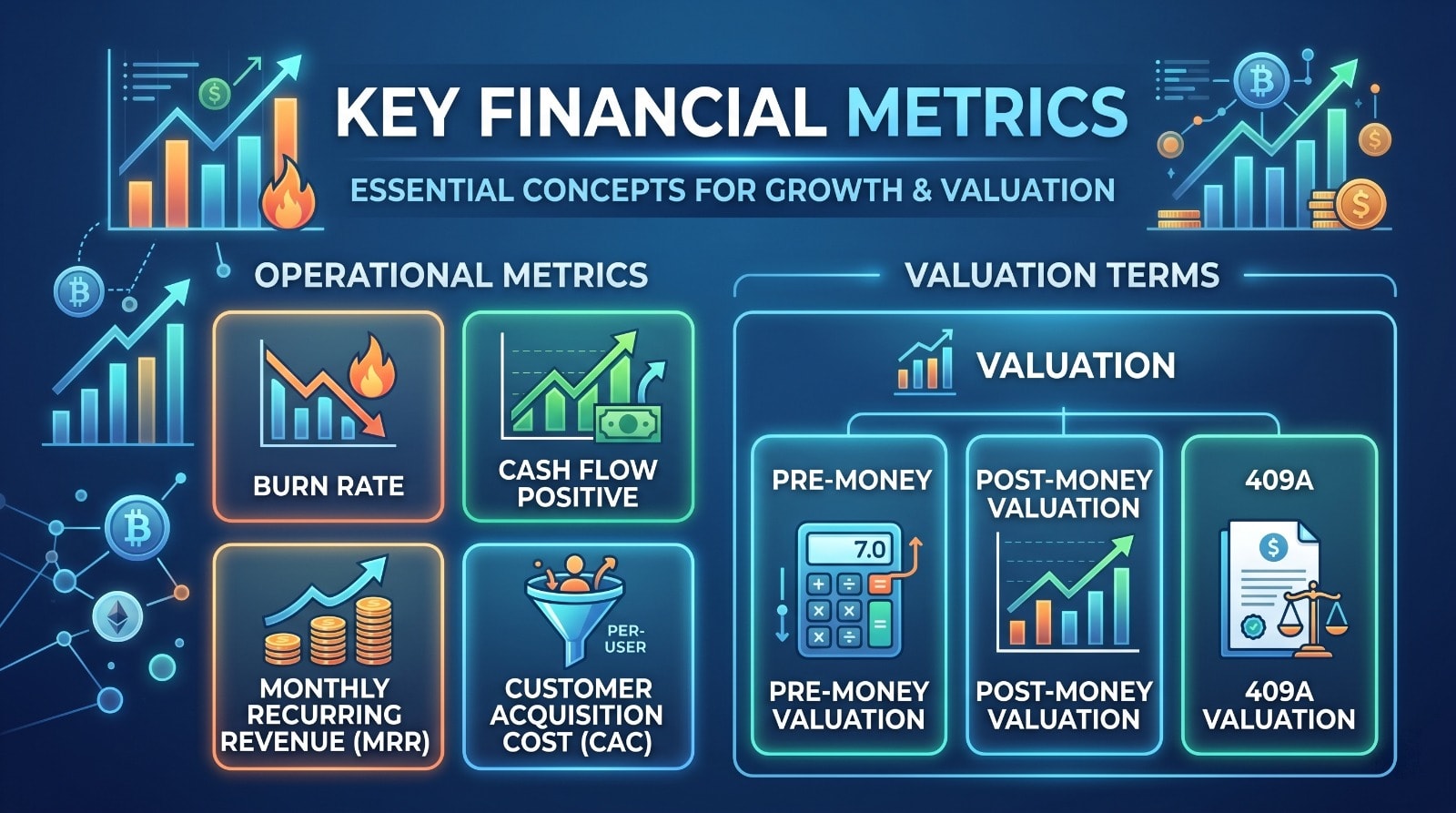
How quickly a startup is spending its cash. If a company brings in two lakh rupees a month but spends ten lakh, the burn rate is eight lakh per month. Knowing the burn rate tells you how long the runway is before money runs out.
Cash Flow Positive
The point where money coming in exceeds money going out. Reaching cash flow positive is a significant milestone because the business can sustain itself without depending on the next funding round.
Monthly Recurring Revenue (MRR)
The predictable revenue a subscription-based business generates each month. SaaS companies, membership platforms, and subscription products use MRR as a core health metric. Investors watch it closely.
Customer Acquisition Cost (CAC)
The total cost of acquiring a single customer, calculated by dividing total sales and marketing spend by the number of new customers gained. Lower CAC generally means the business is growing efficiently.
Valuation Terms
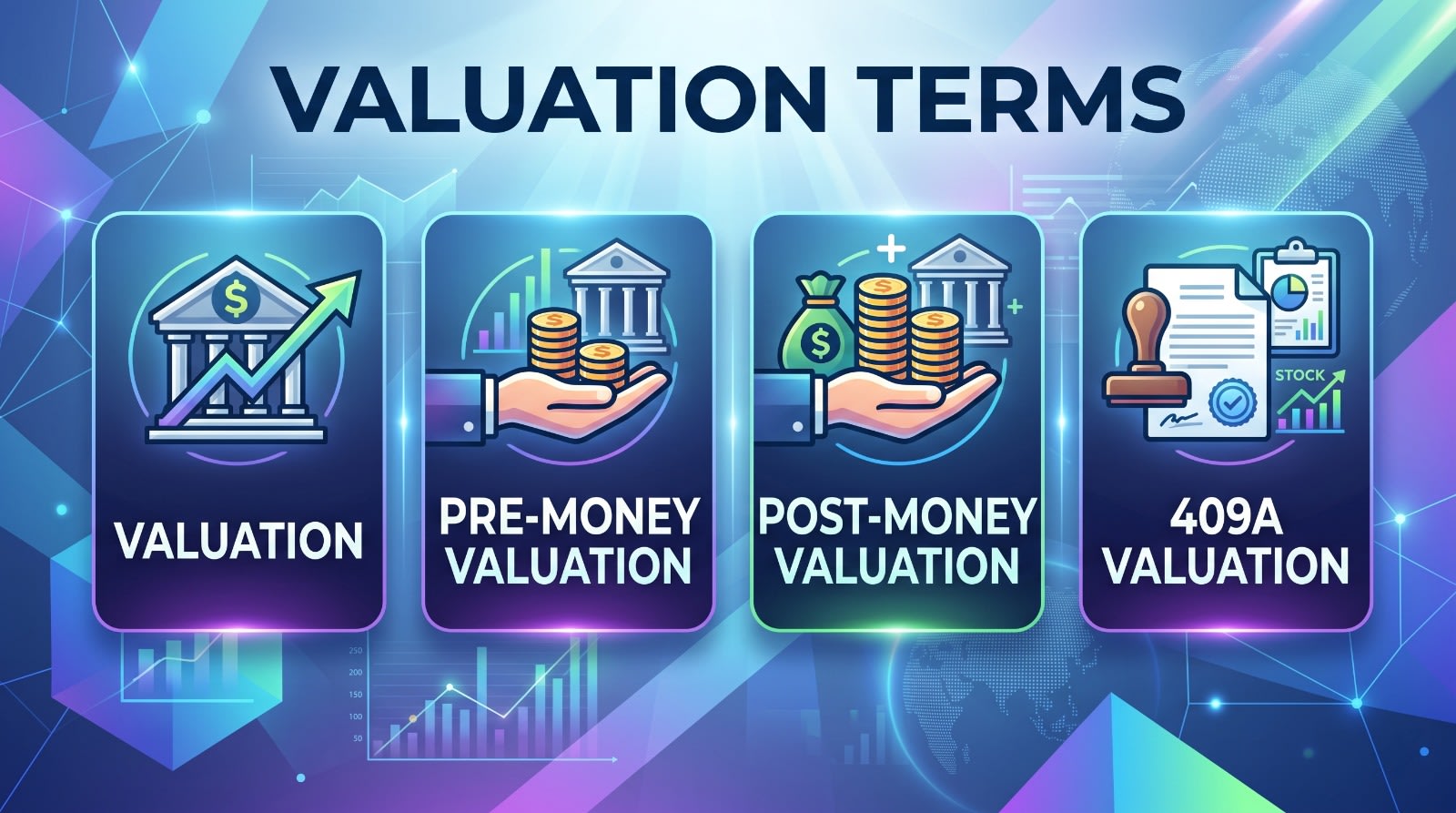 Valuation
What a startup is judged to be worth. Investors use valuation to calculate how much equity they should receive in return for their investment.
Pre-Money Valuation
The value of the startup before new investment comes in.
Post-Money Valuation
The value after the new investment is added. If a startup has a pre-money valuation of ten crore and raises two crore, the post-money valuation is twelve crore.
409A Valuation
An independent third-party assessment of a private company's fair market value. It is used primarily to set the exercise price for employee stock options in a way that is compliant with tax regulations.
Equity and Ownership Terms
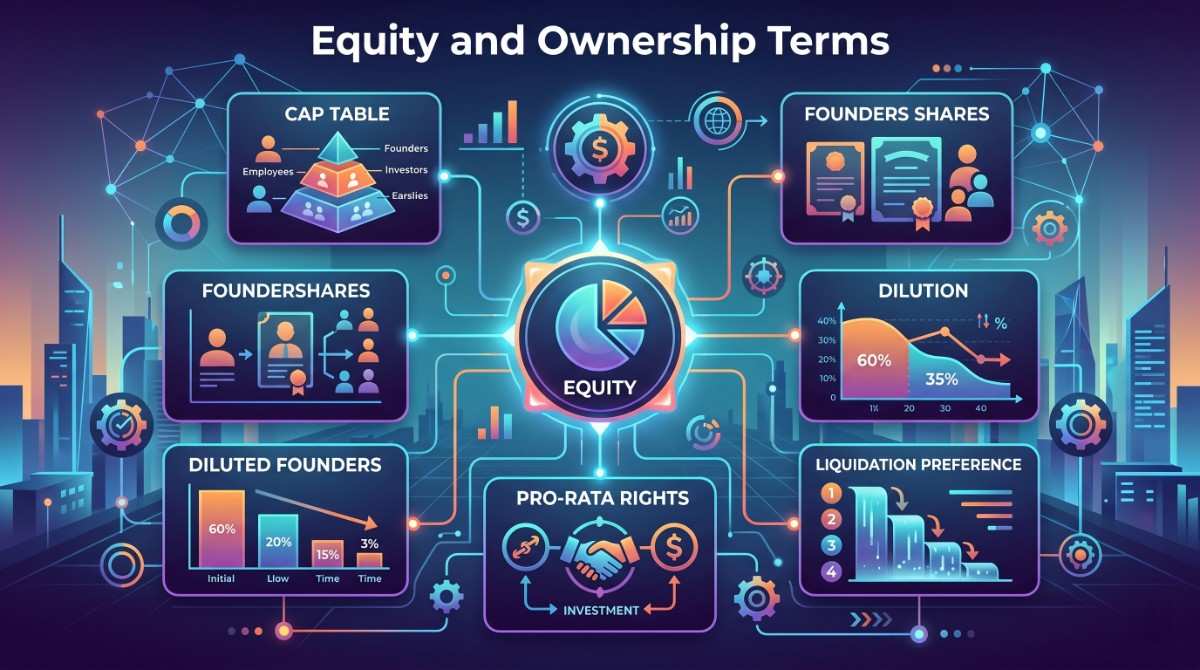 Equity
Ownership in a company. When investors fund startups, they receive equity shares in return. The more equity you give away, the less of the company you own.
Cap Table
Short for capitalization table. It shows exactly who owns what in a startup, including founder shares, investor equity, and employee stock options. Keeping the cap table clean and well-managed matters enormously as the company grows.
Founders Shares
The equity allocated to founders when the company is first formed, before any outside investment.
Dilution
When new shares are issued to investors, existing shareholders own a smaller percentage of the company even if the number of their shares stays the same. This is known as dilution or equity dilution. It happens with every funding round.
Diluted Founders
Founders whose ownership percentage has reduced significantly after multiple rounds of funding. Common in mature startups that have raised heavily.
Pro-Rata Rights
Give existing investors the right to participate in future rounds at the same ownership level. It protects investors from being diluted out of a business they got into early.
Liquidation Preference
Determines the order in which people get paid if a company is sold or shut down. Investors with liquidation preferences get their money back before founders and common shareholders see anything.
Funding Instruments
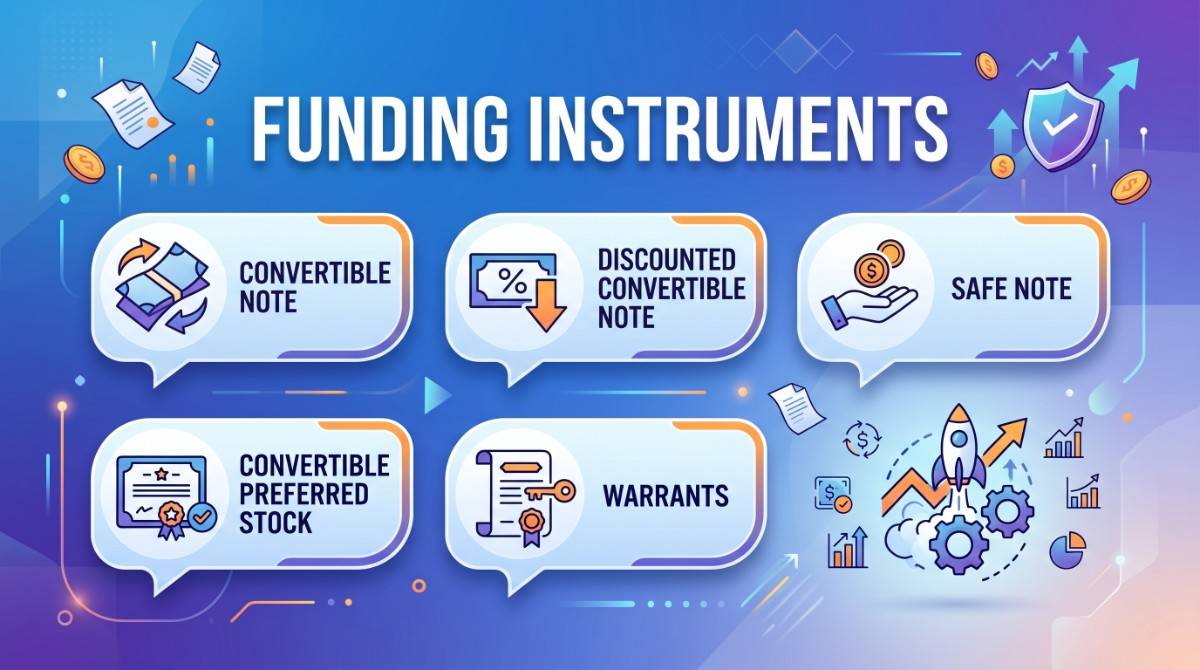 Convertible Note
A short-term loan that converts into equity during a future funding round rather than being repaid in cash. Popular at early stages because it avoids the need to agree on a valuation immediately.
Discounted Convertible Note
A convertible note that gives the investor a discount on the share price when it converts, as a reward for investing early and taking on more risk.
SAFE Note
Simple Agreement for Future Equity. Created by Y Combinator as a simpler alternative to convertible notes. Investors receive the right to future equity without immediate valuation negotiations. Very common at the seed stage.
Convertible Preferred Stock
Stock that gives investors special rights and protections and can be converted into common shares later, typically at IPO or acquisition.
Warrants
Give investors the right to buy company shares at a fixed price in the future. Often used as sweeteners in bridge financing.
Alternative Funding Methods
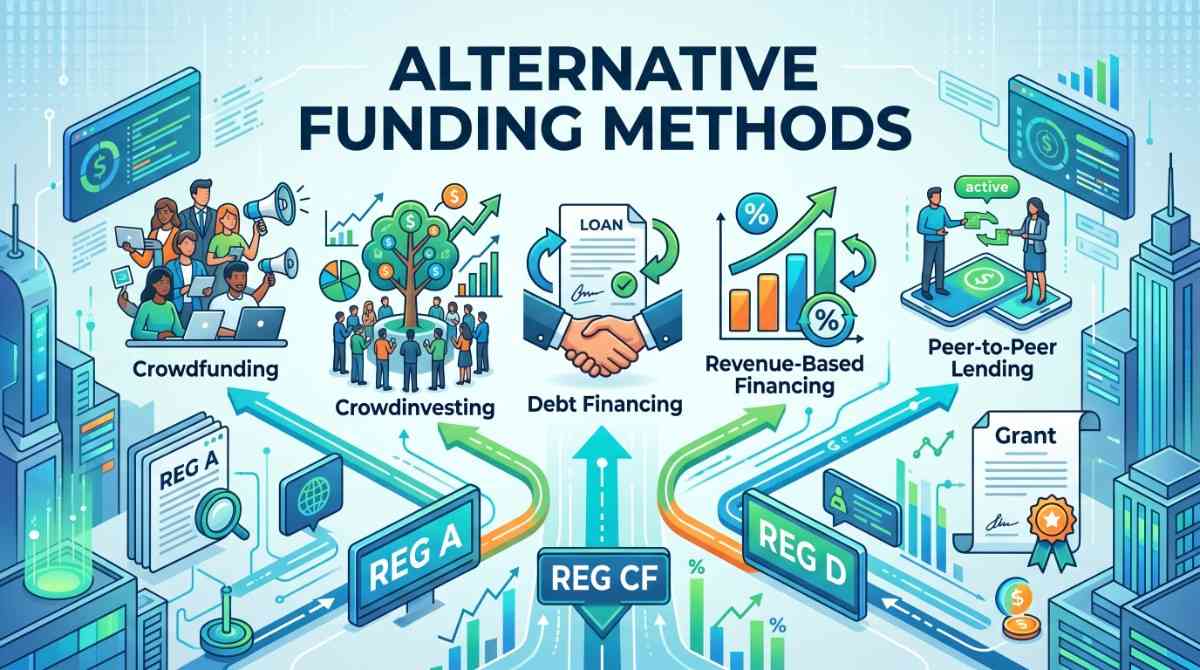 Crowdfunding
Raising money from a large number of people, typically through online platforms. Models include reward-based, donation-based, and equity crowdfunding.
Crowdinvesting
A form of equity crowdfunding where individuals invest in startups in exchange for an ownership stake.
Debt Financing
Borrowing money that must be paid back with interest. Unlike equity, the founder does not give up ownership, but there is an obligation to repay regardless of how the business performs.
Revenue-Based Financing
Investors provide capital and are repaid using a percentage of future revenue rather than a fixed schedule. Works well for businesses with consistent revenue.
Peer-to-Peer Lending
Platforms that connect startups or individuals directly with lenders, bypassing traditional banks entirely.
Grant
Non-repayable funding provided by governments, foundations, or institutions, usually for specific purposes like research, social impact, or innovation. No equity is given up.
REG A, REG CF, REG D
US regulatory frameworks that govern how startups can raise money from investors. REG D is used for private placements, REG CF for equity crowdfunding from the general public, and REG A for larger public offerings without a full IPO process.
Investor and Fund Terms
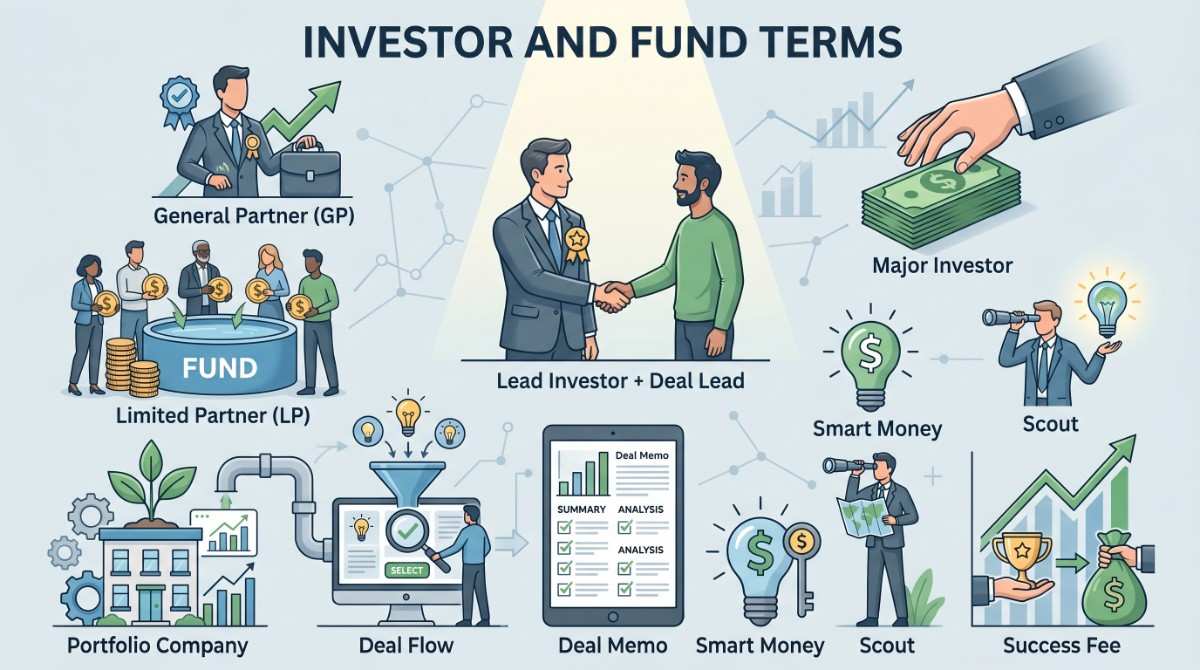 General Partner (GP)
The people who manage a venture capital fund, source deals, make investment decisions, and sit on boards.
Limited Partner (LP)
Institutions or wealthy individuals who provide capital to a VC fund but do not manage it. Pension funds, university endowments, and family offices are common LPs.
Lead Investor
The primary investor in a round who negotiates terms, leads due diligence, and typically puts in the largest cheque.
Deal Lead
Similar to a lead investor, the person or firm that drives the deal forward on the investor side.
Major Investor
An investor contributing a significant portion of a round, often receiving additional rights as a result.
Portfolio Company
Any startup a VC firm has invested in. Managing and supporting portfolio companies is a core part of what VC firms do after writing the cheque.
Deal Flow
The volume of investment opportunities a firm or investor sees. Strong deal flow usually comes from reputation, network, and being the kind of investor founders want to work with.
Deal Memo
An internal document summarizing an investment opportunity, covering the market, team, product, financials, risks, and reasons to invest or pass.
Smart Money
Investment from someone who brings more than cash, mentorship, connections, operational experience, or strategic guidance alongside their capital.
Scout
Someone who identifies startup investment opportunities on behalf of a VC firm, often in exchange for a small carry or finder's fee.
Success Fee
A fee paid to an advisor, broker, or intermediary when a deal closes successfully.
Exit and Late-Stage Terms
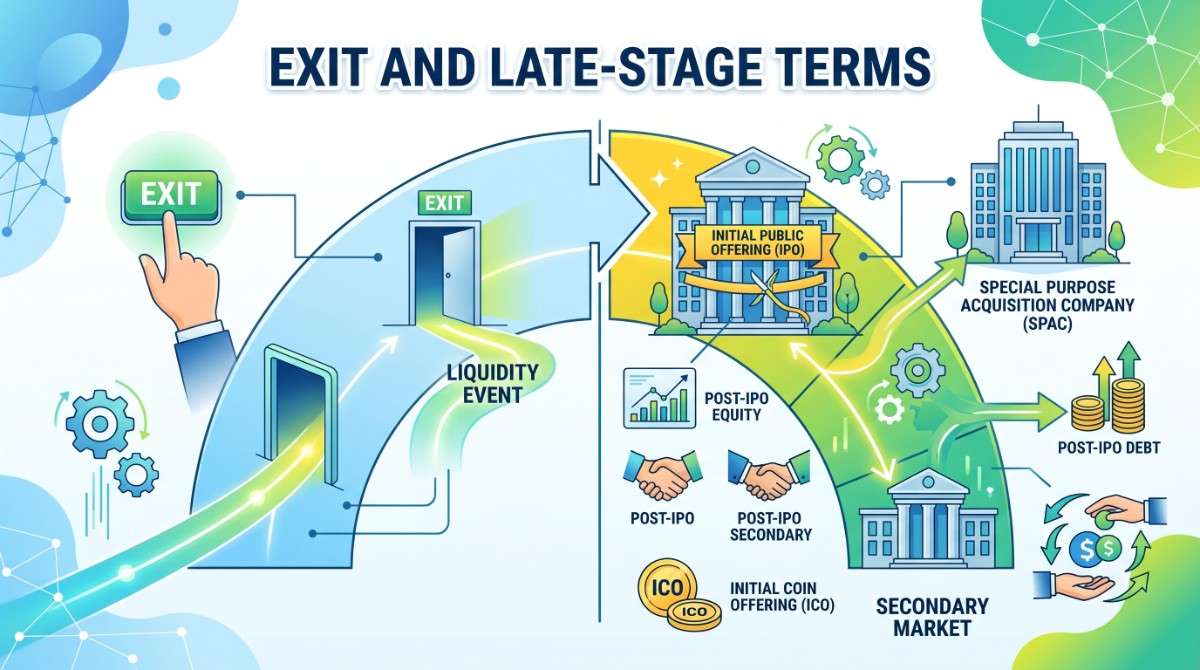 Exit
Exit
When investors and founders sell their ownership and receive returns. The most common exits are acquisition, IPO, merger, or secondary share sale.
Liquidity Event
Any event that allows shareholders to convert equity into cash. Acquisitions and IPOs are the primary liquidity events.
Initial Public Offering (IPO)
The moment a company's shares are listed on a stock exchange and available to the public. Typically the largest liquidity event.
Post-IPO Equity
Equity or stock issued after a company has gone public.
Post-IPO Debt
Debt financing raised after a company has already listed publicly.
Post-IPO Secondary
Secondary market transactions in a company's shares after the IPO, allowing early investors or employees to sell existing holdings.
Secondary Market
A market where investors buy and sell shares of private companies before any IPO happens. Allows early investors or employees to get some liquidity without waiting for a full exit.
Special Purpose Acquisition Company (SPAC)
A shell company that raises money through an IPO with the intention of merging with a private company to take it public, bypassing the traditional IPO process.
Initial Coin Offering (ICO)
A fundraising method used by blockchain and crypto startups where investors buy digital tokens in exchange for capital. Largely unregulated and high risk.
Fund Types
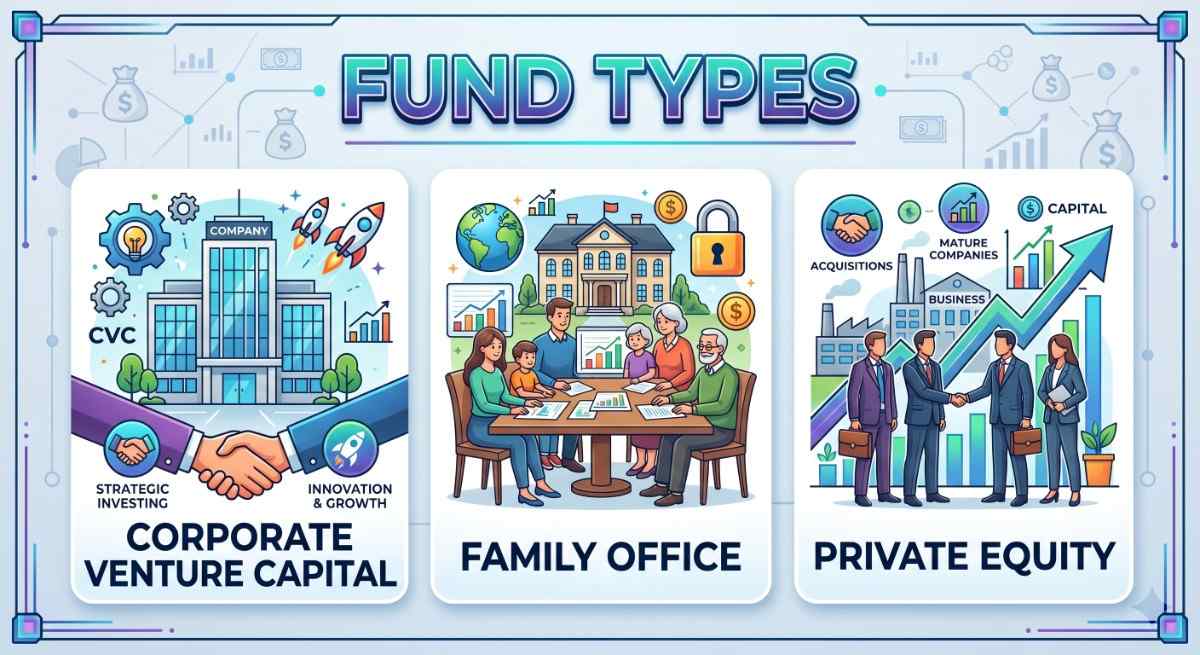 Corporate Venture Capital
Large corporations running their own investment arms. They invest in startups that align strategically with their business, offering both capital and potential partnership or acquisition down the line.
Family Office
A private organization managing investments and wealth for a high-net-worth family. Many family offices invest directly in startups or through VC funds.
Private Equity
Firms that typically invest in mature, established businesses rather than early-stage startups, focusing on profitability, restructuring, and large-scale acquisitions rather than growth-at-all-costs.
Startup Categories
 Unicorn
A private startup valued at over one billion dollars. The name was coined because such companies were once considered rare. They are far more common now but still represent a significant milestone.
Hectocorn
A private startup with a startup valuation of over one hundred billion dollars. Extremely rare.
Zebra
A startup that prioritizes sustainable, profitable growth over chasing hyper-growth at any cost. The term pushes back against the "growth at all costs" mentality that has burned many startups.
Zombie Unicorn
A startup with a high paper valuation but weak fundamentals, low revenue, and limited path to profitability. Keeps going on investor money without ever becoming truly viable.
Vulture Capitalist
An investor who swoops in on struggling or distressed startups and invests at extremely low valuations, often taking significant control in the process.
Series A Crunch
The gap many seed-funded startups fall into when trying to secure Series A investment. Not every seed-funded company makes it to Series A, and those that do not often struggle to survive the gap.
Conclusion
Startup funding is genuinely complicated, but understanding the language makes everything easier. Whether you are a founder preparing to raise your first round, an early employee trying to understand your equity, or someone looking to invest for the first time, knowing these terms means you can have real conversations, spot bad deals, and make smarter decisions. The ecosystem keeps evolving and new instruments appear regularly, but the core concepts around equity, valuation, dilution, and exit hold true across every stage and every market.
Frequently Asked Questions
Q: What is the difference between pre-seed and seed funding?
Pre-seed is the very earliest stage where a founder is usually just validating an idea. Seed funding comes slightly later when there is a product or clear direction and the startup needs capital to build properly.
Q: What is a SAFE note and why do startups use it?
A SAFE note is an agreement where an investor puts in money now and receives equity at a later round. Startups use it because it avoids the need to agree on a valuation early, making deals faster and simpler.
Q: What does dilution mean for founders?
Every time new shares are issued to investors, founders own a smaller percentage of the company. Dilution is normal and expected but needs to be managed carefully across multiple rounds.
Q: What is burn rate and why does it matter?
Burn rate is how much cash a startup spends each month. It tells you how long the company can operate before it runs out of money, which is one of the most critical numbers for any early-stage business.
Q: What is the difference between a unicorn and a zebra startup?
A unicorn chases billion-dollar valuation growth as fast as possible. A zebra focuses on building something profitable and sustainable without burning through investor capital in pursuit of hyper-growth.
Q: What is a cap table and why does it matter?
A cap table tracks who owns what in a company. It becomes especially important during fundraising because investors want to see the ownership structure clearly before committing capital.
Q: When should a startup consider debt financing over equity?
When the founders want to avoid giving up ownership and the business has reliable enough revenue to service debt repayments. Debt costs money in interest but preserves equity.
Q: What is a down round and why is it bad?
A down round is when a startup raises money at a lower valuation than its previous round. It dilutes existing shareholders more heavily and signals that the company has not grown as expected, which can hurt morale and reputation.