Equity vs Debt Funding: Which Is Right for Your Startup?
By Toishaa Soni · 5 November 2025
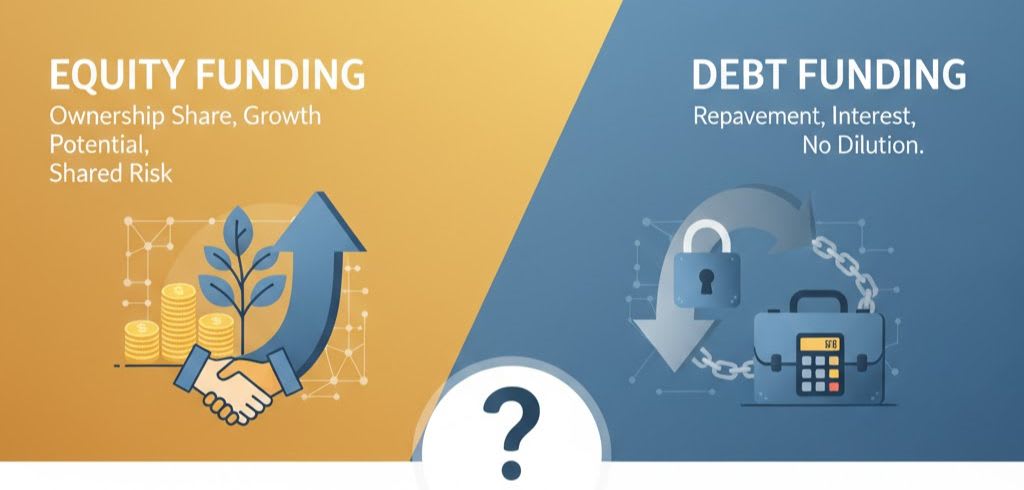
Know the real difference between equity and debt funding, understand their pros, and learn which financing option best suits your startup's growth goals.
In every startup journey, at some point, growth requires more than effort and ideas; it needs capital. Funding decisions can shape how fast and how far your business goes, be it building a product, hiring talent, or expanding into new markets for better startup growth and business scaling.
Deciding between equity and debt funding is one of the major questions for any startup. Each alternative has advantages, challenges, and positive or negative long-term effects. The choice really depends on where your startup currently stands, the stability of your finances, and what you try to achieve in your overall startup funding strategy.
Understanding Equity Funding
Equity funding means selling a part of your company for capital. The investors who buy the equity become partial owners; hence, they share in both the risks and rewards of the business. Common sources include angel investors, venture capitalists, or crowdfunding platforms.
Perhaps the major plus in equity funding is that you won't have to repay this money if your startup does not return a profit right away. The investors share that risk with you, in other words. Moreover, often equity investors bring valuable experience, mentorship, and connections that will help you grow faster and make wiser business decisions.
The trade-off, however, is ownership dilution. By giving away equity, one will have to give way to shared decision-making powers; investors might want a say in key strategic choices. That said, for startups with big ambitions and growth potential, the best route to securing money and guidance for long-term success often lies in equity funding.
Understanding Debt Funding
Debt funding is different. It involves borrowing money that you agree to repay over a period of time with interest. You may avail of debt funding through banks, NBFCs, venture debt firms, or even government schemes for startup loans.
This is a good option for those startups that are already at the point where they have a steady revenue stream or predictable cash flows. It helps in scaling up operations, buying equipment, or managing working capital-all without giving up ownership of your company.
The problem is with the repayments: monthly loan payments are a strain on your finances, especially if your income is irregular; missing such payments can be damaging to your credit score, therefore limiting further access to credit. Because of that, debt works best for those startups that are already stable and able to comfortably meet repayment obligations.
What is the difference between equity and debt funding?
Equity funding: You raise capital by giving investors a share in your company. There’s no repayment, but you share profits and ownership.
Debt funding: You borrow money and repay it with interest, while keeping full ownership of your business.
Returns: Equity investors earn when your company grows in value, while lenders earn through fixed interest payments.
Best suited for: Equity funding is ideal for startups focused on rapid growth and innovation, while debt funding suits stable businesses with steady cash flow.
Benefits of Equity and Debt Funding
Category | Equity Funding | Debt Funding |
Cash Flow Flexibility | No fixed repayments enable the business to reinvest any profits. | Predictable interest payments make it easier to plan finances. |
Risk Management | No debt burden during slow periods reduces financial pressure. | Founders can retain full ownership and decision-making power. |
Support & Expertise | Investors bring mentorship, networks, and valuable market experience. | No external interference in business strategy. |
Scalability | It is best for startups targeting rapid growth or major expansion. | It works for established startups with steady incomes. |
Financial Stability | Goodwill for potential investors and venture capitalists. | deductibility of interest payments, hence reducing costs. |
Long-term impact | Provides patient capital to your business. | Once the loan is repaid, there are no further obligations. |
Factors to Consider Before Choosing One
The decision between equity and debt is less about the money and more about alignment with your vision and the kind of business you want to build. A few key points to consider are as follows:
1. Stage of your startup
If the startup is at an early stage and not profitable, then equity might be a better choice since investors share this risk with you. Debt could be a good option later on when cash flow becomes stable in order to avoid giving away ownership.
2. Cash Flow and Revenue
A consistent revenue means you can handle debt repayments with confidence. In the case of unreliable income, equity frees up breathing space because there are no repayment obligations.
3. Risk Appetite
Debt increases financial stress since one has to repay it irrespective of performance. The equity reduces all the stress, but it requires giving away control and ownership in return.
4. Control and Decision-Making
If staying in full control of your company is the most important thing to you, debt is preferable. If you value strategic advice and mentorship, equity investors bring much more than funding.
5. Long-term goals
There is equity for quick growth and exit, or going public. For building a sustainable, founder-led business, debt allows the founders to keep full ownership of the company.
Which funding option is right for your startup?
Equity funding is best for early-stage startups building products or finding market fit, as it offers capital without repayment and access to investor mentorship.
Debt funding suits startups with stable revenue, helping them scale while retaining full ownership.
Balanced approach: Many startups raise equity early and use debt later for expansion.
The right choice depends on your growth stage, financial stability, and long-term goals.
Conclusion
Equity and debt funding serve different roles in your startup journey. Equity offers long-term capital, mentorship, and faster growth but requires giving up ownership. Debt preserves control and offers predictable costs but demands steady revenue and discipline.
The right choice depends on your goals and stage. For expert guidance and smart funding strategies, StartupCoaching.in can help you navigate your fundraising journey and achieve sustainable startup growth and success.
FAQs
Q- What is equity funding?
Equity funding means raising money by selling shares in your company to investors; hence, you give them partial ownership in return.
Q- What is debt funding?
Debt finance is where there is an agreement for returning the money along with interest and no compromise on ownership.
Q-Which of the funding options is better for an early-stage startup?
As a rule, equity financing is more suitable for early-stage startups because of the absence of any kind of repayment pressure and sometimes even additional support from investors.
Q- Can I use both equity and debt funding?
Yes, many companies do both: equity for early growth and debt later on to expand.
Q- How am I supposed to differentiate between the two?
It depends on your revenue consistency, growth goals, and risk appetite, along with what control you want to maintain.