Startup Grants vs Loans vs Equity: Which Is Best for Your Startup?
By Toishaa Soni · 24 February 2026
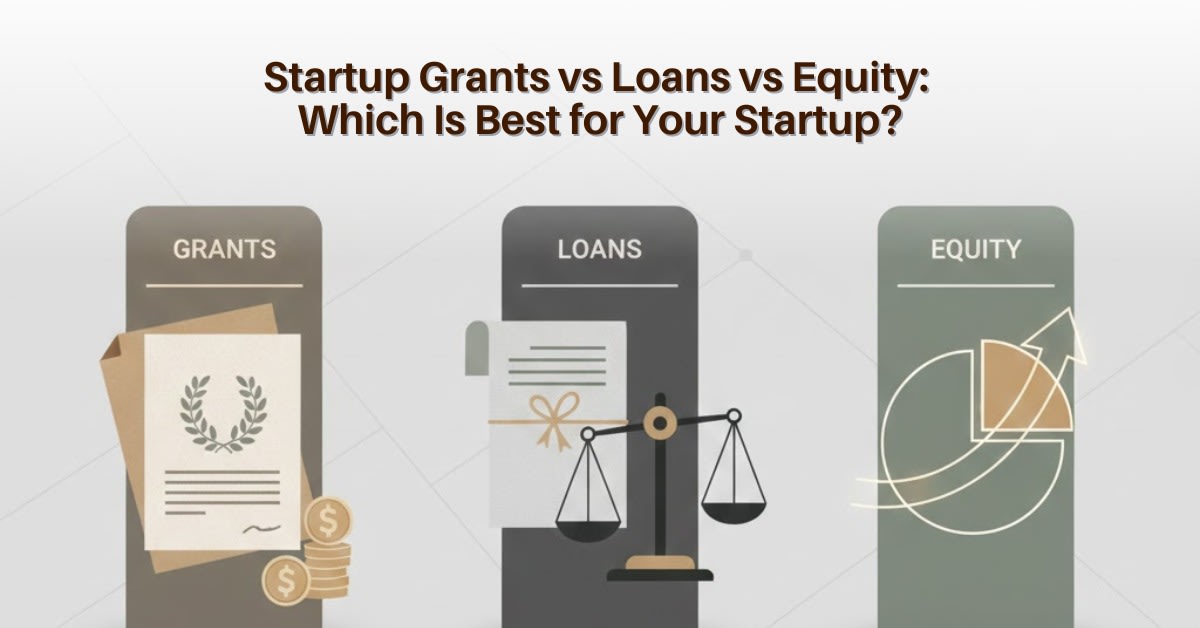
Grants, loans, or equity - understand the pros, risks, and best use cases to choose the right funding for your startup stage.
One of the most confusing decisions for founders is choosing the right type of funding. Should you apply for grants, take a business loan, or raise equity from investors?
Each option comes with different trade-offs around ownership, risk, speed, and control. There is no universally “best” funding type. The right choice depends on your startup’s stage, cash flow stability, and long-term growth ambition.
This guide breaks down grants, loans, and equity funding in a simple, founder-friendly way so you can choose what actually fits your business.
Startup Grants: Free Capital with Conditions
Startup grants are funds provided by governments, foundations, or institutions that do not need to be repaid and do not require giving up equity.
Grants are typically designed to support innovation, research, social impact, or early-stage validation. They are most useful when a startup is building prototypes, conducting R&D, or testing feasibility.
The biggest advantage of grants is that they are non-dilutive. Founders keep full ownership and face no repayment pressure. However, grants are highly competitive, time-consuming to secure, and often restricted to specific use cases. They are rarely flexible enough to fund sales, marketing, or aggressive scaling.
Grants work best for early-stage, pre-revenue startups, research-driven products, and impact-focused ventures.
Equity Funding: Capital for High-Growth Startups  Equity funding involves raising money from angel investors or venture capital firms in exchange for ownership in the company.
This type of funding is ideal for startups aiming for rapid growth, large markets, and category leadership. Beyond capital, equity investors often bring mentorship, industry access, and strategic guidance.
The trade-off is dilution and reduced control. Founders give up a share of ownership and face pressure to scale fast and deliver high returns. Equity funding is not suitable for businesses aiming for slow, steady, or lifestyle growth.
Equity works best for high-growth, high-risk startups, especially in tech, platforms, and innovation-led sectors.
Startup Loans and Debt: Growth Without Dilution
Loans and debt financing involve borrowing capital that must be repaid with interest. This includes bank loans, NBFC funding, and venture debt.
The key advantage of loans is that founders retain full ownership. Interest payments are also tax-deductible, which can help optimize finances. However, loans create fixed repayment obligations, regardless of business performance.
Debt is best suited for startups with predictable revenue, stable cash flows, and clear repayment capacity. For early-stage or pre-revenue startups, loans can be risky due to repayment pressure and collateral requirements.
Loans work well for established startups, SMEs, and businesses focused on profitability rather than aggressive scaling.
Grants vs Loans vs Equity: How They Compare
Grants offer free capital but come with restrictions and low certainty. Equity provides growth capital and expertise but requires dilution and aggressive execution. Loans preserve ownership but demand financial discipline and steady cash flow.
No option is inherently better. The mistake founders make is choosing funding based on availability rather than alignment.
Which Funding Option Is Best for Your Startup Stage
For pre-revenue or very early-stage startups, grants are useful for validation and R&D, while equity can support early scaling if the opportunity is large.
For high-growth, technology-driven startups, equity funding is often the most practical choice due to high capital requirements and risk.
For stable or lifestyle businesses with predictable income, loans are usually the most efficient option.
Many successful startups follow a hybrid approach, using grants for research or validation, equity for growth, and debt to optimize capital efficiency later.
Startup Coach Perspective
Funding should support your execution strategy, not define it. Each funding type solves a different problem at a different stage.
At Startup Coach, we advise founders to first understand why they need capital and what pressure they can handle. The smartest founders use the right mix of grants, equity, and debt at the right time, rather than chasing one option blindly.
Conclusion
Startup grants, loans, and equity are tools, not trophies. Grants protect ownership, equity fuels scale, and loans support disciplined growth.
The best funding choice is the one that aligns with your startup’s stage, risk appetite, and long-term vision. When funding is chosen strategically, it accelerates growth instead of creating future constraints.
FAQs
Q: Are startup grants really free money?
Yes, grants do not require repayment or equity dilution, but they are competitive and usually restricted to specific use cases like R&D or validation.
Q: Can early-stage startups take business loans?
Early-stage or pre-revenue startups usually struggle with loans due to repayment pressure and collateral requirements. Loans work better once revenues are stable.
Q: Is equity funding risky for founders?
Equity funding involves dilution and pressure to grow fast, but it also brings capital, expertise, and networks that can significantly accelerate growth.
Q: Which funding option gives founders the most control?
Bootstrapping and loans offer the most control, as founders retain ownership. Grants also preserve ownership but come with usage conditions.
Q: Can startups use a mix of grants, loans, and equity?
Yes, many successful startups use grants for research, equity for scaling, and loans for cash flow or efficiency at later stages.