SAFE Notes vs. Convertible Notes: Which Should Indian Startups Use?
By Rohini Rajpoot · 13 July 2026
Compare SAFE Notes vs Convertible Notes for Indian startups. Learn key differences, legal status, pros, cons, and which fundraising instrument suits your startup.
India's startup scene has grown fast enough that fundraising conversations now happen at every stage, from a founder raising a small pre-seed round from friends and family to a startup closing a proper VC round. Somewhere in that process, most founders run into the same question. Should the money coming in be structured as a SAFE note or a convertible note?
Both exist for the same basic reason. Early on, it's genuinely hard to agree on a startup's valuation, and forcing that conversation too soon can slow down a round or scare off investors who'd rather wait for a priced round to set the number. SAFE Notes and Convertible Notes both let founders raise money now and figure out the actual share price later. But they work quite differently, and in India specifically, only one of them has real legal footing. This guide breaks down what each instrument actually is, how Indian law treats them, and which one tends to make sense depending on your stage.
What are SAFE notes?
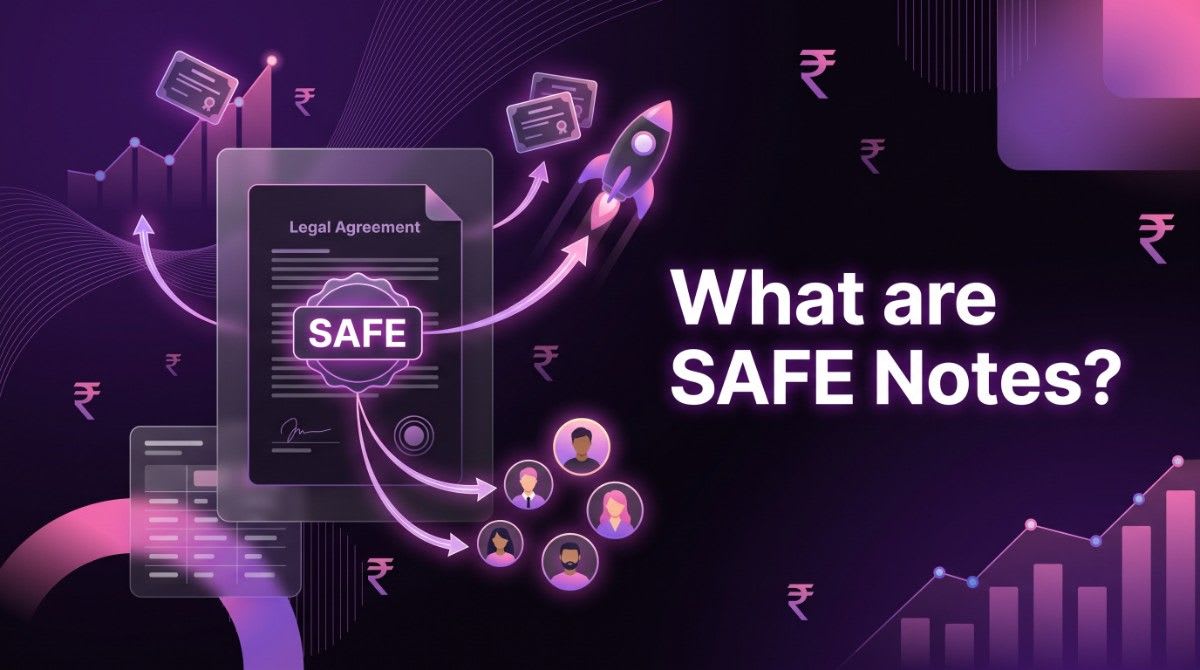 A SAFE, short for Simple Agreement for Future Equity, was created by Y Combinator in the US as a simpler alternative to convertible debt. It's not a loan. There's no interest attached and no date by which anything needs to be repaid. Instead, the money an investor puts in converts into equity later, usually when the startup closes its next priced funding round.
The appeal is obvious once you look at what it removes. No maturity date means no ticking clock forcing a conversion or repayment. No interest means the amount owed doesn't grow while everyone waits for the next round. And because it converts automatically at a future round rather than getting negotiated upfront, it tends to close faster than a traditional equity deal.
In the US, SAFEs are especially common at the pre-seed stage, when a founder just needs enough capital to get to a real product and a real valuation without spending weeks negotiating terms for a small check.
What are convertible notes?
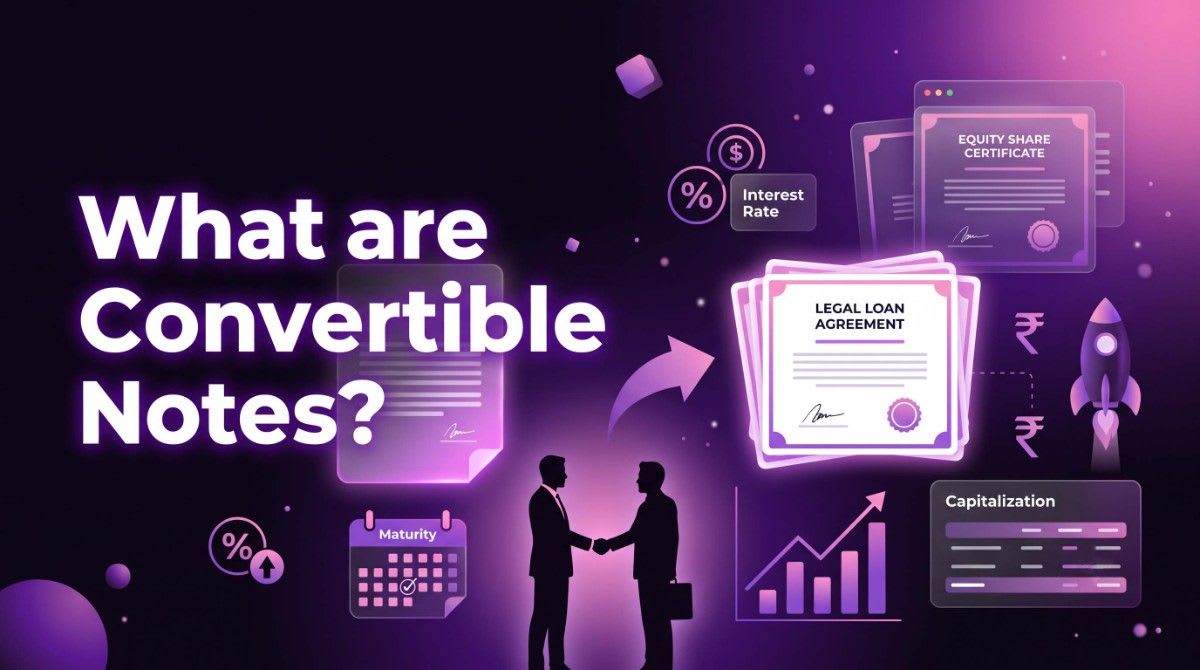 A convertible note starts life as debt. An investor lends the startup money, that loan usually carries an interest rate, and it comes with a maturity date, a point by which the note has to either convert into equity or get repaid.
Unlike a SAFE, a convertible note is legally a loan until it converts. If a qualifying round happens before the note matures, it converts into equity, often at a discount to the new round's price or against a valuation cap. If no round happens in time, the terms of the note usually determine what happens next, sometimes an extension and sometimes repayment.
This structure gives investors more protection than a SAFE does, since there's an actual debt obligation sitting behind the investment rather than just a promise of future shares.
SAFE Notes vs Convertible Notes: key differences
Legal structure A SAFE is structured as an agreement for future equity. A Convertible Note is a debt instrument, plain and simple, at least until it converts.
Interest rate SAFEs don't carry interest at all. Convertible Notes do, and that interest keeps accruing until the note either converts or gets repaid.
Maturity date SAFEs have none. Convertible Notes come with a fixed maturity period, after which something has to happen, conversion or repayment.
Repayment obligation A SAFE never requires repayment, since it isn't debt. A Convertible Note can require repayment if a qualifying conversion event doesn't happen before maturity.
Complexity SAFEs are built to be short and simple, sometimes just a few pages. Convertible Notes need more legal documentation, since debt terms, interest, and maturity conditions all need to be spelled out properly.
Investor protection Convertible Notes give investors a stronger legal position, since there's an actual debt claim behind the money. SAFEs trade that protection for flexibility, which tends to favor founders more than investors.
Are SAFE Notes legal in India?
This is where things get genuinely important for Indian founders, and where a lot of confusion tends to creep in. A pure, US-style SAFE is not a legally recognised instrument under Indian law. It doesn't appear anywhere in the Companies Act, 2013, or under FEMA, the Foreign Exchange Management Act that governs how foreign money can come into an Indian company.
Convertible Notes, on the other hand, are formally recognised, but only under specific conditions. A startup needs to be DPIIT-recognised to issue one. Each investor needs to put in a minimum of ₹25 lakh in a single tranche. And the note has to convert into equity or get repaid within a defined window, generally up to ten years from issuance.
A US-style SAFE simply isn't formally recognized under Indian law, not under the Companies Act, and not under FEMA either. Neither statute lists it as a permitted capital instrument, which means a founder who issues a plain SAFE to an investor is operating outside any framework Indian regulators actually acknowledge. For a purely domestic round between two Indian residents, a SAFE might still hold up as an enforceable contract. But the moment a non-resident investor is involved, that inflow has no recognised category to sit in, and an authorised dealer bank simply won't process it as reportable foreign investment.
Because a plain SAFE doesn't fit anywhere in this framework, most Indian startups end up using an adapted version instead. This is commonly called an iSAFE, short for India Simple Agreement for Future Equity, and rather than being a true SAFE, it's legally built as Compulsorily Convertible Preference Shares, or CCPS, under the Companies Act. On paper and in spirit, it's designed to feel like a SAFE, quick to sign, founder-friendly, deferred valuation, no upfront pricing debate. But underneath, it's actually a different instrument entirely, structured specifically so it complies with Indian company law and FEMA's foreign exchange rules. The economics can look nearly identical to a US SAFE. The legal skeleton holding it up is not the same thing at all.
This is exactly why many Indian founders say they used a SAFE when what actually got issued, on paper, was a Convertible Note or a CCPS structure. The economics can look similar. The legal paperwork underneath needs to match Indian regulation regardless of what the agreement is called.
Given all this, getting a lawyer involved before choosing between these instruments isn't optional. The gap between what looks simple on a template and what's actually enforceable in India is wide enough that a founder can end up with real compliance problems by the time a later round or an acquisition rolls around.
Advantages of SAFE Notes (and SAFE-like structures)
Faster fundraising is the biggest draw, since there's no need to negotiate a valuation or hammer out debt terms before money moves. They tend to be founder-friendly too, keeping control and equity dilution decisions deferred to a later, better-informed round. Legal costs are generally lower given the shorter documentation, and there's no debt sitting on the books creating repayment pressure. This tends to make them, or their Indian-compliant equivalents, a good fit for pre-seed startups that need quick capital without a lot of back and forth.
Advantages of Convertible Notes
Convertible Notes are familiar territory for a lot of Indian investors, since they're the instrument actually built into Indian law for this purpose. They give investors better security, since there's a real debt claim if things don't work out the way anyone hoped. They tend to suit startups with more developed financial planning, since interest and maturity terms need to be tracked properly. And because the legal framework is clearer, there's less ambiguity about enforceability compared to a SAFE-style agreement.
SAFE Notes vs Convertible Notes: which is better for Indian startups?
 Pre-seed startups SAFE-style structures, adapted to Indian compliance, tend to work well here, since the priority is usually speed and simplicity over investor protection.
Seed-stage startups This tends to come down to what the specific investor prefers. Some are comfortable with SAFE-like terms, others will only invest through a Convertible Note.
Angel-funded startups Convertible Notes are often preferred here, partly because many angel investors are more familiar with debt-style instruments and want the added protection.
VC-backed startups This usually needs a proper look at the overall fundraising strategy and regulatory requirements, since VC rounds often involve larger sums, foreign investors, and more scrutiny on compliance.
Factors to consider before choosing
A few things are worth thinking through before picking one over the other. What stage the fundraise is at matters a lot, since early rounds tolerate more flexibility than later ones. What investors actually expect matters too, since pushing an unfamiliar structure on someone who wants a Convertible Note can slow a round down rather than speed it up.
Future valuation and how much dilution the founders are comfortable with should factor in as well, since these instruments handle conversion mechanics differently depending on caps and discounts. Legal compliance needs real attention given everything covered above, and the cost of documentation is worth weighing against how much capital is actually being raised. Speed matters too, obviously, but it shouldn't be the only factor driving the decision.
Common mistakes founders should avoid
Picking the wrong instrument for the stage a startup is at tends to create problems down the line, either scaring off investors or creating unnecessary debt pressure too early. Ignoring valuation caps is another common one, since a cap that's set too low can end up diluting founders far more than expected once the note converts.
Not understanding discount rates is a related mistake, since that discount directly affects how much equity investors end up with relative to the next round's price. Skipping legal advice is probably the most common and most costly mistake of all, especially given how much Indian regulation shapes what these instruments can actually look like on paper. And accepting unfavorable terms just to close a round quickly tends to cause more damage at the next fundraise than it saves in the current one.
Conclusion
There's no single right answer between SAFE Notes and Convertible Notes for Indian startups. SAFEs, or their India-compliant iSAFE equivalents, tend to favor speed and founder flexibility, while Convertible Notes offer a clearer legal framework and stronger investor protection, at the cost of more documentation and an actual debt obligation. Which one makes sense really depends on your stage, what your investors expect, and how much regulatory complexity you're prepared to manage.
Given how much Indian law shapes what these instruments can actually look like once the paperwork is signed, this isn't a decision worth making off a template alone. If you're weighing SAFE Notes against Convertible Notes for an upcoming round, talk to a startup lawyer or a fundraising advisor before finalising your term sheet. Getting the structure right early saves a lot of cleanup later, especially once a larger round or an acquisition is on the table.
This article is for general informational purposes and does not constitute legal or financial advice. Founders should consult a qualified lawyer or financial advisor before choosing a fundraising instrument for their startup.
FAQs
1. What is the difference between SAFE Notes and Convertible Notes?
A SAFE is an agreement for future equity with no interest and no maturity date. A Convertible Note is a debt instrument that carries interest and a fixed maturity, converting into equity under specific conditions or requiring repayment if those conditions aren't met.
2. Are SAFE Notes legal in India?
A pure, US-style SAFE isn't formally recognised under the Companies Act or FEMA. Indian startups typically use an adapted structure, often called an iSAFE, which is built as Compulsorily Convertible Preference Shares to stay compliant while keeping the same basic economics.
3. Do convertible notes have interest rates?
Yes. Convertible Notes carry an interest rate that accrues until the note either converts into equity or gets repaid at maturity.
4. Which is better for seed-stage startups?
It depends mostly on what the investor is comfortable with. Some seed investors are fine with SAFE-style terms, while others prefer the added protection of a Convertible Note.
5. Can SAFE Notes convert into equity?
Yes, that's the entire point of the instrument. A SAFE converts into equity when a triggering event happens, usually the startup's next priced funding round.
6. Are investors in India comfortable with SAFE Notes?
Many Indian investors are more familiar with Convertible Notes, since that's the instrument actually built into Indian regulation. SAFE-style agreements are gaining traction, particularly through iSAFE structures, but comfort still varies quite a bit from one investor to another.