Working Capital Management for Startups: Why Running Out of It Can Stop Your Business Overnight
By Rohini Rajpoot · 7 August 2026

Discover the importance of working capital for startups, how to manage it effectively, and strategies to ensure financial stability and growth.
A startup can be profitable on paper and still run out of money. That sounds contradictory, but it happens all the time, and it's almost always a working capital problem. Sales are up, the P&L looks fine, and then payroll is due before customer payments come in. Working capital is the number that tells you whether your business can actually survive its own growth.
What Is Working Capital?
Working capital is the cash and short-term resources a business has available to cover its day-to-day obligations. It's the difference between what a company owns that can be turned into cash relatively quickly and what it owes that's coming due soon.
This is different from profit. A startup can show a healthy profit margin on its income statement while still being unable to pay its bills, if too much of that "profit" is tied up in unpaid invoices or unsold inventory rather than sitting in a bank account. Profit is an accounting concept. Working capital is closer to a survival concept.
Liquidity, meaning how easily a business can access cash when it needs it, matters more for startups than almost any other type of company. Startups tend to have thinner cash reserves, less access to emergency credit, and less room for error than established businesses. Running out of working capital, even temporarily, can force a founder into decisions no one wants to make: delaying payroll, missing a supplier payment, or taking on expensive short-term debt just to stay open.
Why Working Capital Is Critical for Startups
Every routine business activity depends on having enough working capital to cover it.
Salaries need to go out on schedule regardless of when customers pay their invoices. Rent and utilities don't wait for a big contract to close. Inventory has to be purchased before it can be sold, which means cash goes out the door well before it comes back in. Suppliers expect payment on agreed terms, and missing those terms can damage relationships that a young company depends on.
Day-to-day operations, the unglamorous stuff like software subscriptions, insurance, and office supplies, all draw from the same working capital pool. And when a growth opportunity shows up, whether that's a chance to take on a bigger client or expand into a new market, having working capital in reserve is often what determines whether a startup can actually seize it or has to watch it pass by.
Working Capital Formula
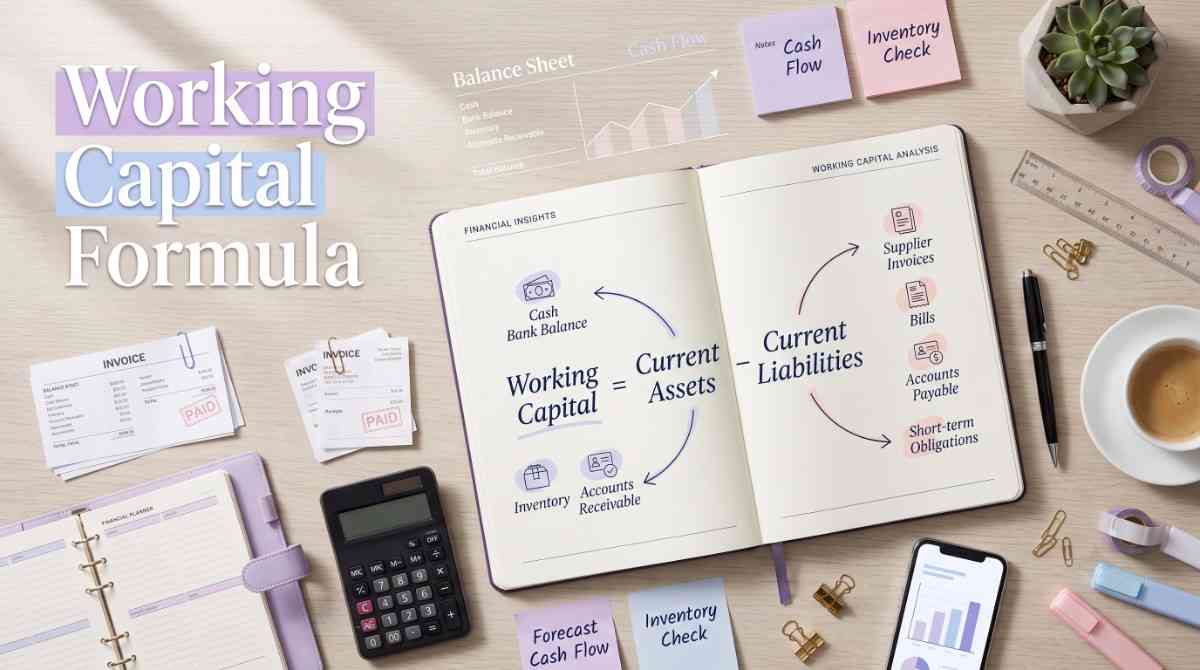
The basic formula is straightforward:
Working Capital = Current Assets − Current Liabilities
Current Assets include:
Cash
Inventory
Accounts Receivable
Short-term Investments
Current Liabilities include:
Accounts Payable
Short-term Loans
Taxes Payable
Outstanding Expenses
Current assets are resources a company expects to convert into cash within a year. Current liabilities are obligations a company expects to pay within that same window. The gap between the two tells you whether a business has enough short-term resources to cover its short-term obligations, with some cushion left over.
Components of Working Capital
Current Assets
Cash is the most liquid asset a business has and the first line of defense against short-term obligations. Bank balances function the same way, and for most startups this is the primary buffer against unexpected expenses.
Inventory represents money already spent that hasn't converted back into cash yet. It's an asset on paper, but it's also a risk, since unsold inventory ties up cash that could be used elsewhere.
Accounts receivable is money customers owe but haven't paid yet. It counts as an asset, but only in the sense that it will eventually become cash. Until it's collected, it does nothing to help pay this month's bills.
Current Liabilities
Supplier payments, often tracked as accounts payable, represent money a company owes for goods or services already received. Operating expenses due in the near term, along with any short-term debt and taxes owed, round out the liability side.
Each of these components affects liquidity differently. A pile of unpaid invoices from customers looks good on a balance sheet but does nothing for a founder trying to make payroll next week. That gap between "asset on paper" and "cash in hand" is exactly what trips up a lot of first-time founders.
Understanding the Working Capital Cycle
The working capital cycle describes the journey cash takes as it moves through a business: purchasing inventory, selling products or services, collecting payment from customers, and reinvesting that cash back into the business to start the cycle again.
A company buys raw materials or inventory using cash. It converts that inventory into a finished product or service and sells it, often on credit terms rather than for immediate payment. Eventually the customer pays, and the company gets its cash back, hopefully with a profit attached, which it can then reinvest into more inventory, payroll, or growth.
The Cash Conversion Cycle (CCC) measures how long this entire process takes, from the moment cash goes out to purchase inventory to the moment cash comes back in from a customer. A shorter CCC means cash comes back faster, which reduces how much working capital a business needs to keep on hand at any given time. A longer CCC means more cash gets tied up in the gap between spending and collecting, which is exactly the kind of squeeze that catches fast-growing startups off guard.
How to Calculate Working Capital (Example)
Here's a simple example for a fictional startup.
Current Assets: ₹18,00,000 Current Liabilities: ₹12,00,000
Working Capital = ₹18,00,000 − ₹12,00,000 = ₹6,00,000
This startup has ₹6,00,000 more in short-term assets than it owes in short-term liabilities, which generally indicates healthy liquidity. It suggests the business can cover its near-term obligations with room to spare, assuming those current assets are reasonably liquid and not tied up in slow-moving inventory or receivables that are unlikely to be collected soon.
A positive number on its own isn't a complete picture, though. If most of that ₹18,00,000 sits in aging receivables that customers are slow to pay, the actual cash available day to day could be much tighter than the raw number suggests.
Positive vs Negative Working Capital
Positive Working Capital | Negative Working Capital |
Healthy liquidity | Cash shortages |
Easier daily operations | Difficulty paying bills |
Better growth opportunities | Higher financial stress |
Stronger financial stability | Increased business risk |
Positive working capital means a company has more short-term assets than short-term liabilities, giving it breathing room to handle unexpected costs or slow periods without panic. Negative working capital means liabilities exceed assets, which can force a business into reactive decisions, like delaying supplier payments or scrambling for short-term financing just to stay current on its obligations.
It's worth noting that negative working capital isn't automatically a red flag for every business model. Some companies, particularly those that collect payment from customers before paying their own suppliers, can operate with negative working capital by design. For most early-stage startups, though, negative working capital is a warning sign worth investigating rather than ignoring.
Common Causes of Working Capital Shortages
A few patterns show up again and again in startups that run into working capital trouble.
Slow customer payments are one of the most common culprits. If customers routinely pay 60 or 90 days after invoicing, a startup can be sitting on strong sales numbers while genuinely struggling to cover this month's expenses.
Excess inventory ties up cash in goods that haven't sold yet, which is especially painful for startups with limited cash reserves to begin with. Poor cash flow planning, meaning a lack of forward-looking forecasting, means founders often discover a shortfall only after it's already a problem rather than seeing it coming weeks in advance.
Rapid expansion, ironically, is a frequent cause of working capital shortages. Growing fast usually means hiring ahead of revenue, buying more inventory, and taking on new fixed costs, all of which draw down cash reserves faster than incoming revenue can replace them.
High operating expenses relative to revenue put steady pressure on working capital, and seasonal fluctuations can create cash crunches during slow periods even when the annual numbers look fine. Inefficient receivables management, like not following up on overdue invoices, compounds all of the above by letting cash sit uncollected longer than it needs to.
How to Manage Working Capital in a Startup
Improve cash flow forecasting: Build a rolling weekly or monthly forecast so you can see a shortfall coming weeks in advance instead of discovering it the day payroll is due.
Speed up customer collections: Shorter payment terms, upfront deposits, or early payment discounts can meaningfully reduce how long cash stays tied up in receivables.
Negotiate better supplier payment terms: Extending payment terms with suppliers, where relationships allow it, frees up cash without requiring any change to sales or collections.
Reduce unnecessary inventory: Carrying only what you need, based on realistic demand forecasts, keeps cash from sitting idle in unsold stock.
Monitor expenses regularly: Recurring costs have a way of creeping up unnoticed. A regular review catches subscriptions or overhead that no longer earn their keep.
Maintain an emergency cash reserve: Even a modest buffer can be the difference between weathering a slow month and scrambling for last-minute financing.
Automate invoicing and payment reminders: Reducing the manual effort and delay in sending invoices and following up on late payments tends to shorten collection times noticeably.
Working Capital vs Cash Flow
Working Capital | Cash Flow |
Measures short-term financial health | Measures movement of cash |
Balance sheet metric | Cash flow statement metric |
Snapshot at a point in time | Continuous business activity |
Focuses on liquidity | Focuses on cash generation |
Working capital is a snapshot, a single point-in-time measure of current assets against current liabilities. Cash flow is more like a video, tracking how cash actually moves in and out of the business over a period.
A company can have positive working capital on its balance sheet today and still experience negative cash flow this month if, for example, a large receivable hasn't been collected yet. The two metrics work together to give a fuller picture: working capital shows the cushion available, and cash flow shows whether that cushion is growing or shrinking.
Key Metrics Every Startup Should Track

Working Capital Ratio (current assets divided by current liabilities) gives a quick read on liquidity. A ratio above 1 generally indicates the business can cover its short-term obligations.
Current Ratio is essentially the same calculation, often used interchangeably with working capital ratio, and gives a broad view of short-term solvency.
Quick Ratio is a stricter version that excludes inventory from current assets, since inventory can be slow or difficult to convert into cash quickly.
Cash Conversion Cycle shows how many days it takes to convert inventory and receivables into cash, net of how long the business takes to pay its own suppliers.
Inventory Turnover measures how many times inventory is sold and replaced over a period, with faster turnover generally meaning less cash tied up in unsold stock.
Accounts Receivable Days tracks the average time it takes to collect payment after a sale, a key driver of how much cash gets tied up in the sales cycle.
Accounts Payable Days tracks the average time a company takes to pay its own suppliers, which affects how much cash it holds onto before payments go out.
Best Practices to Improve Working Capital
Maintaining healthy liquidity starts with treating cash flow forecasting as a monthly habit rather than an occasional exercise done only when something feels off.
Optimizing inventory means ordering based on actual demand patterns rather than guesswork, and regularly clearing out slow-moving stock rather than letting it sit. Reducing unnecessary expenses, particularly recurring ones that have outlived their usefulness, frees up cash without touching revenue at all.
Improving collection efficiency, through clearer payment terms and consistent follow-up, shortens the gap between a sale and the cash actually landing in the bank. Tracking the key metrics above regularly, rather than only at quarter-end, gives founders an early warning system instead of a rearview mirror. Reviewing supplier contracts periodically can also surface opportunities to negotiate better terms as the relationship and order volume grow.
Common Mistakes Startups Make
Confusing profit with cash flow: A profitable startup can still run out of cash if too much revenue is tied up in receivables or inventory rather than sitting in the bank.
Overinvesting in inventory: Buying more stock than current demand justifies locks up cash that could be used elsewhere in the business.
Ignoring receivables: Letting overdue invoices sit without follow-up quietly drains working capital over time, often without founders noticing until it becomes a real problem.
Taking on excessive short-term debt: Leaning too heavily on short-term financing to plug cash gaps can spiral into a cycle where more and more revenue goes toward servicing debt rather than growing the business.
Poor budgeting: Without a clear budget, it's difficult to know in advance where cash pressure is likely to build up.
Lack of financial forecasting: Many working capital crises are avoidable with a few weeks of advance warning, which forecasting is specifically designed to provide.
Conclusion
Working capital is the lifeline of every startup, quietly determining whether a business can meet its obligations even when its long-term prospects look strong on paper. Healthy working capital keeps operations running smoothly, reduces financial stress, and gives founders the flexibility to act on growth opportunities instead of just reacting to cash crunches.
Managing cash flow, inventory, receivables, and payables with real discipline is what separates startups that survive their growth phase from those that get blindsided by it. None of it requires complicated financial engineering, mostly just consistent forecasting, clear metrics, and the willingness to address a cash gap before it becomes a crisis.
Want to build a financially stronger startup? Startup Coach helps founders improve cash flow, optimize working capital, raise funding, and build scalable financial systems. Explore our services or contact our experts to discuss how we can help your startup grow with confidence.
Frequently Asked Questions
1. What is working capital?
Working capital is the difference between a company's current assets and current liabilities, representing the short-term resources available to fund day-to-day operations.
2. How do you calculate working capital?
Subtract current liabilities from current assets: Working Capital = Current Assets − Current Liabilities.
3. Why is working capital important for startups?
Startups typically have thin cash reserves and limited access to emergency financing, which makes maintaining enough working capital essential for covering payroll, rent, inventory, and other operating costs without disruption.
4. What causes a working capital shortage?
Common causes include slow customer payments, excess inventory, poor cash flow forecasting, rapid expansion without matching cash reserves, and inefficient collection of receivables.
5. What is the ideal working capital ratio?
A ratio between 1.5 and 2 is often considered healthy, though the right number varies by industry and business model. A ratio below 1 typically signals a liquidity problem.
6. What is the working capital cycle?
It's the time it takes for a business to convert cash spent on inventory and operations back into cash collected from customers, covering the full loop from purchase to sale to collection.
7. How can startups improve working capital?
Startups can improve working capital by forecasting cash flow regularly, speeding up customer collections, negotiating better supplier terms, reducing excess inventory, and maintaining a cash reserve for unexpected gaps.
8. What is the difference between working capital and cash flow?
Working capital is a snapshot of short-term financial health at a single point in time, while cash flow tracks the ongoing movement of cash into and out of the business over a period.