Founders' Agreement: Clauses That Prevent Co-Founder Disputes
By Rohini Rajpoot · 6 October 2026
Learn the key founders' agreement clauses in India, including equity, vesting, IP, exits and dispute resolution, and how they help prevent co-founder disputes.
Two college friends decide to build a food-delivery app. They split everything 50-50 over chai, with no paperwork, because why would you doubt a friend? A year in, one takes a job in Bengaluru and stops showing up. The other keeps coding every night. Then an investor shows interest, and suddenly everyone has an opinion about who deserves what.
This is one of the most common ways startups come apart, and it rarely starts with bad intentions. It starts with two people remembering a handshake differently.
A founders agreement in India is the fix. You write down what each person expects while you still like each other enough to be honest. This post covers what goes into it, whether you legally need one, the clauses that matter, and how it helps with co founder dispute prevention.
What Is a Founders' Agreement?
A founders' agreement is a contract between the people starting a company together. It records who owns how much, who does what, and what happens if someone leaves or things go sideways. Every co-founder signs it.
Sign it early, ideally before you incorporate, before the first investor call and before the first big customer. Most founders only raise it once there's tension, and by then even a simple chat feels like an accusation. A typical agreement covers equity, roles, decision-making, vesting, intellectual property, confidentiality, exits and dispute resolution. We'll go through each below.
The importance of a founders agreement is simple. You stop relying on what you think everyone meant and start pointing to what everyone actually agreed.
Is a Founders' Agreement Legally Required in India?
Generally, no. Indian law doesn't say every startup must have a separate founders' agreement. But that's the legal side. On the practical side, plenty of things aren't required and are still a bad idea to skip.
It also doesn't replace the documents your company must maintain, such as the incorporation papers and the articles of association. The founders' agreement sits beside those and covers the private arrangement between the people running the company. A private limited company, an LLP and a partnership all work differently, so have a lawyer check the agreement against your actual structure. Stamp duty rules also vary by state, so ask about that too.
Key Founders' Agreement Clauses Every Startup Should Consider
If you read only one section, make it this one. These are the founders agreement clauses people wish they'd written down.
Equity Split
Who owns what percentage, and how did you land on that number? What happens to your shares when new ones are issued to investors or early hires?
Equal splits feel fair and friendly, but they often hide the fact that one person is working full-time while the other still has a day job. Write down the split and the reasoning behind it. It's an awkward half hour now. Later, it's months of arguing.
Vesting Schedule
Vesting means you earn your shares over time instead of owning them all on day one. A common setup runs a few years, often with a cliff, which is a minimum period (say, one year) you must stay before any shares become yours.
Back to our two friends. If the one who left had full ownership after eight months, the founder still working would be running a company that's half owned by someone who's gone. A vesting schedule stops that, and it's fairer to whoever stays.
Roles and Responsibilities
Decide who owns product, finance, sales and operations. Then decide what happens when two people's work overlaps, because it will, usually within the first month. Clear roles mean fewer "I thought you were handling that" conversations.
Decision-Making and Founder Authority
Not every choice needs a vote. Day-to-day calls can sit with whoever owns that area. Bigger ones, like raising money, hiring a senior person or changing the business model, should need agreement from all founders or a defined majority.
Plan for a deadlock too. Two founders at 50% each who disagree will get nowhere. Pick a tiebreaker now, whether that's an advisor or a mediator, because you won't agree on one mid-argument.
IP Assignment Clause
Whoever writes the code, designs the logo or comes up with the brand name is creating something valuable. An IP assignment clause says that work belongs to the company, not to the person who happened to build it. Without it, a founder who leaves can argue the product is theirs, and that's very hard to unwind later.
Founder Exit Clause
People leave. Some resign, some get asked to go, some fall ill, and some just want to cash out. The exit clause says what happens to their shares in each case and how a stake can be sold or transferred. Settling this in advance takes a lot of heat out of a tense moment.
Confidentiality and Non-Solicitation
These protect business information, customer and vendor details, trade secrets and your team. Keep them reasonable. Whether a clause can be enforced depends on how it's worded and on the law, and Indian law is generally strict about restrictions on working after you leave. Section 27 of the Indian Contract Act is the usual starting point. A lawyer can tell you what will hold up.
Dispute Resolution
Agree on how you'll disagree before you do. Most agreements start with a direct conversation between founders, then mediation, then arbitration, and finally courts in a chosen city. With the steps written down, nobody has to invent a process while angry.
How a Founders' Agreement Prevents Co-Founder Disputes

An agreement won't stop founders from disagreeing. That's normal and often healthy. What it does is give you a fair way to settle the disagreement.
If one founder thinks they deserve more equity, the written split gives everyone something concrete to look at. If someone leaves after a few months, vesting terms decide what happens to the shares they hadn't earned. When two founders clash over a big decision, the deadlock rules give you a way forward. If a departing founder says the product is theirs, the IP clause answers it. And when someone wants out and nobody knows what's next, the exit provisions already lay out the steps.
Without anything in writing, each of these can turn into a dispute that drains time, money and friendships.
Founders' Agreement vs Shareholders' Agreement
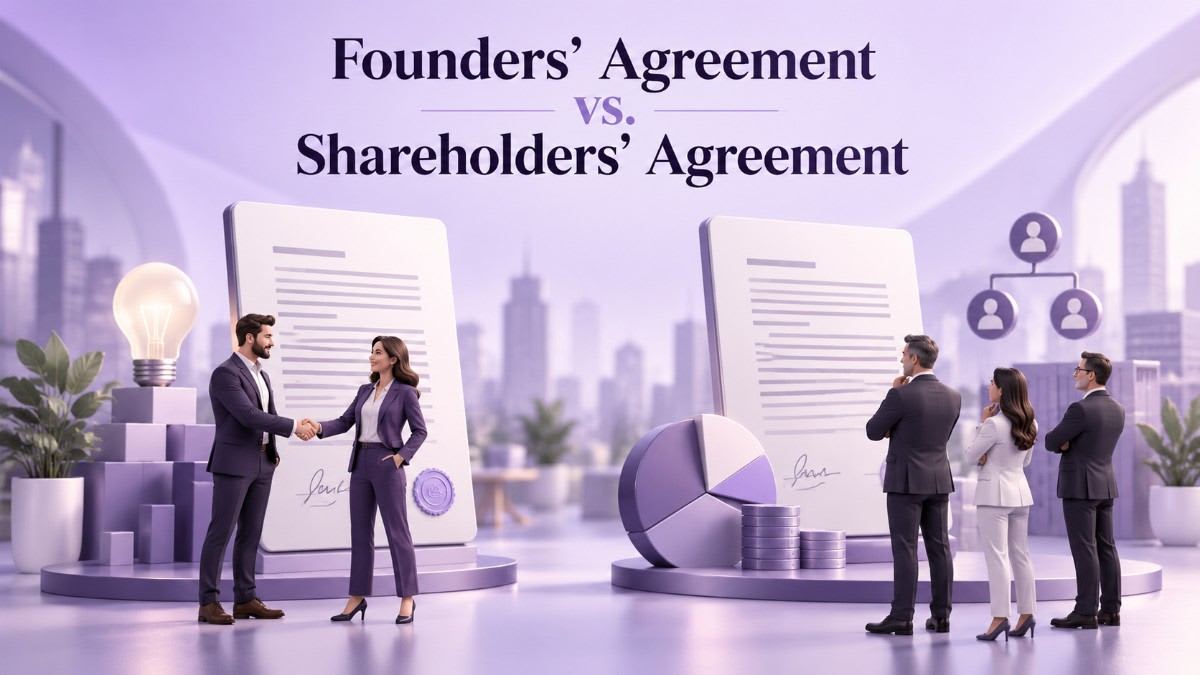
People mix these up constantly. They overlap, but they do different jobs.
Founders' Agreement | Shareholders' Agreement |
Focuses on founder arrangements | Focuses on shareholder rights and relationships |
Roles and responsibilities | Share transfer rights |
Founder equity arrangements | Shareholder voting and protection matters |
Vesting | Shareholder obligations |
Founder exits | Governance and shareholder matters |
Neither automatically replaces the other, and which ones you need depends on your structure and stage. Once investors come in, a shareholders' agreement usually enters the picture, and it has to match what the founders already agreed. If you're unsure where one ends and the other begins, founders agreement vs shareholders agreement is a good question to bring to your lawyer early.
Can a Founders' Agreement Be Changed Later?
Yes, and it probably will be. Startups change, and so do the people in them. You might revisit things after a funding round, when a new founder joins, when someone moves into a different role, or when ownership gets restructured.
How you change it matters more than the change itself. Put amendments in writing and get every relevant person to sign off. A WhatsApp message saying "ok, you take 5% more" is not a safe way to change equity. Casual understandings like that are exactly what people argue about two years later.
What Happens If There's No Founders' Agreement?
You may end up with different ideas about who owns how much, arguments over who was supposed to do what, a messy founder exit, no clear answer on who owns the IP, and no way to break a deadlock.
None of that is guaranteed. Plenty of founding teams get along for years without a document. But if a dispute does arrive, having nothing in writing makes it far harder to resolve.
How to Create a Founders' Agreement in India
It doesn't need to be a big production. Here's a sensible order.
Talk openly: Discuss equity, roles and where each of you sees the business in five years. Be honest about time and money too.
Find the risky areas: Think about exits, decisions, IP and fundraising.
Write it down: Turn what you agreed into a proper written document.
Check it against your other papers: It should fit with your company and shareholder documents.
Have a lawyer review it: A qualified lawyer should read it with your company's situation in mind.
If you're searching for a founders agreement template India founders can download, treat it as a rough starting point. A template doesn't know your business, so get it adapted and reviewed before anyone signs.
Startup Coach: Helping Founders Build on a Stronger Foundation
A good idea gets you started, but it won't carry a business by itself. At some point you need structure, and someone to ask when things get complicated. Startup Coach works with founders at different stages of building and scaling, across strategy, fundraising, finance, legal and compliance guidance, product and growth. If you're sorting out co-founder arrangements or other early decisions, the right guidance can help you build on firmer ground.
Conclusion
Signing a founders' agreement doesn't mean you expect the partnership to fail. It means you'd rather have the awkward conversation now, while you still get along. Equity, vesting, roles, IP, decisions and exits are all easier to talk through before anyone is upset.
A well-drafted agreement gives you something to fall back on when things get hard. Before you sign, ask a qualified legal professional to review it. The best time to agree on what happens when things go wrong is when everything is still going right.
FAQs
1. What should be included in a founders' agreement?
Equity, vesting, roles, decision-making, IP, exits, confidentiality and dispute resolution.
2. Is a founders' agreement legally required in India?
Generally, no separate founders' agreement is required for every startup. It's still strongly advisable, and it doesn't replace the corporate documents your company must maintain. Have a lawyer review it.
3. How does a founders' agreement prevent disputes?
It puts expectations in writing, so confusion about ownership, responsibilities and exits gets cleared up before it becomes an argument.
4. Can a founders' agreement be changed later?
Yes. Put the changes in writing and make sure the relevant parties agree.
5. What happens if there's no founders' agreement?
You're relying on informal understandings, so disagreements over equity, roles, IP and exits get harder to settle.